dailynewsnblog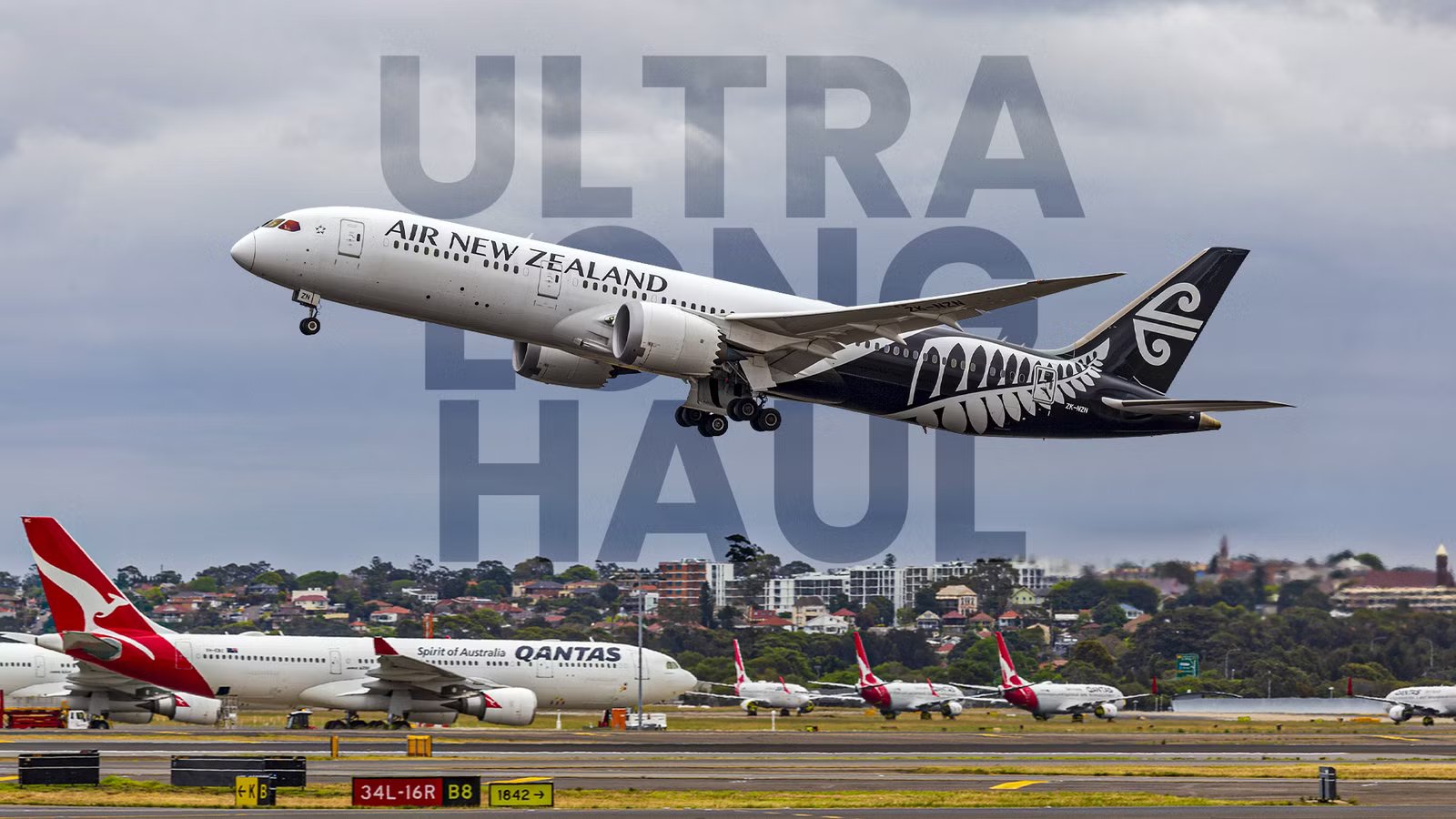
Ultra-long-haul routes are some of the most exciting announcements that an airline can make, since they connect far-flung cities that have never seen nonstop service before and push the boundaries of aircraft capabilities. In recent years, there’s been a notable explosion in the number of new ultra-long-haul routes, which has coincided with deliveries of the Airbus A350 and Boeing 787. These planes aren’t necessarily more capable than older aircraft (aircraft range earlier peaked with the Airbus A340-500 and Boeing 777-200LR), but they are far more economical than anything before them.
With their modest size and correspondingly low fuel burn, these planes have enabled airlines to operate routes connecting hubs to smaller cities and to operate more ultra-long-haul flights, since operating costs are now so much lower than even a Boeing 777, let alone a Boeing 747. But just because these planes make ultra-long-haul routes easier to operate doesn’t mean that they’re a straight ticket to profitability, as Air New Zealand is finding out with its nearly 18-hour flagship route between Auckland and New York.
The Latest News Coming Out Of New Zealand

Air New Zealand has operated its flagship nonstop route between Auckland Airport (AKL) and John F. Kennedy International Airport (JFK) since 2022. At 7,671 NM (14,207 km), it’s Air New Zealand’s longest route ever, and one of the longest routes in the world. The flight to JFK is assigned flight number NZ 2, while the return carries the prestigious NZ 1 flight number. This route was initially successful, but today it’s no longer profitable for Air New Zealand.
Reporting from BusinessDesk suggests that Air New Zealand is strongly considering axing its flagship route to JFK. This comes as the airline is facing financial challenges, while the airline industry is also grappling with rapid rises in oil prices as a result of the war in Iran. The carrier is performing a thorough review of its network, especially of its long and high-cost services, and looking to cut unprofitable routes, with the flagship JFK service being top of the list.
What’s clear is that the route from AKL to JFK is unprofitable for Air New Zealand, and it’s also a major strain on the profitability of its network. This route is extremely costly to operate, and uses a Boeing 787-9 that could otherwise be used for more profitable services. This is especially problematic as Air New Zealand’s widebody fleet is generally small and constrained, meaning that there’s a significant opportunity cost associated with this route. Unless Air New Zealand can turn around the finances of this route, it would only be sticking around for prestige.
The Elephant Across The Tasman

In 2023, Qantas restarted services from Sydney Kingsford Smith Airport (SYD) to JFK, which were cut during the COVID-19 pandemic. Before, these flights operated with the Boeing 747-400 and stopped in Los Angeles, but with the 2023 relaunch, Qantas switched to the 787-9 and moved the stopover point to AKL. Competing against Qantas, Air New Zealand has been failing, despite both airlines using the 787 and Air New Zealand being based in New Zealand, as opposed to Qantas being based in Australia.
From the start, Qantas has had a larger presence on this route, as it serves JFK five times per week, as opposed to Air New Zealand’s thrice-weekly services. What’s more, Qantas is capturing customers traveling between New York and Sydney in addition to those flying between New York and Auckland, and a fifth-freedom route such as this can offer a more streamlined experience than having to connect with Air New Zealand. Furthermore, Qantas has a joint-venture partner with large operations in JFK, American Airlines, whereas Air New Zealand’s US partner, United Airlines, does not fly out of JFK.
|
Airline |
Alliance |
New York Hub Airports |
|---|---|---|
|
American Airlines |
oneworld |
John F. Kennedy International Airport, LaGuardia Airport |
|
United Airlines |
Star Alliance |
Newark Liberty International Airport |
While Air New Zealand’s performance on this route has been far from stellar, Qantas is thriving and will be upping frequencies to daily in June 2026. Qantas’s success on this route has directly come at the expense of Air New Zealand, and upping frequency to daily will make it significantly harder for Air New Zealand to compete. This is further exacerbated by the length of this route, as its operating costs are much higher than even a route to Los Angeles, let alone a seven or eight-hour flight.

Up To 18 Hours: The World’s Longest Airbus A350 Flights
From Singapore to New York and soon Sydney to London, the Airbus A350 is redefining ultra-long-haul flying with record-breaking non-stop routes.
Air New Zealand Versus Qantas On This Route

Even though Qantas and Air New Zealand are both flying the 787-9 on this route, they’re hardly the same plane on the inside. Data from aeroLOPA shows that Air New Zealand has three layouts for its 787-9 fleet, with either 272 seats and 26 business class seats, 275 seats and 27 business class seats, or 302 seats and 18 business class seats. In contrast, Qantas has one configuration for the 787-9, as per aeroLOPA, and it contains a total of 236 seats along with 42 business class seats.
Long-distance routes like these require strong demand for premium cabins due to the higher margins in business class and premium economy, and Qantas is capturing more of it. Air New Zealand’s 787-9 layouts are too dense and too focused on economy passengers for a route of this length, especially considering that New York is traditionally a business-heavy market. Furthermore, Air New Zealand’s dense layouts mean that the carrier may occasionally need to block seats or leave cargo behind, further cutting revenue.
|
Airline |
Aircraft |
Business Class |
Premium Economy |
Economy |
Total Seats |
|---|---|---|---|---|---|
|
Air New Zealand |
Boeing 787-9 |
26 |
33 |
213 |
272 |
|
27 |
33 |
215 |
275 |
||
|
18 |
21 |
263 |
302 |
||
|
Qantas |
Boeing 787-9 |
42 |
28 |
166 |
236 |
Even with planes like the Boeing 787, an airline needs a strong market position and sound business strategy to make money. From a revenue perspective, the most important factors for airlines are a combination of load factor and yield, but Air New Zealand loses against Qantas with its less frequent service, and its 787-9 configuration lacks premium seats. While Air New Zealand could ‘tough it out’ to maintain market relevance otherwise, the market between New Zealand and New York is relatively small, and the high operating cost is making it unsustainable in this case.
Air New Zealand’s Financial Difficulties

Air New Zealand has generally been struggling as it reported a pre-tax loss of $59 million for the first half of 2026, and it’s projected that the carrier may lose over $300 million in 2026. What’s more, it’s uncertain if Air New Zealand will reach profitability in 2027. There are several factors behind the carrier’s woes, including weak domestic demand and a weakening New Zealand dollar. Of course, the current rise in fuel prices, resulting from the current war in Iran, is also hurting.
Air New Zealand has been impacted by issues with the Rolls-Royce Trent 1000 powering its Boeing 787 fleet and the Pratt & Whitney PW1000G powering its Airbus A320neo fleet. On the widebody side, the carrier retired eight Boeing 777-200ERs during the COVID-19 pandemic, which has crippled its long-haul fleet. Air New Zealand has acquired a handful of second-hand 777-300ERs and has ten outstanding orders for 787s (which will be powered by the General Electric GEnx), but as yet, it has been unable to restore widebody capacity since COVID.
Australia and New Zealand have seen a significant increase in capacity from US airlines in recent years, and within the region, Qantas offers premium seating on all of its mainline narrowbodies, whereas Air New Zealand’s narrowbodies are configured in all-economy layouts. As such, the carrier is having tremendous difficulty competing network-wide. However, Air New Zealand’s incoming GEnx-powered 787-9s won’t experience the same durability issues as its current Rolls-Royce-powered Dreamliners, and they will feature a more premium-heavy layout with 42 business-class seats.

What To Expect Onboard The 8 Longest Flights To New Zealand
The longest route to New Zealand is over 9,000 miles long.
The Common Factor Behind Successful Ultra-Long-Haul Routes

The route from Auckland to JFK has two competing airlines operating it. It is, in fact, one of the routes in the top 30 longest nonstop routes that has two competing airlines.  United Airlines and
  Singapore Airlines, which are both Star Alliance members, fly from San Francisco to Singapore and have relatively poor relations.
Airlines already compete with one another indirectly, since virtually every network carrier relies heavily on connections, and ultra-long-haul routes require strong demand from business travelers who will pay a premium for the nonstop flight. Because of the high operating cost and relatively low local demand on such city pairs, there’s typically only room for one airline to operate these kinds of routes.
Because most airlines operating ultra-long-haul routes target premium travelers, use fuel-efficient aircraft, and lack direct competition, ultra-long-haul routes have stuck around after launching in recent years. Given how costly they are to operate, airlines are rarely willing to experiment in this realm. Air New Zealand and its route to JFK are both exceptions. Therefore, it remains to be seen if Air New Zealand will continue to fight, possibly with its premium-heavy GEnx-powered 787-9 in the future, or if it will bow out and leave an Australian airline as the only option to fly from JFK to New Zealand.