dailynewsnblog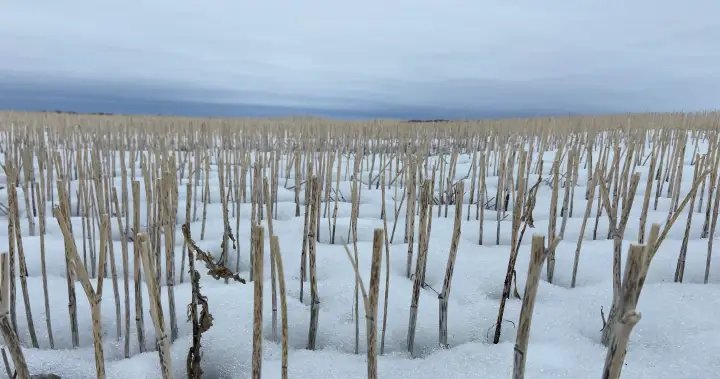
While many Albertans were hoping for warmer weather over the Easter long weekend, a late-season winter storm is instead expected to bring snow to parts of the province.

Snowfall will begin later Monday and continue through Wednesday, Environment and Climate Change Canada said.
“We’re expecting a couple shots of wet snow in the Edmonton area tonight and through Tuesday,” Environment Canada meteorologist Erin Staunton said Monday morning.
A swath of the province north of Edmonton is forecast to be hit the hardest and snowfall warnings are in effect for areas in and around Peace River, Slave Lake, Athabasca, Lac La Biche, St. Paul and Cold Lake.
Environment Canada said the system will spread west to east from Peace River towards Cold Lake Monday evening, with the heaviest snow Monday night into Tuesday morning.
Snowfall amounts in that area will vary, but generally 15 cm is expected, except near the B.C. border where about 20 cm is forecasted. The snow will end Tuesday afternoon or evening.
Temperatures are expected to hover near the freezing mark, meaning some of the snow could melt as it falls, especially in warmer urban areas.
For some farmers, the timing of the spring snow is less than ideal — but not unwelcome.
“We take what we get, and you deal with the cards you’re played,” said Ken Farion, who has been growing grain crops near Vegreville for 50 years.
Farmer Ken Farion has been growing grain crops near Vegreville, Alta. for 50 years.
Global News
He says snow later in the spring can be an inconvenience during seeding season. However, recent snowfall combined with strong winds has also helped protect fields by preventing soil from blowing away.
“This year we got a lot of snow — never a great amount at once, a lot of little snowfalls,” said Farion, who grows wheat, canola and oats on about 4,000 acres.

Get breaking National news
Get breaking Canada news delivered to your inbox as it happens so you won’t miss a trending story.
Farion says the moisture situation is already an improvement compared to last year, when dry conditions persisted well into the growing season.
“It’s probably more than we need out in the field. But on the livestock side, a lot of the dugouts were dry last year. Guys had pasture with no water. This year, at least, all the water ponds should recharge.”
Farion said as long as they’re in the fields by Mother’s Day, they’ll be happy.
“We’re never early seeders, so for us there’s plenty of time and there’s lots could happen between now and then.”
A snow-covered farmer’s field near Vegreville, Alta. on Monday, April 6, 2026.
Global News
While too much snow and rain is a problem that keeps fields too wet and prevents farming equipment from getting in to plow and seed, so too is the opposite.
Last spring, many parts of Alberta saw little precipitation until late June, creating difficult drought conditions for farmers trying to get crops established.
While additional snowfall could briefly delay fieldwork, Farion says having moisture in the ground — especially heading into the warmer months — is critical for both crop growth and livestock operations.
This winter was a bit of a tale of two provinces, Environment Canada said, when it came to how much snow areas received.
“For the Edmonton area and areas to the north, most of those regions did see above-average precipitation through the winter months — that’s December, January, and February,” Staunton said, adding Edmonton received about twice as much precipitation as average.
“Looking further south, some parts of central and southern Alberta — that includes Red Deer, Calgary, Lethbridge areas— were below-average as far as that wintertime precip goes.”
However, the mountain snowpack that feeds the irrigation system so many southern Alberta farmers rely on is deeper right now than in previous years.

Around the beginning of March, 32 mountain snowpack sites were surveyed by provincial scientists. Of the 31 mountain snowpack sites that have more than 20 years of historical records, 21 had snowpack conditions that were above-normal or much above normal.
The excessive snowfall has helped replenish snow pillows and reservoirs, which some experts believe will help reinvigorate ranches and farms across Alberta that have dealt with drought conditions.
Alberta Environment said based on data collected in late winter, the March Water Supply Outlook forecasts river volumes that are generally expected to be greater than those seen in 2025 and, in some cases, well above last year’s volumes.
The province is forecasting normal-to-above-normal river volumes for the Oldman, Bow, Red Deer and North Saskatchewan River basins, and normal-to-below-normal river volumes for the Milk River basin.
© 2026 Global News, a division of Corus Entertainment Inc.