dailynewsnblog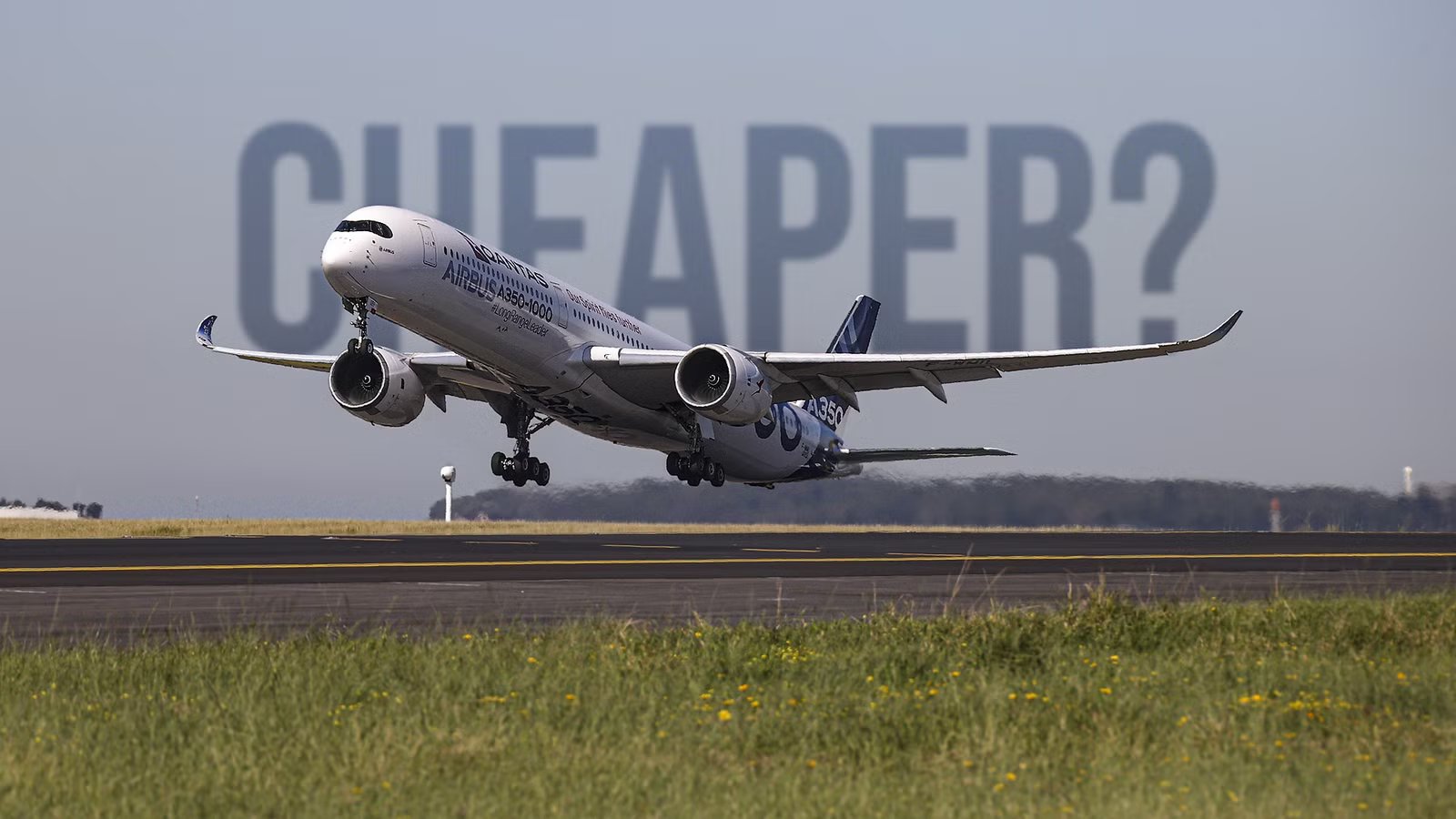
The Airbus A350 cost roughly $15 billion to develop, compared to around $30–32 billion for the Boeing 787 Dreamliner. This gap of about 50% reflects the development strategy rather than aircraft value. Based on industry program data and manufacturer disclosures, much of this difference comes from the 787’s well-documented delays, supply chain issues, and redesign cycles, which pushed its entry into service from 2008 to 2011 and significantly increased costs.
In this article, we will break down key factors behind that gap, including outsourcing strategy, technological risk, and execution. While Boeing outsourced roughly 70% of the 787’s production, Airbus retained greater control over design and integration on the A350. The result is a clear contrast in how two advanced long-haul aircraft were developed, showing why similar end products can come from very different and unevenly costly development paths.
Boeing 787 Vs. Airbus A350: How The Aircraft Compare

The Boeing 787 Dreamliner and the Airbus A350 are often compared as direct rivals, but they differ notably in size and role. The 787 family typically seats 242 to 335 passengers, making it well-suited for long-haul routes with moderate demand. In contrast, the A350 is larger, carrying around 300 to 410 passengers, which positions it closer to higher-capacity widebody aircraft. This difference means the A350 is generally used on busier routes, while the 787 offers more flexibility for airlines opening new long-distance connections.
In terms of performance, both aircraft are designed for long-haul and ultra-long-haul operations, but the A350 has a slight advantage in range and payload. The 787-9 can fly about 7,565 nautical miles (14,010 km), while the A350-900 reaches approximately 8,100 nautical miles (15,000 km). This allows the A350 to operate some of the longest routes in the world with higher passenger and cargo loads, whereas the 787’s lighter structure makes it more efficient on thinner routes where demand does not justify a larger aircraft.
From a passenger perspective, both aircraft deliver significant improvements over previous generations. The 787 is known for its larger dimmable windows, higher cabin humidity, and lower cabin altitude, helping reduce fatigue on long flights. The Airbus A350 offers similar environmental benefits but features a wider cabin, allowing for more comfortable seating layouts, particularly in economy class. While both prioritize comfort and efficiency, their differences in size and design mean airlines choose between them based on route demand.
The Boeing 787: Ambition & Cost Overruns

The Boeing 787 Dreamliner program was one of the most ambitious commercial aircraft projects ever undertaken. It aimed to transform long-haul travel through extensive use of advanced technology, including a structure made of roughly 50% carbon-fiber-reinforced composites, significantly reducing weight compared to traditional aluminum aircraft.
This contributed to 20–25% better fuel efficiency than older models like the Boeing 767, alongside passenger improvements such as higher cabin humidity and larger windows. The aircraft also introduced a ‘more-electric’ architecture, replacing many traditional pneumatic systems with electrically powered ones, adding both efficiency and technical complexity.
A major factor behind the program’s challenges was Boeing’s aggressive outsourcing strategy. Around 70% of the aircraft’s design and manufacturing was delegated to a global network of suppliers, including key partners in Japan, Italy, and the United States. While this was intended to reduce costs and accelerate development, it instead created significant coordination and quality control issues. Many suppliers struggled with the scale of responsibility, leading to incomplete or incompatible components arriving at final assembly, forcing Boeing to step in and fix problems internally.
These issues resulted in delays of more than three years, with the aircraft entering service in 2011 instead of the originally planned 2008 timeframe. Costs escalated dramatically as Boeing dealt with redesigns, supply chain breakdowns, and production inefficiencies. Ultimately, the total development cost rose to an estimated $30–32 billion, far exceeding early projections. What began as a groundbreaking and efficient program became a costly lesson in managing innovation, risk, and global manufacturing complexity.

Why The Boeing 787 Dreamliner Has Such Unparalleled Fuel Efficiency & Range Flexibility
The Dreamliner achieves its fuel efficiency and range flexibility through advanced materials, aerodynamics, and smart design.
The Airbus A350: A More Controlled Approach

In contrast, the Airbus A350 program benefited from a more cautious and controlled development strategy. Launched in the mid-2000s and redesigned as the A350 XWB (‘eXtra Wide Body’), Airbus had the advantage of learning from the earlier difficulties faced by the 787 program. While still incorporating advanced features, such as a structure made of over 50% composite materials and new-generation engines, it avoided introducing too many radical changes at once, focusing instead on a more measured and evolutionary approach.
 Boeing’s heavy outsourcing model, Airbus retained more responsibility for design and integration, with key components produced within its established European network. This reduced coordination issues and ensured smoother communication between teams. As a result, the development process, while still complex, was more stable, with fewer major disruptions, delays, or last-minute redesigns.
The outcome was a total development cost of approximately $15 billion, roughly half that of the 787. This lower figure reflects not only better cost control but also a deliberate strategy to balance innovation with execution. By limiting risk and maintaining oversight, Airbus delivered a modern, competitive aircraft without the same level of financial overruns, demonstrating a more disciplined approach to large-scale aerospace development.
Learning From Industry Mistakes

One of the key reasons behind the cost difference lies in Airbus’s ability to learn from Boeing’s experience with the Boeing 787 Dreamliner. By the time the Airbus A350 was being developed, the challenges of the 787 program, particularly supply chain breakdowns, delays, and cost overruns, were already widely understood across the industry. Airbus used these lessons to refine its own development strategy, placing greater emphasis on coordination, oversight, and realistic timelines.
Rather than pursuing radical changes across every aspect of the aircraft, Airbus adopted a more incremental innovation strategy. It still embraced modern technologies, including extensive use of composite materials and new-generation engines from Rolls-Royce, but implemented them in a more controlled manner. Crucially, Airbus avoided overextending its supply chain and ensured that integration remained tightly managed, reducing the risk of major technical or logistical setbacks.
This highlights an important principle in large-scale engineering: being second can sometimes be an advantage. By observing and adapting, Airbus was able to sidestep many of the costly mistakes encountered by Boeing. The result was a more predictable and disciplined development program, demonstrating how strategic restraint and industry awareness can be just as valuable as bold innovation.

The Airbus A350 Development Timeline
The A350 is an example of a successful cleansheet design and now boasts the highest widebody delivery rate.
Innovation Vs. Efficiency In Aircraft Development

The contrast between the Boeing 787 Dreamliner and the Airbus A350 illustrates a broader tension in engineering: the balance between innovation and efficiency. Boeing’s 787 pushed boundaries across multiple areas at once, from materials and systems architecture to manufacturing strategy. This bold approach created the potential for breakthroughs in performance and efficiency, but it also introduced significant risks that proved difficult to manage.
Innovation often comes with unforeseen challenges. In the case of the 787, the extensive use of composites, a globalized supply chain, and new electrical systems all brought unexpected complications. These included production delays, integration issues, and technical setbacks such as early battery problems. When multiple high-risk innovations are introduced simultaneously, even small issues can cascade into major delays and cost overruns.
Efficiency, by contrast, emphasizes control, predictability, and incremental progress. Airbus applied this philosophy to the A350 by combining modern technology with a more measured development strategy. While it still delivered a highly advanced aircraft, it avoided overextending in too many areas at once. This approach resulted in fewer disruptions, more stable timelines, and ultimately lower development costs—demonstrating how disciplined execution can be just as valuable as technological ambition.
What The Cost Difference Really Means

The fact that the Airbus A350 cost roughly half as much to develop as the Boeing 787 Dreamliner does not mean it is a ‘cheaper’ or inferior aircraft. Both jets represent the cutting edge of modern aviation, incorporating advanced aerodynamics, composite structures, and highly efficient engines. In service, they deliver comparable levels of performance, with excellent fuel efficiency, long range capabilities, and improved passenger comfort compared to previous generations of widebody jets.
What the cost difference really highlights is how differently Airbus and Boeing approached the challenge of building a next-generation aircraft. Boeing pursued a highly ambitious path, attempting to revolutionize not just the aircraft itself but also how it was designed and manufactured. This meant embracing greater risk in exchange for potentially greater rewards. Airbus, on the other hand, took a more measured approach, still innovating, but doing so in a way that prioritized control, integration, and predictability over sweeping change.
In the end, the comparison offers valuable insight into how complex industrial programs succeed or struggle. It shows that technological ambition alone is not enough, as execution, coordination, and strategic decision-making play an equally critical role. The A350 and 787 demonstrate two different philosophies in action, and together they underline a key lesson in engineering: the most successful projects are not just the most innovative, but the ones that manage risk effectively while delivering on their goals.