dailynewsnblog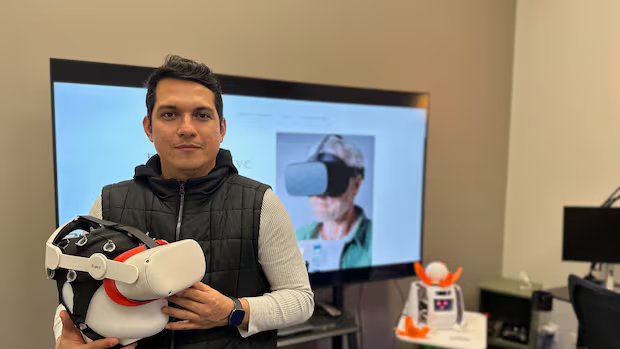

Listen to this article
Estimated 5 minutes
The audio version of this article is generated by AI-based technology. Mispronunciations can occur. We are working with our partners to continually review and improve the results.
Some older adults with dementia can enjoy fishing, rowing and tai chi without ever leaving the Adult Recreation Therapy Centre in Brantford, Ont., as a result of the work of researchers at Wilfrid Laurier University.
Along with his students, John Muñoz, a professor of user experience design, is developing exercise video games — exergames — that participants play using virtual reality.
“For the ones who are confined in certain spaces or cannot do it independently, this is a great opportunity to transport them to a different reality from the ones that they are currently living in while keeping them active,” Munoz told CBC Hamilton from his lab on Laurier’s Brantford campus.
With funding from the Alzheimer Society: Brant, Haldimand Norfolk, Hamilton Halton, Muñoz and his team partnered with Brantford’s Adult Recreation Therapy Centre for a trial on a game aimed at supporting therapeutic movements and engaging users’ brains.

John Muñoz, a professor of user experience design at Wilfrid Laurier University in Brantford, Ont., explains how his lab is using exercise video games to help older people with dementia. He demonstrates some of the games and shares how he sees the field evolving over time.
Muñoz’s work was inspired by his grandmother’s story. She had a stroke and was struggling to find the motivation for physiotherapy.
“I thought that there should be another way of keeping people active and engaged in their therapeutic journey while still conducting exercises,” he said.
Muñoz said his team is actively recruiting people to participate in a 10-week program. Researchers will monitor them during two weekly 20-minute gaming sessions, collecting data on reaction time and memory.
Recruitment has been harder than he expected, he said, suggesting there may be an aversion to video games for some older adults.

In his lab on Laurier’s Brantford campus, Muñoz demonstrates the game Seas the Day. Players wearing a VR headset and holding two controllers move their arms to simulate moving their arms while casting a fishing line and rowing.
Core to the philosophy of user experience design, feedback from users of the product will be key in its creation, Muñoz said. That’s especially important when designing video games for a demographic not typically familiar them.
“We don’t create games like first-person shooters or fantasy games where probably the mapping and the understanding of some of those complex game mechanics could be something challenging for an older adult,” Muñoz said.
Instead, his team asked potential participants what activities they missed doing and worked from there. Muñoz said he wasn’t surprised that many people referred to lakefront action.
The team also worked to make Seas the Day accessible, he said.
For example, people don’t have to push buttons or learn complex controls. Muñoz said the team found some participants instinctively played the rowing game by pushing rows forward to move forward, even though in reality, you need to row in the opposite direction you want to move. To make things easier, they added an option to invert rowing movement so people can play in a way that’s most natural for them.
Exergames have a lot of potential, Muñoz said, noting baby boomers are some of the last people who didn’t grow up with video games. People he sees who are now becoming seniors are more likely to have been casual gamers at some point in their lives and “more open to the idea that games could be used beyond entertainment,” he said, adding it’s a trend that will likely continue.

A study that aims to improve balance in people with multiple sclerosis is ongoing at McMaster University in Hamilton. The study has people hooked up to a computer and play classic videogame Tetris with their body.
The future of exergames
Muñoz told his university’s publication that he hopes technologies he and his students develop make it out of the lab and are adopted widely “by the people who really need them.”
His BioAdaptive Interface Lab is also working on games to use in pediatric medicine, while other teams are using them in different health research.
For example, in January, researchers at McMaster University told CBC Hamilton about a study using Tetris to help people with multiple sclerosis exercise.
At the time, participant Diane Bouwman said playing the classic block-stacking game with motion controls had been an enjoyable way to keep active.
“I’m really engaged in [the video game] and I’m not thinking about [how to move]. This is the game and I’m on it.”
Muñoz said he sees a promising future for exergames.
“I see this happening now and I don’t think it’s going to be hard for us to see in future residences or long-term care facilities a dedicated gaming room for people — not only games that are made for entertainment, but also maybe games that are purposely built to keep them physically and cognitively active.”