dailynewsnblog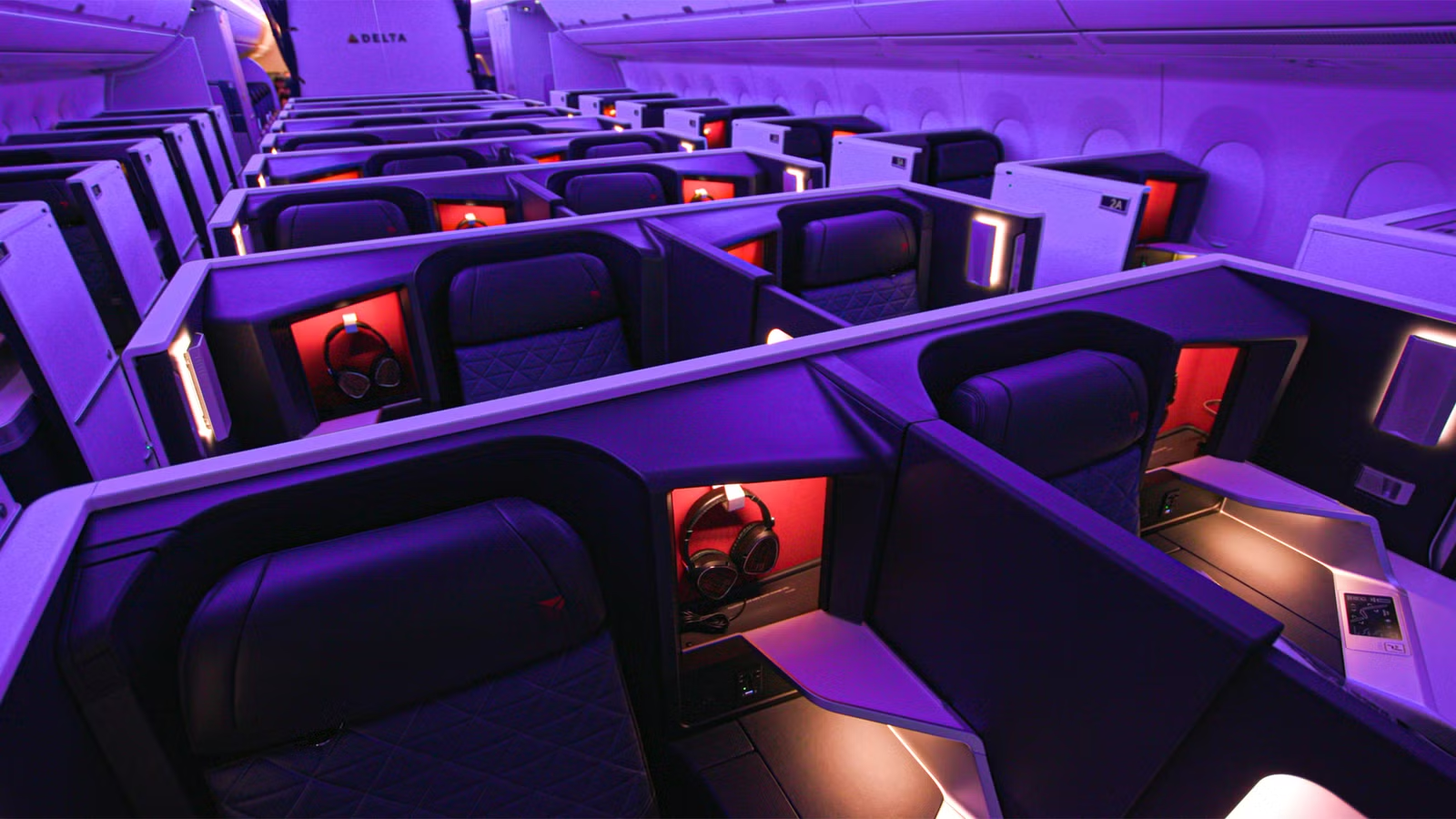
 Delta Air Lines is starting to lean heavily into the premium end of the long-haul market, and its latest fleet decision makes that strategy unmistakably clear. With a firm order for 20 Airbus A350-1000 aircraft, with options for 20 more, the carrier is positioning itself to compete more aggressively on some of the world’s most lucrative international routes, especially across the Pacific. The move also makes Delta the first US airline to commit to the largest variant of the A350 family – an aircraft that has already proven its worth with several global heavyweights.
What makes this order particularly notable is not just the aircraft itself, but how Delta intends to configure it. The airline has indicated that its A350-1000s will feature roughly 15% more premium seating than the aircraft they are expected to replace, a decision that reflects both shifting passenger demand and Delta’s continued focus on high-yield travelers. From its flagship Delta One Suites to its increasingly competitive Premium Select cabin, the airline is doubling down on comfort, privacy, and revenue potential, setting the stage for a new phase in its long-haul evolution. Let’s take a closer look…
A Strategic Leap Into the A350-1000

By selecting the A350-1000, Delta is making a calculated move that aligns with broader industry trends toward larger, more efficient widebody aircraft. The A350-1000 is the stretched variant of the A350 family, offering greater passenger capacity and range compared to the A350-900 variant that the carrier already operates across its long-haul network.
The airline’s order for 20 aircraft, with options for another 20, signals confidence not only in the aircraft itself but also in the continued recovery and long-term growth of international travel demand. These aircraft are expected to enter service later this decade and will primarily be deployed on long-haul international routes, with a particular emphasis on transpacific flying, where sector lengths are long and premium demand tends to be strong. For Delta, this is not just about replacing older aircraft, but about reshaping its network around more capable and efficient platforms.
The A350-1000 also fits neatly into Delta’s broader fleet renewal strategy, which has accelerated in recent years. In early 2026, the airline expanded its Airbus widebody order book with 31 additional aircraft, including 16 A330-900neo aircraft and 15 more A350-900s, reinforcing its commitment to a modern, largely Airbus-based long-haul fleet. This commonality brings operational efficiencies, from pilot training to maintenance, while also allowing Delta to deliver a more consistent onboard product. That said, the carrier has recently also placed an order for 30 Boeing 787-10s.

Delta Air Lines’ Widebody Strategy: Why The Airbus A350 & A330 Work Together
A new era for the iconic carrier.
15% More Premium: What That Really Means

Perhaps the most headline-grabbing aspect of Delta’s A350-1000 plan is the promise of approximately 15% more premium seating compared to the aircraft being replaced. While the carrier has not yet finalized its exact seat map, this increase will almost certainly come at the expense of standard economy class seating, reflecting a broader shift across the airline industry toward higher-margin cabins.
Delta’s premium strategy revolves around several distinct products, each targeting a different market segment. At the top end is Delta One Suites, which feature fully lie-flat seats arranged in a suite configuration with sliding doors, offering a level of privacy that rivals some international first class products. These suites have become a cornerstone of Delta’s brand on long-haul routes and are expected to evolve further by the time the A350-1000 enters service, potentially incorporating new materials, updated finishes, and enhanced technology.
Below that sits Delta Premium Select, the airline’s premium economy product, which has gained importance in recent years as more travelers seek a middle ground between business class and economy. With wider seats, deeper recline, upgraded dining, and additional service touches, Premium Select is designed to appeal to both leisure travelers willing to pay extra for comfort and corporate travelers whose companies may not authorize business class.
Delta Comfort+ rounds out the premium spectrum, offering extra legroom and priority boarding. While it is not a separate cabin like Premium Select, it still contributes to the overall premium mix. By increasing the proportion of these seats, Delta is effectively rebalancing its cabin to reflect changing consumer preferences and revenue dynamics.
Comparing Cabin Density & Layout

One of the most intriguing aspects of Delta’s A350-1000 is how its configuration may compare not only to its own fleet but also to those of its global competitors. Early estimates suggest a total capacity of around 350 passengers, although some projections point to a significantly lower figure of around 287 seats, depending on how heavily the aircraft is weighted toward premium cabins.
For comparison, many airlines currently operating the A350-1000, such as  Qatar Airways and Cathay Pacific, tend to configure the aircraft with higher overall seat counts, often exceeding 350 passengers. These carriers frequently deploy the aircraft on slot-constrained routes where maximizing passenger numbers is critical, balancing large economy cabins with a strong premium offering.
Delta Air Lines appears to be taking a different path, one that prioritizes passenger space and premium density over sheer volume. This approach mirrors what the airline has already done with its A350-900 fleet, opting for fewer seats in exchange for a more spacious, comfortable cabin. If Delta ultimately settles on a lower-density configuration for the A350-1000, it could become one of the least densely packed A350-1000s in service.
This strategy has implications beyond passenger comfort, as a lower seat count combined with a higher proportion of premium seats can significantly increase revenue per available seat mile, particularly on routes with strong business travel demand. However, it also requires careful route planning to ensure that demand for those premium seats remains consistently high.

Why In The World Did Delta Air Lines Order The Largest Airbus A350 Variant?
Dive into the story behind Delta opting in to Airbus and out of Boeing.
Engine Choice & Performance Advantages

Powering Delta’s A350-1000s fleet will be the Rolls-Royce Trent XWB-97, a high-thrust engine specifically developed for the larger variant of the A350 family. This engine is widely regarded as one of the most efficient in its class, delivering lower fuel consumption and lower emissions than older-generation widebody engines.
The performance benefits of the A350-1000 extend well beyond fuel efficiency, and the aircraft offers an impressive range, enabling Delta to operate ultra-long-haul routes without significant payload restrictions, even in challenging conditions such as strong headwinds across the Pacific. This capability is particularly valuable as airlines look to open new nonstop routes that would have been uneconomical with previous-generation aircraft.
From a passenger perspective, the A350 platform is designed with comfort in mind. Features such as higher cabin humidity, a lower cabin altitude, and larger windows help reduce fatigue on long flights, while advanced noise-reduction technologies create a quieter cabin environment. These elements may seem subtle, but on flights lasting 12 to 15 hours, they can make a meaningful difference in the overall travel experience. For Delta, these performance and comfort advantages are closely aligned with its premium strategy, allowing the airline to offer a product that is not only more luxurious but also more efficient to operate.
How It Stacks Up Against Competitors

When evaluating how Delta’s A350-1000 will stack up against competitors, it becomes clear that the airline is carving out a distinct niche. Airlines like Virgin Atlantic and Qatar Airways have configured their A350-1000s to strike a balance between premium cabins and high overall capacity, often using the aircraft on heavily constrained routes such as those serving  London Heathrow Airport (LHR) or
  Doha Hamad International Airport (DOH).
Delta’s approach, by contrast, leans more heavily toward maximizing yield rather than passenger numbers. By increasing the proportion of premium seats, the airline is effectively betting that it can generate higher revenue per flight, even if the total number of passengers carried is lower. This strategy is particularly well-suited to markets with strong premium demand, such as major business hubs and long-haul leisure destinations.
Another key differentiator is product consistency: while some airlines operate multiple business-class configurations across different aircraft types, Delta has made a concerted effort to standardize its Delta One Suites across its widebody fleet. This consistency can be a significant advantage for frequent travelers, who value predictability and reliability when choosing an airline.
At the same time, Delta faces stiff competition from carriers that have invested heavily in premium products, including enclosed business class suites, high-end dining, and extensive onboard amenities. The success of the carrier’s A350-1000 strategy will depend not only on the number of premium seats it offers but also on how those seats compare in terms of comfort, privacy, and overall passenger experience.

The New Delta Air Lines Long-Haul Aircraft Coming In 2026
A look at what these planes will bring to Delta, where they could fly, how they fit into Delta’s network, and what they may look like on the inside.
A Key Role In Long-Haul Expansion

The A350-1000 is expected to play a central role in Delta’s long-haul expansion plans, particularly as the airline looks to strengthen its position in the Asia-Pacific region from West Coast hubs such as  Seattle-Tacoma International Airport (SEA) or
  Los Angeles International Airport (LAX). Transpacific routes are among the most demanding in the world, requiring aircraft that can combine long range with strong payload capabilities and a compelling onboard product.
By deploying a premium-heavy A350-1000 on these routes, Delta can better compete with both US and international carriers that have traditionally dominated the high-end segment. The additional premium seats will allow the airline to capture more revenue from business travelers, while also appealing to leisure passengers willing to pay extra for a more comfortable experience.
Beyond Asia, the aircraft’s flexibility makes it suitable for a wide range of long-haul markets, including key transatlantic routes and emerging destinations where demand may not yet justify the largest aircraft but still requires a high-quality product. This versatility will be crucial as Delta continues to refine its network in response to shifting demand patterns and competitive pressures.
As deliveries begin later in the decade, the A350-1000 will join a growing fleet of modern Airbus widebodies that are reshaping Delta’s long-haul operations. With its emphasis on premium seating, advanced technology, and operational efficiency, the aircraft represents a significant step forward in the airline’s ongoing effort to position itself at the top of the global aviation market, where competition is fierce and differentiation increasingly defined by the quality of the passenger experience.