dailynewsnblog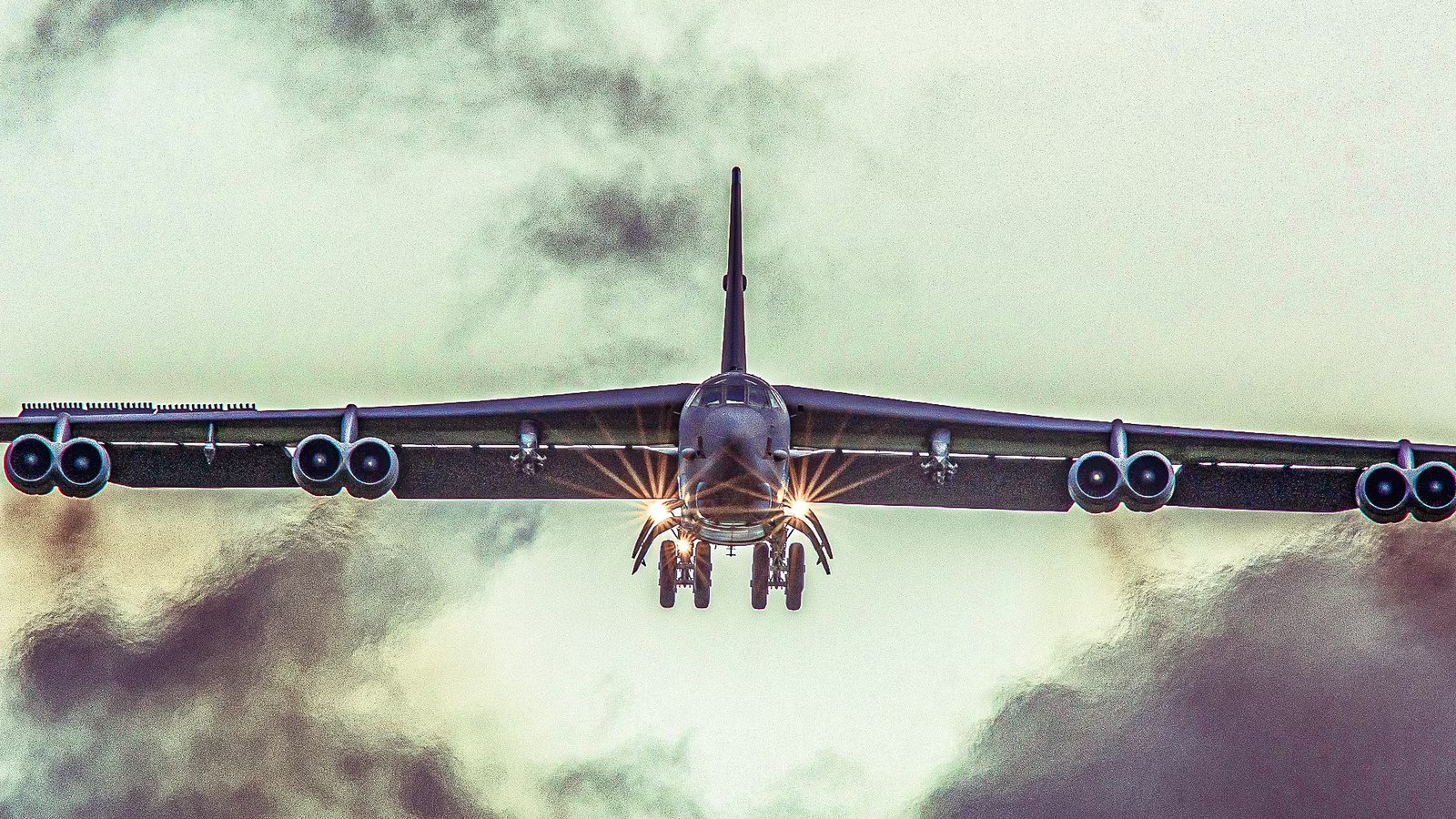
The US Air Force still relies on the Boeing B-52 Stratofortress (and its 70,000 lbs of payload capacity) to bring massive ordinance to bear in permissive environments. Perhaps more importantly, it is also a missile truck for long-range bespoke stand-off munitions in non-permissive environments. This enduring aircraft allows the Air Force to make up its bomber numbers in an affordable manner in a world where it hasn’t been able to purchase high-end stealth bombers in sufficient numbers.
The Boeing B-52 is the missile truck of choice for the US Air Force over the Rockwell B-1B Lancer by default. Despite being decades older than the B-1B, the B-1B airframes are rapidly coming to the end of their service lives, while the B-52s have the flight hours to operate into the second half of the century. This article will examine what you need to know about why the Air Force continues to rely on the B-52.
The Last Of A Second World War Lineage

The Boeing B-52 Superfortress can be regarded as the final iteration of the US’s Second World War series of bombers running from the Boeing B-17 Flying Fortress to the B-29 Superfortress to the Convair B-36 Peacemaker to the B-52 Superfortress. A couple of notable differences with the B-52 are that it is a jet-powered aircraft and was designed to carry nuclear bombs. Early development of the B-52 started around the end of the Second World War in the 1940s.
The first B-52 flew in 1952, with production running until 1962. At the time, the USAF was operating under the Second World War idea of massive waves of bombers taking significant losses on their sorties. These bombers would have to fly directly over their targets deep behind enemy lines, and it was assumed many would be lost on this mission. The US did use the B-52 in Operation Linebacker II over Vietnam in 1972, and, in those raids, the B-52 did suffer significant losses.
The B-52 is a lumbering subsonic aircraft for which speed, stealth, and agility are abstract notions. They were built to be able to take substantial damage and be the flying fortresses that their name suggests, and were even originally fitted with machine guns for self-defense against enemy fighters. Reports indicate that their gunners managed to down one or two Vietnamese fighters during Operation Linebacker II, but those guns have since been removed.
From Attrition To Speed To Stealth

As the US Air Force was building the B-52 in the 1950s, it started to dramatically shift its strategic bomber concepts with the Convair B-58 Hustler. The Hustler introduced the idea of outrunning threats, and it was hoped that this would allow the aircraft to be survivable in contested airspace. It was able to fly at Mach 2.0 and first flew in 1960.
The US then got to work on developing the XB-70 Valkyrie, a sort of souped-up Hustler, which could fly high at Mach 3.0. However, the development of surface-to-air defenses rendered them obsolete. Only two test XB-70s were built, forcing the USAF to continue to rely on its B-52s. To survive SAM threats, the XB-70 would have to fly low, but that was not what the aircraft was designed for.
|
United States Air Force strategic bomber fleets |
Number in service (per USAF) |
|---|---|
|
Boeing B-52 Stratofortress |
76 |
|
Rockwell B-1B Lancer |
46 |
|
Northrop B-2 Spirit |
19 |
|
Northop-Grumman B-21 Raider |
2+ (in testing) |
The US Air Force then developed the Rockwell B-1A Lancer with a speed of Mach 2.0 that was specifically designed to follow the map of the Earth. However, this too was cancelled, although the Air Force returned to it with the redesigned B-1B that was to fly at Mach 1.25 and have a dramatically reduced radar cross-section.
The Air Force procured 100 B-1Bs as an interim measure to bridge the lumbering B-52s with a stealth bomber project that would eventually produce the B-2 Spirit. However, by the time the B-2 was ready, the Cold War had ended, and the pressing need for an expensive stealth bomber had collapsed. Only 21 of the originally planned 132 B-2s were procured, forcing the Air Force to keep its B-52s and B-1s in service.

How Many B-2 Spirit Bombers Are Left?
The US’ B-2 stealth bomber is an awesome warplane, but how many are there?
A Question Of Usable Flight Hours

The B-1B Lancer has a problem. It is designed to fly low and follow the map of the earth, which means that the aircraft has to push through the thickest air. This stresses the airframes. Today, the Air Force has 46 of them remaining in service, but it is struggling to maintain that number as the airframes are rapidly wearing out and are expensive to overhaul. They are expected to be the first to be phased out between 2028 and 2032 as the new B-21 Raider enters service.
The B-2 Spirit also has problems, as it is expensive, only available in low numbers (19 usable airframes remaining), and has eroding relative stealth capabilities from new radars. For the B-2, the B-21 changes everything. As long as the B-21 is not in service, the B-2 is the world’s only stealth bomber offering a unique and indispensable capability. Once the B-21 enters service (in numbers), it is essentially obsolete.
By contrast, the B-52 is designed to fly high and slow, and these airframes have plenty of flight hours remaining. Its missions are not nearly as taxing on its airframes as those of the B-1. Another advantage is that they are relatively cheap to fly per hour. The B-52 doesn’t compete with the B-21 the way the B-2 does, as it is an entirely different type of bomber built for different missions. Indeed, if the B-2 and B-21 are Formula One racing cars, the B-52 is a pickup truck.
A Different Mission Set

The B-2 and B-21 are both designed as bespoke stealth strategic bombers capable of penetrating enemy air defenses and taking out high-value targets deep within contested airspace. They are also smaller aircraft, with the B-21 being significantly smaller than the B-2. Such jets are designed to carry a smaller number of high-end precision missiles and bombs internally. They are built to be survivable.
The B-52 is none of that, as it famously has the radar cross-section return of an apartment building and is not survivable in contested airspace. However, modern munitions leave a niche for the B-52, as stand-off munitions allow it to stay outside contested airspace and release its payload from afar. The B-52 can also carry bespoke munitions like JASSM and future hypersonic missiles.
Additionally, the massive size of the B-52 allows it to carry a large quantity of munitions that the B-21 can’t. This allows the ancient B-52 to complement the B-21. The B-21 will be the ninja flying unseen into the danger zone, taking out high-value targets, while the B-52 is the missile truck that is seen but stays outside of the danger zone, shooting arrows.

The 4 Largest Bomber Fleets In The US Air Force
A closer look at some of the biggest warbirds in America.
Upgrading The B-52 Superfortress

To keep the B-52 Superfortress relevant, the Air Force is upgrading its remaining fleet of 76 B-52H bombers to the B-52J standard. The upgrades will bring a range of improvements, including new Rolls-Royce engines to replace their aging engines. The upgrade program has run into cost overruns and delays, and the first are expected to be delivered in 2033.
It is expected that the Air Force will retire its B-1s by around 2032 and then retire its B-2s in the 2040s. However, the B-52s are not expected to retire until the 2050s or even as late as the 2060s. This means that some of these airframes have a shot at becoming the world’s first combat aircraft to achieve 100 years of continual combat service. Already, the youngest B-52 airframes are around 64 years old.
What sets the B-52 apart from other long-lived US Air Force programs, like the Lockheed U-2 and the Lockheed C-130 Hercules, is that those aircraft remained in production for much longer. The U-2 may have entered service in the 1950s, but the airframes flying today were built in the 1980s. The C-130 remains in production, so old airframes are being replaced. Production of the B-52 ended in 1962, so the USAF could only upgrade those airframes built in the 1950s and early 1960s.
Diminishing Opportunities For Stand-In Munitions

In a certain sense, the B-52, as it was originally intended to be used, was obsolete decades ago. However, it has been saved by the development of new stand-off munitions, allowing the aircraft to achieve the range needed to stay out of contested airspace. That said, there are scenarios where the US Air Force can still use its B-52s using stand-in munitions, like JDAMs. The 2026 air campaign over Iran is one example of that.
Indeed, in that conflict, the USAF was able to establish sufficient air superiority over much of Iran that enabled it to use its lumbering B-52s with stand-in munitions. Going forward, opportunities for the B-52 to use stand-in munitions will likely diminish. It is generally expected that there is no chance they will be used in that capacity in a future South China Sea campaign. It can also be noted that while the B-52’s flight hour costs are comparatively low, the cost of stand-off munitions is very high.