dailynewsnblog
Garth DeAngelis remembers being in the room when Firaxis chose to ditch XCOM: Enemy Unknown’s procedurally generated maps. Despite being a feature of the original 1994 game, when Firaxis tried to build the tech for their reboot of the turn-based tactical classic 15 years later, it was causing major headaches.
Early experiments were spitting out levels with trash cans in the middle of wheat fields and cover objects placed with no regard for where your soldiers might need them. Good procedural generation requires finely honed rules telling the computer what can be placed where, to create spaces that both look believable and play well.
“From what I saw from the team, I didn’t think we were ready.”
Working out those rules while also learning what makes for a good XCOM level, creating all the art assets, building every other system in the game, and solving the challenges of getting things like the new after-action glam cam to work, risked being one hurdle too many. The alternative was to produce a large roster of handcrafted maps set in urban, suburban, and rural environments. That route meant Firaxis could ensure the quality of every map. The downside was that, even with a large pool of levels, dedicated players would see the same maps cropping up.
In the room there were champions of each approach, DeAngelis recalls. Jake Solomon, creative director on the project, was pushing for procedural generation. He wanted “to give the player as much value as possible, and [make it so] they don’t see the same thing twice”. Art director Greg Foertsch was fighting for handcrafted levels – “He wanted it to look as great as possible”.
Despite it only being DeAngelis’s first job out of graduate school, after the two directors had laid out their cases, Solomon called on him to share his thoughts. “He’s like, ‘Hey, you over there, kid from New Jersey, what do you think?’,” DeAngelis remembers. “In my heart, I wanted procedural maps. But from what I saw from the team, I didn’t think we were ready. Based on what I saw, the timeline that we had remaining, the lack of tools that we had for the pipeline, the things that we were spinning out did not look good. And I told them that in the meeting, I thought we had to go handcrafted.”
DeAngelis is quick to say that his voice alone wasn’t the reason Firaxis made the decision to drop procedurally generated levels in XCOM: Enemy Unknown – he says he was “basically an intern” at the time. (Though, as lead producer on the game, he may be selling himself short.) But shortly after that meeting, the team went all in on handcrafted maps. This wasn’t a decision that meant less work. Firaxis had the ambitious goal of making sure there were enough maps for two playthroughs with no repeated levels- – more than 70 individual maps. It made for many late nights getting XCOM over the line.
“One of the things that Garth, Jake and I have in common is we like to swing big,” Greg Foertsch tells me. “Go big or go home.” So, even though he had argued for handcrafted maps in the room, ditching procedural generation didn’t sit well with him or the others. When 2K gave the greenlight on XCOM 2, cracking procedurally generated maps was top of everyone’s agenda.
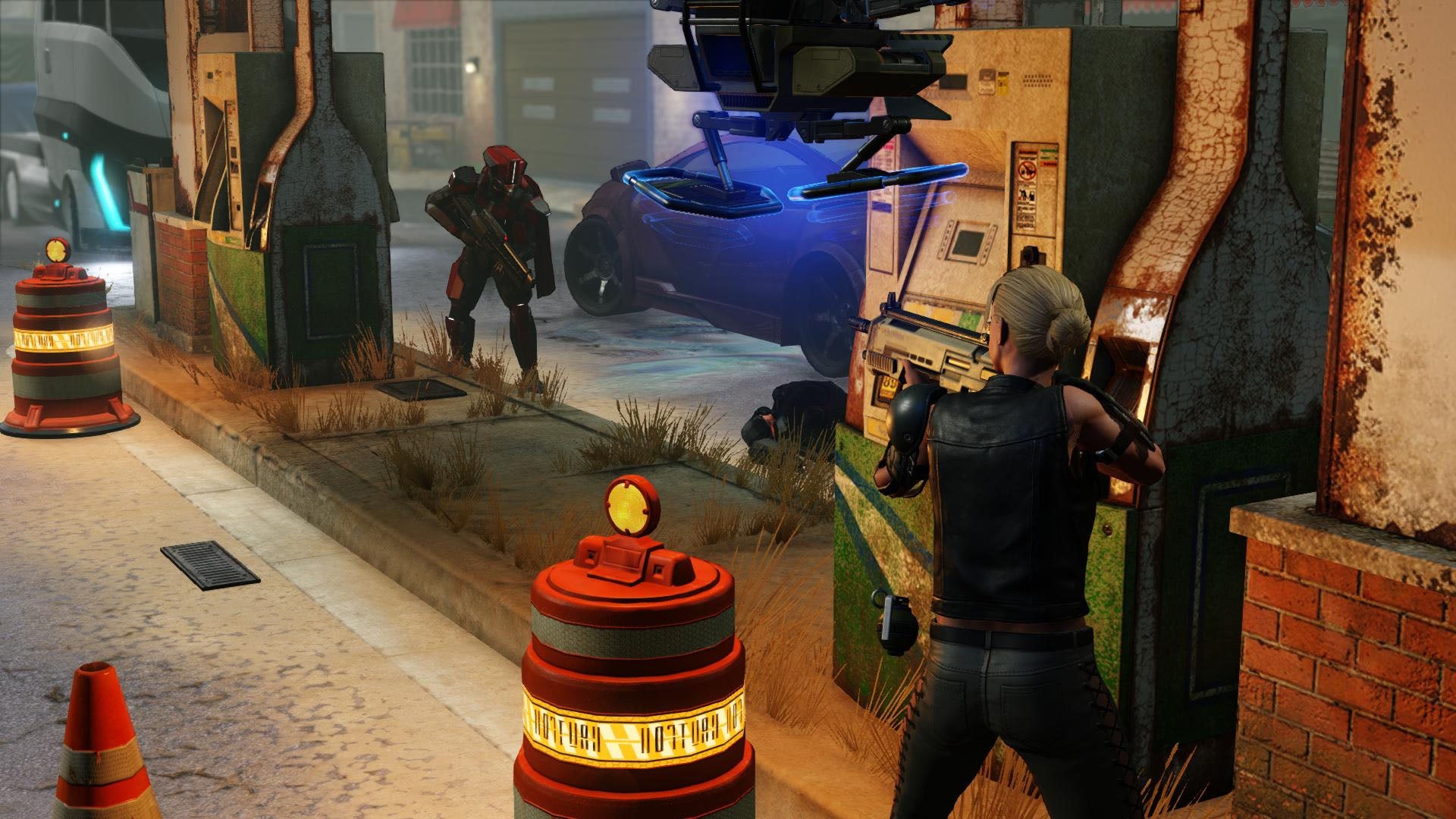
“I was chomping at the bit to crack the code for procedural maps,” DeAngelis says, but it wasn’t simply that the team at Firaxis wanted to challenge themselves, though. “We wanted to surprise the player, and we knew too that the XCOM audience would eat up procedural maps if we could nail it and make it feel right.”
While the bulk of the XCOM team worked on Enemy Within, the 2013 expansion to Enemy Unknown, a small group split off and began production on an ambitious sequel. “We were able to start the development in parallel,” DeAngelis says. “I was able to peel off a strike team with Greg, Jake, and others to start prototyping procedural maps for XCOM 2.”
“Having that time between XCOM and XCOM 2 to just sit down and sort through what we had learned by doing it the wrong way the first time was useful,” Greg Foertsch, XCOM 2’s art director says. “I felt like I knew how to do it now, it was just a bridge too far for the first one.”
“It was just a bridge too far for the first one.”
The main challenge was defining a ruleset for where to place rooms, objects, and cover that would both make for a fun map to play and a believable one to look at. The rules didn’t just have to work in one environment, they had to map onto urban, suburban, and rural maps. Where a bus stop might make a good piece of cover in one map, it shouldn’t exist in a rural environment, so an equivalent object had to be found. Foertsch remembers the small team spending long days “just trying to figure out the rules of the procedural system, and how could we make a ruleset that spanned all of those three very different visual spaces and still make sense.”
Another wrinkle in the challenge was destruction. In both the original X-Com and the XCOM: Enemy Unknown reboot, the walls and floors of buildings and many cover objects are destructible. If a muton is ducked down behind a window in a corner shop taking potshots at your squaddies, you can fling a grenade their way and blow a great big hole in the wall, exposing the alien to fire. There was no question destruction would return in XCOM 2, but it raised questions of what to do if a procedurally generated map stuck two buildings back to back. Would destroying an adjoining wall in one destroy the other? Would it look awkward and messy?

Firaxis’s solution was something they called the ‘plot and parcel’ system. Each map in XCOM 2 is divided into a grid of plots, and these plots can be filled with parcels of preassembled assets. No buildings were directly next to each other because of a thin space between each parcel. “Think about that as if you’re playing tic tac toe,” Foertsch says. “If you add thickness to the lines that draw the board, it gives you a buffer between one cell to the next cell.”
That approach made for more interesting playable levels, but to appear like a natural, coherent whole, the team had to focus on blending the gaps between the parcels. “We went from having a map where we just pop down random cover elements [where] there’s really no value in that,” Foertsch says, to maps where the blending assets were selected by the parcels in neighbouring plots. “Whatever drops down in [a plot] can drastically change the one that’s in the next one. That allowed us to set up rules that made sense and visually didn’t [create] a weird space.” It’s a system Firaxis continued to use in the XCOM series and recreated for its Marvel tactics game Midnight Suns.
The team avoided maps turning into a uniform grid by varying the size of plots. “There were three different sizes,” Foertsch says. “There were XCOM units, which were like a metre and a half each. So 16×16, 16×32, and 32×32.” Within an urban map, this meant you might come across a large petrol station sandwiched between a row of small square houses on one side and a long thin book shop on the other, with roads, bus stops, park benches, and street signage giving the different buildings the look of all being part of one handcrafted environment.

While it might sound straightforward, it wasn’t easy to replicate. Foertsch heard from the team at Splash Damage working on Gears Tactics that their procedural system didn’t have the gaps between parcels. “They had problems,” Foertsch says. “How do you sew those two things together if there’s no in-between?”
When work on Enemy Within was completed and the larger team began to move onto the project, Foertsch handed off the plot and parcel system to the level designers and they took it much further than he imagined. “They started adding procedural chunks everywhere inside of the plots, too, so along those little lines, there’s different streets and different street corners and different cover. Everything ended up dialing up times 1000 at that point.”
Foertsch calls out the work of “exceptional” Brian Hess in particular. Joining the team as a level designer on the Enemy Within expansion, Hess became lead level designer on XCOM 2 where, Foertsch says, he was “the one who largely took it to the final version, [and] added all sorts of crazy stuff to it.” In 2018, Hess gave a talk at GDC that reveals the complexity of the rules underpinning every map generated in XCOM 2.

As well as managing XCOM 2’s development, creating schedules across the team to make sure all the many, many tasks that make up a game were being completed, DeAngelis was in the habit of staying late into the night playing the latest build to share notes with the team the next day. “I loved the game so much, I made sure I played the heck out of it continually,” he says. Those after hours play sessions meant DeAngelis was one of the first people to see XCOM 2 coming together. He remembers, for instance, the first time he was able to cut one of his soldiers free from the suffocating coils of an alien viper with his ranger’s machete, and telling the team to “hear and see their reactions”.
DeAngelis also remembers another night. “It’s 1am in the morning, and I’m playing this thing after my normal work hours and meetings,” DeAngelis says. What he was seeing on the screen wasn’t as dramatic as an alien viper, or a new character class, or mission type. But, for the person who was in the room when they decided reaching for procedural generation in XCOM: Enemy Unknown was beyond their grasp, it was perhaps more significant. He remembers looking at the level before him and thinking “Damn, this city centre procedural map… I’m a believer.”