dailynewsnblog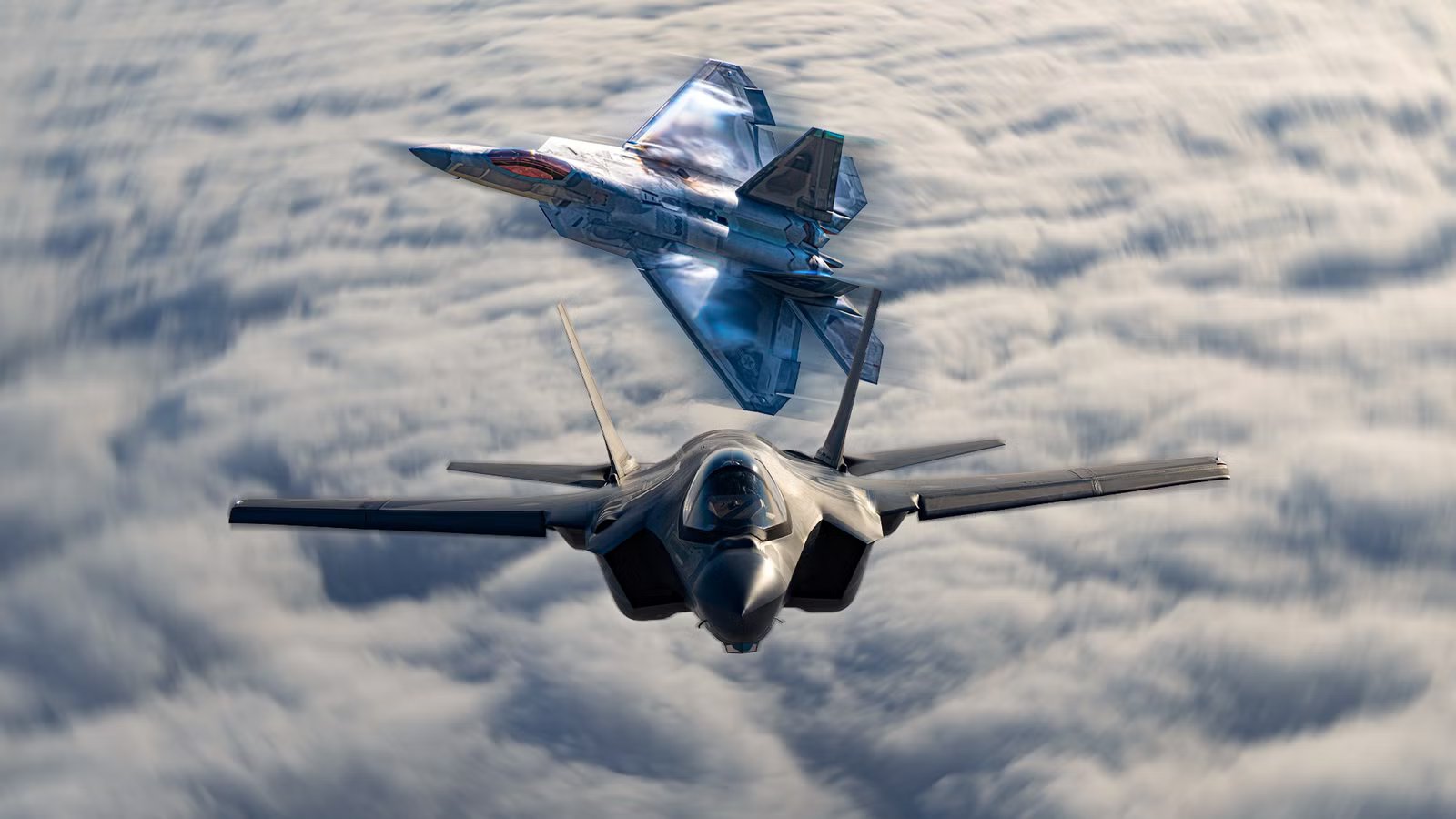
The Lockheed Martin F-22 Raptor and F-35 Lightning II remain the backbone of United States Air Force fifth-generation airpower in 2026, but for very different reasons. The US Air Force operates around 183 combat-coded F-22s, while the global F-35 fleet has surpassed over 1,000 delivered aircraft across more than 15 operators, according to recent Pentagon and Lockheed Martin program data. The key difference is simple: the F-22 still dominates high-end air superiority missions, while the F-35 has become the primary multirole and data-sharing platform for the US and its allies.
Where the F-22 dominates through individual lethality, the F-35 dominates through collective awareness. Together, these two aircraft now define the cutting edge of how the United States projects airpower across the globe, from the contested skies of Eastern Europe, where NATO partners are increasingly folding F-35s into US-led operations, to the vast, high-stakes theater of the Indo-Pacific, passing through the war-torn Middle East.
Using publicly available USAF fleet data, program reports, and operational doctrine updates, we will compare these two aircraft across these key factors: design philosophy, stealth, performance, avionics, cost, and combat integration. This matters now more than ever, as the US continues to refine its “high-low mix” approach to counter near-peer threats, with the F-22 focusing on air dominance and the F-35 acting as a battlefield information hub.
Air Superiority Vs Multirole Design Philosophy

The core conceptual difference between the F-22 Raptor and the F-35 Lightning II stems from their opposing design philosophies: air superiority versus multirole versatility. The F-22 was developed under the Advanced Tactical Fighter program during the 1980s as a replacement for the F-15 Eagle, at a time when the US Air Force expected to face advanced Soviet fighters such as the Sukhoi Su-27 Flanker and Mikoyan Gurevich MiG-29 Fulcrum. As a result, the aircraft was designed primarily to win air-to-air combat and establish air dominance in highly contested environments.
Because of this mission, the F-22 was optimized for raw air combat performance. The aircraft combines stealth shaping, supercruise capability, a very high thrust-to-weight ratio, and 2D thrust-vectoring engines, along with internal weapons bays to maintain low observability. These features allow the F-22 to engage enemy aircraft at long range while remaining difficult to detect, and if necessary, outperform most fighters in close-range maneuvering combat. In simple terms, the aircraft was built to destroy enemy fighters and control the skies before other aircraft enter the battlespace.
By contrast, the F-35 emerged decades later from the Joint Strike Fighter program with a fundamentally different objective: replace multiple legacy aircraft across the US Air Force, US Navy, Marine Corps, and allied air forces with a single multirole platform. Instead of focusing purely on air combat, the F-35 was designed to perform air-to-air missions, precision strike, close air support, reconnaissance, electronic warfare, and battlefield coordination. This philosophical difference explains why the F-22 remains a specialized air superiority fighter, while the F-35 functions as a multirole strike fighter and information platform within modern networked air operations.
Stealth Technology And Radar Signature Differences

Both the F-22 Raptor and F-35 Lightning II are fifth-generation stealth fighters that employ advanced airframe shaping, radar-absorbent materials (RAM), and internal weapons bays to drastically reduce their radar signatures. However, their stealth capabilities are optimized for different combat roles. The F-22 was engineered from the outset as a dedicated air-superiority platform, with exceptional emphasis on minimizing its frontal radar cross-section (RCS) against the X-band radars typically used by enemy fighters.
Public estimates place the F-22’s frontal radar cross-section (RCS) at approximately 0.001–0.005 square feet (0.0001–0.0005 square meters), often described as the size of a marble, while the F-35’s frontal RCS is estimated at around 0.015 square feet (~0.0015 square meters), commonly likened to the size of a golf ball. These figures are highly aspect- and frequency-dependent and should be treated as illustrative rather than definitive, as precise RCS data for both aircraft remain classified.
The F-22 achieves an exceptionally low signature particularly from the front, whereas the F-35 trades some degree of frontal optimization for better all-aspect stealth performance, greater maintainability, and deeper integration with its advanced electronic warfare suite (AN/ASQ-239 Barracuda) and 360° Distributed Aperture System (DAS). Both aircraft carry weapons internally to preserve low observability. The F-35’s more comprehensive sensor fusion and jamming capabilities reflect its broader multirole design priorities, while the F-22’s electronic warfare suite, though highly capable, is narrower in scope.
In simple terms, the F-22 is built to sneak up on enemy aircraft with minimal chance of detection, using its superior frontal stealth and kinematic performance (Mach 2+ top speed with supercruise) to dominate the air battle. The F-35 is engineered to penetrate contested airspace, deliver precision strikes, survive integrated air-defense systems, and serve as a battlefield information hub by fusing and sharing data with other platforms in real time.

Why The F-35 Is The US Air Force’s Most Important Fighter Jet
Discover why the F-35 is the US Air Force’s most critical fighter — from stealth and sensors to strategy, readiness, and future upgrades
Speed, Maneuverability, And Flight Performance

If the F-35 is the brain of modern American airpower, the F-22 Raptor is its fist, and not many aircraft in history have ever hit harder. Designed from the ground up as a pure air superiority machine, the Raptor was never asked to be versatile, exportable, or affordable. It was asked to win. And in the realm of raw flight performance, it still does, decisively and by a margin that no rival, allied or adversarial, has yet managed to close.
The numbers tell part of the story. The F-22 can exceed Mach 2 at altitude and, more critically, sustains supercruise at around Mach 1.5, supersonic flight achieved without the roaring, fuel-consuming, heat-bleeding blast of afterburners. The F-35, depending on variant and configuration, tops out at around Mach 1.6 and can briefly push past the sound barrier without afterburner, but it cannot sustain that pace. The Raptor doesn’t sprint to supersonic. It lives there.
Then there is the matter of maneuverability. The F-22’s 2D thrust-vectoring engines can redirect exhaust independently of the aircraft’s trajectory, allowing the Raptor to point its nose at angles that would push conventional fighters well past their aerodynamic limits. Combined with its fly-by-wire control system and an airframe optimized for supersonic agility, the result is a level of close-in maneuverability that remains, even two decades into its service life, essentially unmatched among operational fighters.
Where the Raptor wins battles by outflying its enemies, the Lightning II wins them by making the traditional notion of a dogfight irrelevant. Its advanced sensor suite sees farther, fuses data faster, and fires longer-range missiles with greater situational awareness than almost anything else in the sky. Modern air combat increasingly unfolds at distances where neither aircraft can see the other with the naked eye, and at those ranges, agility matters far less than information. The F-35 doesn’t need to outmaneuver a threat. It simply needs to find it first, and it almost always does.
Cost, Production, And Global Operators

The F-22 Raptor program originally planned to build more than 700 aircraft, but after the end of the Cold War and rising program costs, production was drastically reduced. In total, 187 production F-22 aircraft were built, with the final aircraft delivered in 2012. The total program cost is estimated at around $67 billion with a unit cost at over $300 million per aircraft, although the flyaway cost was significantly lower. Because of the aircraft’s sensitive stealth technology, the US government also banned exports, meaning the F-22 has only ever been operated by the US Air Force.
Another major difference between the two programs is sustainment and operating cost. The F-22 has historically had very high operating costs per flight hour due to its specialized stealth coatings and limited fleet size. The F-35 also has high operating costs, but because the fleet is much larger and still in production, there are ongoing efforts to reduce maintenance costs and improve availability rates through upgrades and logistics system improvements.
Ultimately, the difference between the two aircraft programs reflects two very different strategic decisions. The F-22 was designed as a highly specialized air superiority fighter built in relatively small numbers, while the F-35 was designed as a scalable, exportable multirole aircraft intended to replace multiple aircraft types across many countries. This is why the F-22 remains rare and specialized, while the F-35 is rapidly becoming the standard Western fifth-generation fighter aircraft.

The Striking Differences Pilots Notice Between The F-35 Lightning II & F-22 Raptor
Explore how F-22 vs F-35 cockpit design, helmet tech & VTOL shape radically different pilot experiences in modern stealth fighters.
Avionics, Sensors, And Information Warfare

One of the most important differences between the F-22 Raptor and the F-35 Lightning II is not speed or maneuverability, but avionics architecture and sensor integration. The F-22 was revolutionary when it entered service with the AN/APG-77 AESA radar, advanced electronic warfare systems, and early sensor fusion capabilities. However, the F-35 was designed from the beginning around sensor fusion and network warfare, meaning its avionics are more integrated and data-focused rather than purely radar-centric. In modern air combat, situational awareness and data sharing are often more important than raw aircraft performance.
The F-35’s avionics suite includes the AN/APG-81 AESA radar, the AN/AAQ-37 Distributed Aperture System (DAS), the AN/AAQ-40 Electro-Optical Targeting System (EOTS), and the AN/ASQ-239 electronic warfare system. The AESA radar can simultaneously track air targets, map terrain, and conduct electronic warfare functions, while the DAS provides 360-degree infrared missile warning and situational awareness. This sensor fusion allows the F-35 to detect, track, and share targets with other aircraft, ships, and ground forces through datalinks, effectively making it an airborne information node rather than just a fighter aircraft.
While the F-22 was originally less focused on network warfare, the aircraft has received significant avionics upgrades through modernization programs such as Increment 3.2B and later updates. These upgrades added improved electronic protection, enhanced geolocation capability, expanded data link functionality, and integration of newer missiles such as the AIM-120D and AIM-9X. While the F-35 is generally considered the more advanced information and sensor platform, modernized F-22 aircraft still have very powerful radar, electronic warfare, and situational awareness capabilities, particularly in air-to-air combat environments.
Which Aircraft Is More Important In 2026?

When comparing the F-22 and F-35, one might ask which aircraft is more relevant today, but the answer depends entirely on mission requirements. The F-22 remains the United States’ premier air superiority fighter and would be critical in any high-end conflict where control of the air is contested. Its combination of stealth, supercruise, speed, altitude performance, and maneuverability still makes it one of the most capable air-to-air combat aircraft in the world.
However, the F-35 has become far more numerous and widely deployed, and by 2026 it is increasingly the aircraft that forms the backbone of US and allied tactical aviation. The aircraft is now operated by a growing number of NATO and allied countries, and its ability to perform strike missions, intelligence gathering, electronic warfare, and battlefield coordination makes it extremely versatile. In many modern operations, the F-35 may be used more frequently simply because it can perform a wider range of missions than the F-22.
In strategic terms, the two aircraft are not competitors but complementary systems. The F-22 provides air dominance and protects the airspace, while the F-35 conducts strikes, gathers intelligence, and connects the battlefield through data sharing. Together, they represent the US military’s high-end air combat capability in 2026, combining stealth, sensors, networking, and performance in a way that no previous generation of fighter aircraft could achieve.