DUBAI, United Arab Emirates (AP) — Iran fired on targets across the Middle East, sparking multiple blazes at a Kuwaiti oil refinery, while American and Israeli airstrikes hit the Islamic Republic on Friday as the war neared the end of its fifth week unabated and the U.N. Security Council prepared to meet over Tehran’s stranglehold on the Strait of Hormuz.
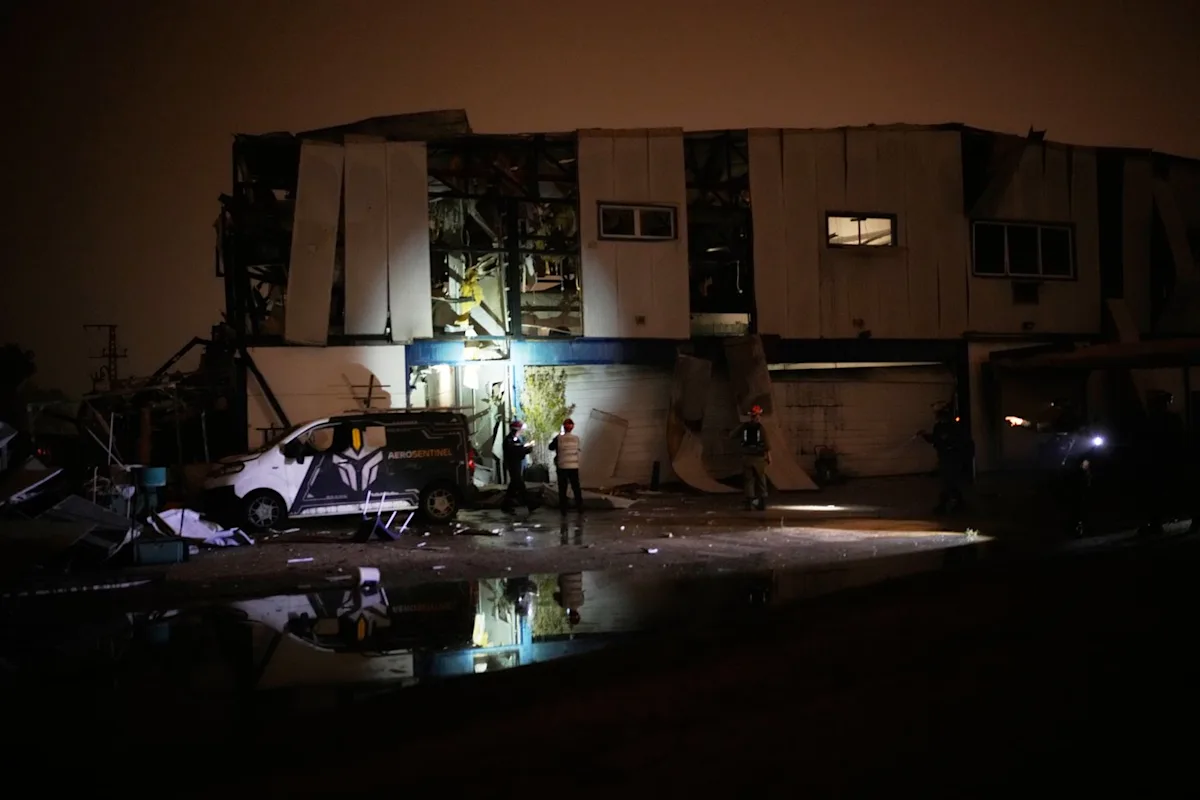
Despite claims from the U.S. and Israel that Iran’s military capabilities have been all but destroyed, Tehran has continued to keep the pressure on Israel and its Gulf Arab neighbors, hitting Kuwait’s Mina al-Ahmadi oil refinery early Friday in a drone attack.
The refinery has been hit multiple times during the war and state-run Kuwait Petroleum Corp. said firefighters were working to control several blazes. Sirens also sounded in Bahrain warning of Iranian attacks, Saudi Arabia said it had destroyed several Iranian drones, defenses were activated in the United Arab Emirates and Israel reported incoming missiles.
Activists reported strikes around Tehran and the central city of Isfahan, but it wasn’t immediately clear what was hit.
Iran’s attacks on Gulf region energy infrastructure and its tight grip on the Strait of Hormuz, through which a fifth of the world’s oil and natural gas transits in peacetime, have sent oil prices skyrocketing and is impacting global economies.
Spot prices of Brent crude, the international standard, were around $109 early Friday, up more than 50% from Feb. 28 when Israel and the U.S. started the war with their attacks on Iran.
UN Security Council to take up Strait of Hormuz security question
Shipping had flowed freely through the strait before the war, but U.S. President Donald Trump has said it’s not now Washington’s responsibility to get the waterway reopened, instead putting the onus on others, saying this week that the countries that depend more on fuel shipped through Hormuz should “build some delayed courage” and go “take it.”
The U.N. Security Council was expected to vote Saturday on a proposal from Bahrain that would authorize defensive action to ensure vessels can safely transit the strait. Bahrain’s initial draft would have allowed countries to “use all necessary means” to secure the strait, but Russia, China and France — who have veto power on the Council — expressed opposition to approving the use of force.
Following meetings in Seoul between South Korean President Lee Jae Myung and French President Emmanuel Macron, the two leaders said they resolved to “cooperate to ensure safe passage” through the strait but did not offer specifics. The day before, Macron had said the American expectation that the waterway could be reopened by force was unrealistic.
Macron said a military operation “would take an infinite amount of time and would expose anyone passing through the strait to coastal threats from (Iran’s) Revolutionary Guard.” He added that reopening of the strait “can only be done in coordination with Iran,” through negotiations that would follow a potential ceasefire.
Thousands of U.S. Marines and paratroopers have been ordered to the region and Trump could try a ground operation to take Iran’s Kharg Island, its main oil terminal, or territory along the strait, but both carry significant risks, former CIA Director Bill Burns said on a Foreign Affairs magazine podcast.
“Then there’s the third option, which is effectively declaring victory and the inversion of the old Colin Powell Pottery Barn rule, which was ‘We break it, we own it,’” Burns said, referencing a comment attributed to former U.S. Secretary of State Colin Powell before the 2003 U.S.-led invasion of Iraq.
“Instead, it would be, ‘We break it, you own it, and it’s over to you guys,’ whether it’s European allies or Gulf Arabs or anybody else to ensure safe passage through the Strait of Hormuz.”
Iran’s former top diplomat suggests terms to end the war
The U.S. has presented Iran with a 15-point plan for a ceasefire that includes reopening the Strait of Hormuz, but no signs of progress were apparent in the diplomatic effort, with Iran regularly noting the U.S. has attacked the nation the last two times it was in negotiations with the Trump administration, including to start this war.
In a proposal published Friday in Foreign Affairs, Iran’s former top diplomat Mohammad Javad Zarif suggested, however, that Iran should now “use its upper hand” to make a ceasefire deal.
Zarif, the former foreign minister who helped reach the 2015 nuclear deal with world powers, wrote that Tehran “should offer to place limits on its nuclear program and to reopen the Strait of Hormuz in exchange for an end to all sanctions — a deal Washington wouldn’t take before but might accept now.”
While Zarif has no official position now in Iran’s theocracy, he helped get reformist President Masoud Pezeshkian elected. He also would not have been able to publish such a piece without at least running the positions past senior members of the country’s theocracy.
It is not clear how Trump would respond to such a pitch, particularly as Zarif referred to the envoys Trump sent previously to negotiate with Iran — close friend Steve Witkoff and his son-in-law Jared Kushner — as “completely illiterate on both geopolitics and nuclear technicalities.”
Death toll keeps rising
More than 1,900 people have been killed in Iran during the war, while 19 have been reported dead in Israel. More than two dozen people have died in Gulf states and the occupied West Bank, while 13 U.S. service members have been killed.
More than 1,300 people have been killed and more than 1 million displaced in Lebanon, where Israel has launched a ground invasion in its fight with the pro-Iranian Hezbollah militant group. Ten Israeli soldiers have also died there.
___
Rising reported from Bangkok. AP journalists Sylvie Corbet in Paris, Tong-hyung Kim in Seoul, South Korea and Edith M. Lederer at the United Nations contributed to this report.
Jon Gambrell And David Rising, The Associated Press


 dailynewsnblog