dailynewsnblog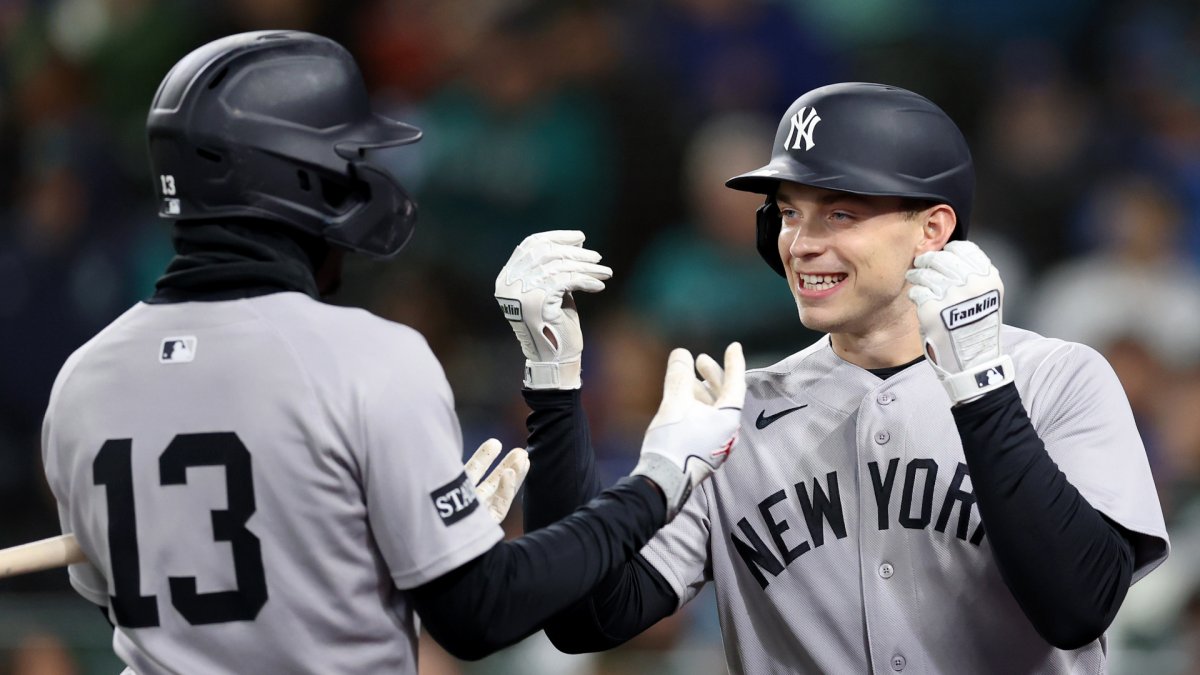
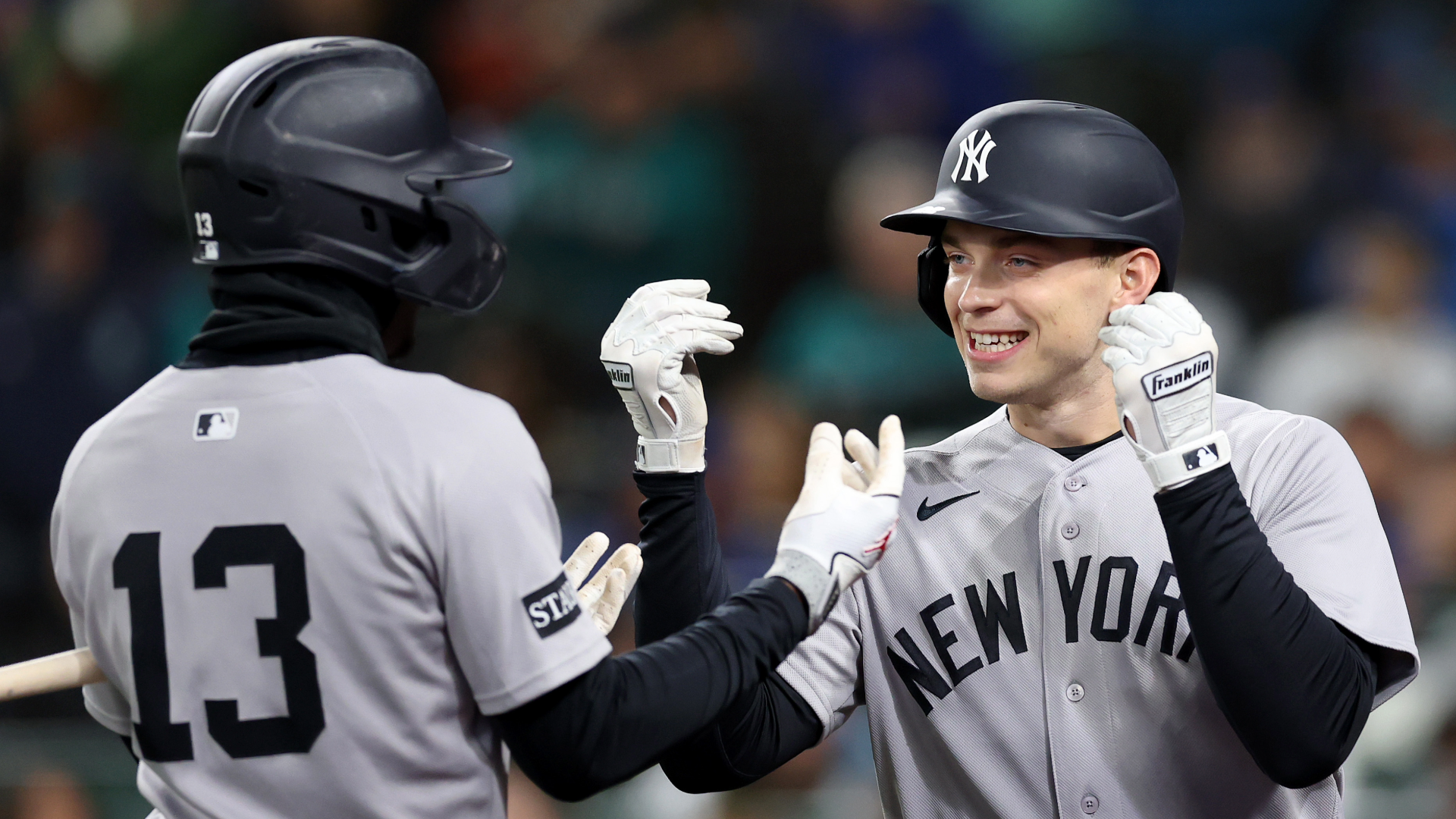
Things could not be going much better for the New York Yankees six games into the new season. They’re 5-1 and have allowed six runs total, including zero home runs. Every other team has allowed at least 12 runs and two homers, and 25 of the other 29 teams have allowed at least 20 runs. Only the 2002 San Francisco Giants and 1915 Philadelphia Phillies gave up fewer runs through their first six games; they both allowed five.
“I think this team as a whole, we’re just feeding off each other and rolling with it,” righty Cam Schlittler said following Wednesday afternoon’s win over the Seattle Mariners (NYY 5, SEA 3). “To take the series here is a good feeling, and we’ll go home confident to play on Friday.”
The Yankees have started 5-1 despite not yet playing a home game and despite two-time reigning AL MVP Aaron Judge not doing much of anything. Judge is 3 for 24 (.125) with two homers, one walk, and 11 strikeouts. The Yankees have also gotten basically nothing from the bottom of the lineup. Their 7-8-9 lineup spots have combined for a .339 OPS, the lowest in baseball. The Yankees have been carried by Cody Bellinger, Ben Rice, Giancarlo Stanton, and their pitching staff.
It’s only six games, but the Yankees are off to a hot start, particularly after an offseason in which they didn’t do much beyond re-sign their own players. Their most significant outside addition was lefty Ryan Weathers, who allowed one run in 4 ⅓ innings in his Yankees debut Monday. Otherwise, the Yankees brought back starting outfielders Bellinger and Trent Grisham, plus some role players (Paul Goldschmidt, Amed Rosario, etc.). That’s really it.
The run-it-back approach made for a boring offseason and some fan angst. OK, a lot of fan angst. The Athletic polled more than 11,000 fans before the season and Yankees fans ranked 22nd in optimism heading into 2026. The Yankees were behind the Athletics, Miami Marlins, and Pittsburgh Pirates, among others.
That’s insane, right? That ranking reflects fatigue with manager Aaron Boone and GM Brian Cashman more than it does an objective look at the talent on the roster and the organization as a whole. The Yankees had the American League’s best run differential last season (by 54 runs) and won 94 games, only losing the AL East to the Toronto Blue Jays thanks to a tiebreaker. Fans are down because the Yankees haven’t won the World Series since 2009, not because they’re not a very good team.
The 2026 Yankees look like the 2025 Yankees plus Weathers, and that is not a bad thing. They’re returning almost all of a very good team and have some pieces on the way who will raise their ceiling. Here are four reasons to believe the 2026 Yankees will be better than the 2025 Yankees despite all the familiar faces.
1. A full season of Schlittler
The single biggest reason to believe the 2026 Yankees will be better than the 2025 Yankees is the guy they had on the mound Wednesday. Schlittler, who thoroughly dominated the Boston Red Sox in Game 3 of last year’s Wild Card Series, held the Mariners to two hits in 6 ⅓ innings. He struck out seven and threw only 79 pitches while on a pitch limit after a minor back issue delayed his start to spring training. Figure Schlittler will throw 90-ish pitches next start, then 100-ish the start after that.
Two starts into his season, Schlittler has thrown 11 ⅔ scoreless innings and allowed only three baserunners. He opened the year as New York’s No. 2 starter behind Max Fried. He opened last year in Double-A. Schlittler’s meteoric rise last season took him from Double-A on Opening Day to Triple-A in June to the Bronx in July. He made 14 starts for the Yankees as a rookie, pitching to a 2.96 ERA with solid under-the-hood numbers (3.74 FIP, 4.11 xERA, etc.), and also starred in the postseason.
This season, Schlittler is in the rotation to begin the year and he’s positioned to give the Yankees 25-plus starts, depending on how they manage his workload. He’s armed with a new cutter, one that has outlier movement given its mid-90s velocity, …
… as well as upper-90s four-seamers and sinkers. Hitters have missed with more than half their swings against the four-seamer in Schlittler’s two starts. It has been straight bully ball. Schlittler threw 88% fastballs in two starts, so almost nine times out of 10. It’s a “here you go, try to hit it” approach and no one’s hit it yet. The power stuff, the precision (zero walks in two starts), and the fact he’s an imposing presence at 6-foot-6 give Schlittler a very high ceiling. We saw it in last year’s Wild Card Series.
The Yankees got only 14 regular-season starts out of Schlittler last season. He stepped into a rotation spot that had been occupied by veteran hangers-on Carlos Carrasco, Marcus Stroman, and Ryan Yarbrough. This year, Schlittler is in the rotation from Day 1. He won’t have a 0.00 ERA all year, and probably not even a sub-3.00 ERA, but Schlittler is very good. He’s showing he can be a true impact starter who you want taking the ball in the biggest games come October.
2. Cole’s return
Gerrit Cole did not throw a single pitch in 2025. He blew out his elbow in spring training and had Tommy John surgery, reducing him to a spectator and secondary pitching coach throughout the summer. Cole’s rehab has been very smooth, about as smooth as you’ll see a Tommy John rehab, and he’s on track to start a minor-league rehab assignment soon and rejoin the Yankees in late May or early June. That’s enough time for what, 20 starts? I think the Yankees would be thrilled with 20 and happy with 15.
In his two spring training starts, Cole’s fastball hummed in around 96 mph and topped out at 98.7 mph, which is exceptional velocity for the first game action after elbow reconstruction. The movement traits on his two breaking balls were right where they needed to be as well. For all intents and purposes, Cole looked like Cole in spring training. He looked like a veteran starter going through the motions in March and I say that as a positive. It was business as usual.
Sandy Alcantara is a reminder that even the very best pitchers can have hiccups in their first year back from Tommy John surgery, so it is not a given Cole returns to make an impact. He doesn’t need to come back as an ace though. The Yankees have Fried (and Schlittler?) to fill that role. Can Cole come back and be better than Weathers and Will Warren, the team’s No. 4 and 5 starters? The Yankees would love to get the ace version of Cole. If they get a 3.80 ERA version, well, that guy can help too.
Whatever the Yankees get out of Cole this year, even if it’s 10-15 starts with an ERA near 4, is something they did not get last year. There is still a lot of build-up and rehab to go, but Cole’s recovery so far has gone so well that it’s hard not to be optimistic. He’s far enough along that we can begin to reasonably assume he’ll contribute something this season. If that’s 12 starts with a 4.25 ERA, those are 12 starts that can help the Yankees and be better than whoever’s next on the rotation depth chart.
(Carlos Rodón and Clarke Schmidt are also on the mend from elbow surgery. Rodón is expected back in late April or early May after making 32 starts a year ago. Schmidt, who was limited to 14 starts last year, is unlikely to be back until August or September, which won’t be enough time to really move the needle.)
3. A full season of last year’s deadline additions
The Yankees had a low-key winter partly because they did much of their offseason shopping at last summer’s trade deadline. Setup man Camilo Doval and closer David Bednar came over at the deadline, and were not rentals. Jake Bird, who was so bad after his acquisition last summer that he was demoted to Triple-A after just three games, has given up just one hit in three appearances. Ditto third baseman Ryan McMahon and utility man José Caballero, the latter of whom is filling in at shortstop while Anthony Volpe rehabs from shoulder surgery. Those deadline trades kept the Yankees out of the bullpen and the infield markets in the offseason.
Yes, the 2026 Yankees look like the 2025 Yankees, but more specifically, they look like the post-deadline 2025 Yankees. That team had baseball’s second-best record behind the Phillies after the deadline. Bednar has really settled down in the ninth inning, and while McMahon hasn’t hit much in pinstripes, his Gold Glove-caliber defense alone makes him a big upgrade over the third basemen they’ve employed the last three years (Oswaldo Cabrera, Oswald Peraza, late career Josh Donaldson and DJ LeMahieu).
The 2025 Yankees won 94 games and had the AL’s best run differential despite a shaky bullpen the first four months of the season and a black hole at third base, both offensively and defensively. Having Bednar, Doval, and McMahon at the outset this season is not as sexy and probably not as impactful as having a full year of Schlittler or a partial year of Cole, but those guys put the Yankees in better shape right now than they were at this time last season. The Yankees did their offseason shopping last July.
4. ABS challenges
One week in, the new ABS challenge system seems to be working very well league-wide. Fans at the stadium certainly appear to enjoy it based on the crowd reactions to successful challenges (or unsuccessful challenges for the visitors). The Yankees have been one of the most successful teams in ABS challenges in the early going. Here are the numbers:
|
Total challenges |
16 |
2nd |
|
Successful challenges |
13 |
2nd |
|
Success rate |
81% |
2nd |
The Yankees are second across the board (behind different teams). They challenge frequently, including going 5 for 5 in Tuesday’s game, and they’re successful when they do. Catcher Austin Wells is a perfect 5 for 5 behind the plate on challenges and New York’s 81% team success rate is well above the 55% league average.
With the caveat that it has only been a week, the Yankees have all the ingredients to be one of the game’s most successful ABS challenge teams. Their hitters are very disciplined and know the zone well, and their catchers are excellent pitch-framers. The entire roster controls the strike zone well. Will they stay at an 81% success rate all year? No, almost certainly not, but the Yankees will likely finish near the top of the league in total challenges and success rate.
We’ve already seen how much ABS challenges can swing an inning or a game. Last Friday, Judge challenged a called strike with a runner on second and no outs in a scoreless game. The 1-1 call was overturned into a hitter-friendly 2-0 count, then Judge hit a home run that gave the Yankees the only two runs they’d need that afternoon.
ABS challenges are a tool the 2026 Yankees figure to use well as any team in the game. They’re also a tool the 2025 Yankees did not have. Unless the Yankees are unexpectedly bad at ABS challenges (it’s possible, sure), there will be a few extra runs and wins to be had throughout the season. Even one additional win would be a lift. It’s just not something last year’s team could use. This is a rule change that appears to favor the Yankees given the roster’s top-to-bottom control of the strike zone.
The Yankees also have much improved depth this season. Cabrera (third base) and Jasson Domínguez (left field) were in the Opening Day lineup last year. This year, they’re in Triple-A. The bench includes players with strategic uses: Goldschmidt, Rosario, and Randal Grichuk, all of whom are above-average hitters against lefties. Last year’s Opening Day bench included Peraza and Pablo Reyes, two break glass in case of emergency types. The margins of the roster are much stronger.
As good as it is, the pitching staff will not continue to average one run allowed per game. There will be a crash back to Earth at some point, which will be offset by Judge, Jazz Chisholm Jr., and a few others rising at the plate. The 2026 Yankees look a lot like the 2025 Yankees, for sure, but 2025 is 2025 and 2026 is 2026. What happened last year won’t have any bearing on this year. The Yankees have a roster now that is deeper and, thanks largely to Cole and Schlittler, possesses greater upside than last year’s team.