dailynewsnblog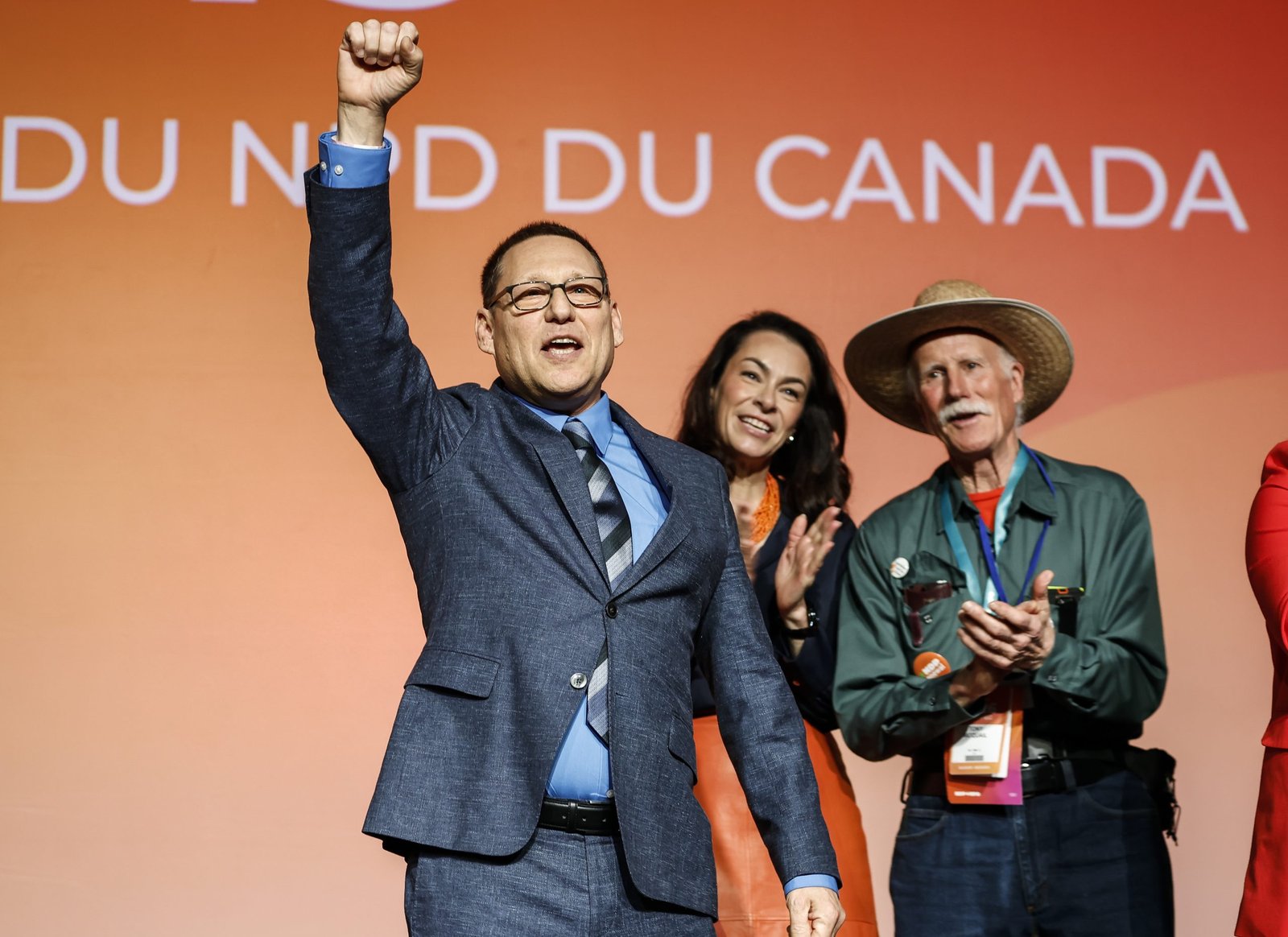
Here’s what the activist media is reporting on this week.
Avi Lewis’s landslide first-round win at the New Democratic Party leadership convention in Winnipeg last week “is the rupture with the recent past that the party needed for a fresh start,” according to Canadian Dimension contributor Steven High.
“His victory speech on Sunday was bold and unapologetic. He took aim at the billionaire class, telling them that the party was coming for their money, and the tech barons who are ramming unregulated AI down our throats. He was similarly unflinching in his condemnation of pipelines and the fossil fuel economy. He also spoke with moral clarity about the Middle East.”
It was also “the most left-wing speech from an NDP leader in my lifetime, and I am 57,” he notes.
“There was no ambiguity, strategic or otherwise. Nor was there the usual drop-down listing of deserving Canadians that has been the hallmark of NDP politics since the early 1990s. What was on offer instead was a unifying vision based on the 99 percent. One could feel him channelling his inner-Bernie Sanders and Zohran Mamdani. I was reminded of Ed Broadbent’s 1984 campaign when he campaigned on behalf of ‘ordinary Canadians’ against the ‘Bobsy-twins of Bay Street.’”
High acknowledges that “the road ahead will not be an easy one,” for Lewis or his party.
“His French is atrocious and Alexandre Boulerice will soon jump to Québec Solidaire. Nor does Lewis have a seat in the House of Commons. His firm stance against pipelines will enrage the provincial parties in Alberta and Saskatchewan. I wouldn’t be surprised if they re-brand themselves. Ultimately, though, Lewis’s vision may resonate more with the party’s urban progressives than its working-class base.”
Even so, “it is exciting to think that the NDP might once again be the source of bold new ideas,” he contends. “Canadian politics will be better for it.”
In fact, within minutes of Lewis’s victory being announced, “a couple of provincial New Democrat leaders on the oil-drenched Prairies kickstarted the inevitable the-party-is-over trope with churlish commentaries on Lewis’s victory as soon as it was known,” Rabble writer David Climenhaga points out.
Among the first to react was Alberta New Democrat leader Naheed Nenshi, who, “in a statement emailed to media at 9:25 a.m,” declared that the “direction of the federal party under this new leader, someone who openly cheered for the defeat of the Alberta NDP government, is not in the interests of Alberta,” Climenhaga notes.
“About the nicest thing that can be said about Nenshi’s screed is that it’s ill-timed and clearly a reaction to United Conservative Party (UCP) Premier Danielle Smith’s inevitable effort to tie the Alberta NDP to its federal counterpart. It has the potential, though, to turn into a spectacular own goal, driving away many in the party’s traditional base – already fed up with Nenshi’s passive approach to Smith’s ideologically driven misrule – in the next provincial election.”
For her part, Nenshi’s Saskatchewan counterpart, Carla Beck, “took a similar tack to Nenshi, focusing on Lewis’s environmental positions in an ‘open letter’ to the new national leader,”and informed him that she would meet with him only when he “publicly reverses (his) position on these matters, and show a willingness to try to understand the realities of our province and the thousands of proud Saskatchewan workers who rely on our industries to feed their families,” Climenhaga notes. “No meeting then, I guess.”
As he sees it, there are “two conclusions can be drawn immediately from what happened in Winnipeg: Financial contributions to leadership candidates really are a good way to forecast the outcome of a party leadership vote, especially in a grassroots-driven party like the NDP,” and the “base of the national NDP remains dominated by social democrats, no matter what the party establishment thinks or wishes.”
In addition to the real-time video coverage that The Breach provided from the convention floor, coordinating editor Saima Desai offered a preview of how it could turn into a “battleground between the left and the establishment” over internal governance issues.
“As media headlines focus on the race for leader, there are other battles over the coming days that will shape the party’s future,” she predicted.
“The fight over the elected executive of the NDP—a governance body that makes key decisions about finances and party affairs—will pit the establishment of the party against a left wing challenge. An incumbent slate that includes B.C. Federation of Labour President and NDP treasurer Sussanne Skidmore and officials from the Canadian Labour Congress (CLC) is being taken on by a left-wing slate that includes Libby Davis, a longtime MP and anti-poverty advocate who served the downtown Vancouver east side for nearly 20 years, and Niall Clapham Ricardo, a lawyer, former labour organizer, and member of Independent Jewish Voices.”
As Rabble’s Nick Seebruch reports, the “unified” candidates ultimately prevailed, with Ricardo, Davies and Keira Gunn elected to serve as president, vice-president and treasurer, respectively.
“Davies endorsed Avi Lewis for the NDP leadership early in the campaign, and Lewis was right beside Davies and the rest of the new executive committee team after their victory was announced,” he notes.
Meanwhile, The Breach’s Desmond Cole chatted with Naomi Klein, who, in addition to a “researcher, activist (and) brilliant journalist,” is also “the partner of the man who just took over the leadership of the NDP,” as Cole notes, and proclaimed herself “overwhelmed” by the experience.
“It felt more like a movement than a campaign, like all the best political … campaigns do,” she added before proclaiming Lewis’s speech to be “dynamite.”
Over at Ricochet, Zeinab Diab explores how the ongoing Supreme Court hearings on Quebec’s controversial Bill 21 reveals the “secular hypocrisy” behind a law that “claims neutrality while targeting Muslim women and entrenching a double standard that protects Catholic symbols and erodes minority rights across Canada.”
She also emphasizes that it is “crucial to remember that this case cannot be reduced to a technical matter,” as “behind constitutional principles lie lives, interrupted professional trajectories, and well-documented experiences of exclusion.”
The current legal battle “represents a pivotal moment,” she concludes.
“Yet a democracy is not measured solely by the sophistication of its legal debates. It is also measured by its capacity to hear the voices of those who live the most direct consequences of its political choices. In the case of Bill 21, these voices have too often been pushed to the margins of the debate, rendered inaudible. Perhaps it is finally time to listen to us.”
Elsewhere on the site, Jon Thompson takes a closer look at how the Ontario legislature’s “blanket ban” on “political statements” inside the legislature has led to security barring visitors wearing ‘Every Child Matters’ orange t-shirts, “and in another case, a sewn patch of the Transgender pride flag,” he reports.
Rounding out the progressive-left roster, The Maple’s Adam D.K. King makes the case that Canada’s labour movement “can be the base for a more just and humane Canadian immigration system,” as well as “the role that unions can play in resisting anti-immigrant backlash and promoting migrant workers’ rights.”
Trending on the right-of-centre side of the Canadian activist mediaverse:
- Rebel News commander Ezra Levant scored an “exclusive interview” with U.S. Ambassador to Canada Pete Hoekstra that led to a “wide-ranging hour-long conversation (that) touched on issues like Prime Minister Mark Carney fanning the flames of anti-Americanism, Canada’s strained relationship with the U.S., Albertan independence, energy production, and even the state of legacy media outlets.”
- Rebel reporter Tamara Ugolini delivers a status update on the Liberals’ latest budget bill, which made it to the legislative finish line last week “after moving swiftly through the Liberal-packed Senate,” and “quietly embeds the High-Speed Rail Network Act within it, effectively handing the federal government sweeping new tools to fast-track the ALTO high-speed rail project.”
- Juno News correspondent Cosmin Dzsurdzsa highlights the recent move by the Alberta government to “ban ideology in schools with (a) new education neutrality bill,” which would “prevent the flying of political flags at schools and mandate that students hear the national anthem every week.”
- Over at Counter Signal, Dzusrdzsa filed a separate piece on how the Canadian cattle industry is “pushing back against new federal livestock tracking rules, warning they could pave the way for an expansive digital identification system with serious consequences for farmers.”