dailynewsnblog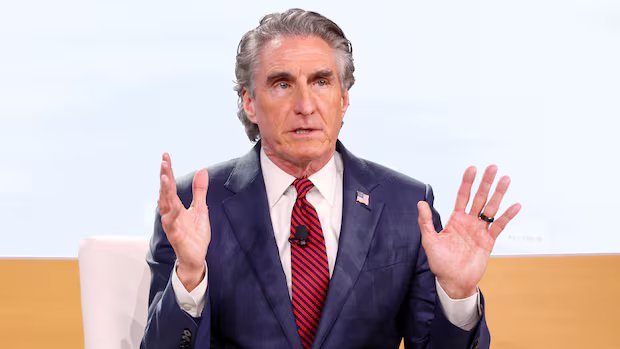
When U.S. Interior Secretary Doug Burgum travelled to Venezuela with oil and mining executives last month, he was trying to pitch them on the opportunity that exists in that country’s neglected oil and gas fields.
Then last week at a conference in Houston, he again tried to sell a room full of energy executives on the massive bounty of oil, natural gas and precious metals in the South American country.
Burgum — who plays a key role in the Trump administration — used the word “opportunity” three times when speaking about Venezuela at S&P Global’s recent CERAWeek energy conference.
“The resources there are quite amazing,” Burgum said.
U.S. Energy Secretary Chris Wright also appeared to be making the Venezuela sales pitch, speaking at the conference about how well “aligned” the interim government and the U.S. administration are when it comes to growing Venezuelan production.
But it’s unclear whether oil and gas executives are buying.
There is a plethora of challenges in Venezuela, from ongoing safety concerns to an unstable government, as well as the massive investment required to improve the infrastructure in its derelict oilfields.

U.S. President Donald Trump has been pressuring American oil and gas executives to invest in Venezuela’s energy sector, nearly three months after the toppling of former president Nicolás Maduro, as the country is said to have the largest crude oil reserves in the world.
In January, Trump held a White House meeting with the bosses of the biggest U.S. oil companies to ask for at least $100 billion US in investment to grow Venezuelan oil production to help lower U.S. energy prices.
Once a major producer, Venezuela only pumped about 900,000 barrels per day out of the ground last year, following many years of declining investment because of sanctions and failed government policies.
At its peak in 1970, Venezuela produced 3.7 million barrels per day.
According to Rystad Energy, Venezuela requires approximately $183 billion US in capital investment between 2026 and 2040 to restore oil production to three million barrels per day.

Venezuela sits on one of the largest oil deposits in the world – but not all oil is created equal. CBC’s Johanna Wagstaffe explains how millions of years of buried seabeds and oil-eating bacteria turned that reserve into some of the heaviest, hardest-to-extract crude on the planet.
The U.S. involvement has yet to result in a turning point in the country’s energy sector, said Luis A. Pacheco, a visiting fellow at the Baker Institute in Texas and a former Venezuela energy executive.
The actions of the Trump administration did “trigger a large expectation that has not been fulfilled as of today,” Pacheo said. “We’re not as close as we would like.”
Limited interest to invest
Some companies with existing operations in the country are considering whether to expand.
Shell, the U.K.-based global energy company may decide on whether to invest in one or two Venezuelan natural gas projects by the year-end.
“I don’t think anyone would dispute the enormity of the resource base in Venezuela,” said Shell chief executive Wael Sawan, pointing to the need for continued legal and fiscal regulation changes by the Venezuela government to create a stable investment environment.
“I’m encouraged by what we see. But we still have a long way to go,” he said.
ExxonMobil had a team in Venezuela last week to assess the state of energy infrastructure.
Meanwhile, Chevron has increased its oil production in the country in recent months, but chief executive Mike Wirth’s messaging remained cautious. “There’s still things that need to happen to encourage investment at the scale that people would like to see,” he said, pointing to legal reforms as an example.
For others, Venezuela remains a work in progress where it’s still too early to consider investing.
The ruling government recently updated its hydrocarbon law, but it remains “woefully inadequate,” said ConocoPhillips CEO Ryan Lance.
The hydrocarbon law now allows private companies, including foreign firms, more autonomy in the country’s lucrative oil sector, as opposed to past legislation giving majority control to state oil company PDVSA over operating oil projects.
“You need policy durability not only on the Venezuelan side, but the U.S. side. What happens when another administration comes in?” said Lance.
Concerns persist
Venezuela produces a heavy crude, which is similar to the type of oil that is mostly produced in Western Canada. In January, Canadian heavy oil prices began to slide following the upheaval in Venezuela because of the prospect that some U.S. refineries could have less demand for Canadian oil in the future.
But Venezuela will have to provide a higher level of guarantees and policy certainty to foreign investors compared to other countries to compensate for several decades of not respecting property rights and contracts, said Luisa Palacios, an adjunct senior research scholar at Columbia University’s Center on Global Energy Policy.
In past decades, foreign companies have had their assets seized. In the case of ExxonMobil, it happened twice.
At some point, there will be elections in the country, as Delcy Rodríguez remains in a temporary role as the acting president.
Nobel Peace Prize laureate María Corina Machado is committed to running again to be leader in the country and is promising the opening of “a new era” in Venezuela in the hope of convincing major foreign oil companies to invest in her country.

Machado delivered a keynote speech in Houston last week at CERAWeek, an energy conference with 10,000 attendees. She presented a five-point plan to revive oil production with the goal of reaching five million barrels per day, including a promise of 25-year leases to foreign investors and a full privatization of the oil and natural gas industry.
“[If elected,] the Venezuelan state will get out of the way and pave the way to give the conditions so that the oil and gas sector in Venezuela will go fully private,” said Machado.
“The role of the state will be strictly as a regulator, creating incentives for long term investment,” she said, noting the need for clear rules and enforceable contracts.
For the immediate future, the Canadian oilpatch shouldn’t be concerned, said Colin Gruending, an executive vice-president at Enbridge.
“It’s uncertain how much more production Venezuela can produce. That’s the first question. And the second question is then where will that oil go?” he said.