dailynewsnblog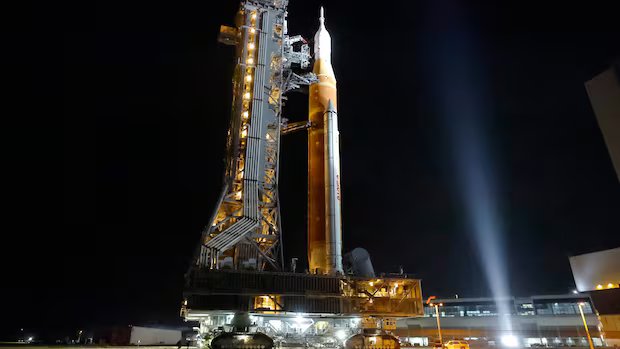
Think of it like a long family trip, with everyone packed into a minivan along with all of your stuff — except that you’re hitting the road at 28,000 km/h and there are no pit stops for nearly 10 days.
That’s what four astronauts can expect, including the Canadian Space Agency’s (CSA) Jeremy Hansen, when they travel around the moon in the Orion capsule as part of NASA’s Artemis II lunar mission.
The spacecraft could launch from the Kennedy Space Center in Florida as early as Wednesday evening, just under two months after the initial launch was postponed due to a hydrogen leak during a wet dress rehearsal. NASA also shelved plans for a March attempt after discovering a problem with rocket’s helium flow.
The crew — which also includes veteran NASA astronauts Reid Wiseman, Victor Glover and Christina Koch — has trained extensively and is prepared for their time in the tight quarters, as they travel the one million-kilometre journey from Earth to orbit the moon and back.
“They’re going to go further than any humans have ever been,” said astronaut David Saint-Jacques, deputy director of the lunar exploration program at the CSA.
This is a test flight and Saint-Jacques says there will be a lot to learn from it, including about the day-to-day life during a modern lunar mission and for potential deep space travel in the future.
As the astronauts prepare for the first crewed lunar mission since Apollo 17 in 1972, here’s a peek inside the Orion capsule that will transport them around the moon.

For the first time in more than half a century, astronauts will soon be heading back to the moon. CBC’s Nicole Mortillaro breaks down the preparations for the mission, Artemis II, which will send astronauts on a historic loop around the moon.
How big is Orion?
A minivan or SUV is an accurate comparison when it comes to Orion’s size, according to Saint-Jacques.
There is about 9.3 cubic metres of space inside the capsule but it’s “bigger than it might look,” he says, and more of that space can be used when you’re floating around in zero gravity.
It’s far tighter than what Saint-Jacques experienced during his 204 days on the International Space Station (ISS), which he describes as the size of five or six school buses, before returning to Earth in June 2019.
But he says the Artemis II mission crew had a “unique” opportunity to be a part of designing the new spacecraft and determining what will work best for them.
“What they will have to do is make sure they evenly share the time looking out the window,” he said, “because that will be quite an incredible view of our planet as it recedes.”
Where do they sleep?
At day’s end, the astronauts will stretch out or curl up inside hammock-like sleeping bags that will be strung up across the capsule.
Saint-Jacques says you can sleep quite comfortably in microgravity, comparing it to “dozing off in a swimming pool.”

Sleep will be crucial, so they’ll go to bed and wake up at the same time each day, says Dr. Farhan Asrar, a space medicine researcher and associate dean at Toronto Metropolitan University’s school of medicine.
And while not every human’s sleep pattern is exactly alike, he says that their travel kits will include earplugs, sleep masks and even sleep aid medication, if it’s needed.
One challenge, he says, will be winding down after the excitement of being part of such a monumental mission and viewing the moon from a perspective that hasn’t been seen in more than five decades.

Jeremy Hansen knows the risks that come with travelling into deep space. Ahead of NASA’s Artemis II mission around the moon, the Canadian astronaut tells The National’s Ian Hanomansing about his intensive training and preparing for worst-case scenarios.
What will they eat?
Astronauts have long relied on freeze-dried meals that are easily rehydrated and consumed on board spacecraft.
It may not sound appetizing but Saint-Jacques says it’s actually quite delicious, though he admits that not everything can be prepared for space travel and he longed to have fried eggs once he returned to Earth.
Each crew member has an 11-day menu tailored to meet both their nutritional needs and personal preferences.
There is a food warmer on board — a flat metal box about the size of a small briefcase that takes about an hour to heat a meal.
In a vlog CSA posted last year (see below), Hansen said they each selected foods they didn’t mind eating at room temperature.
The CSA says Hansen will also have some Canadian goodies with him, from maple products to salmon bites and curry that he can enjoy with the three others.
WATCH | What will the astronauts on Orion eat — and how will they prepare it?:
How much water do they have to drink?
Orion won’t have unlimited potable water, unlike the ISS (more on that further down).
The capsule has four tanks that will store 240 kilograms of water and each person will have to use their daily allotment for both food preparation and to drink.
Hydration is just as important in space as it is on Earth, says Asrar, but there’s not quite the same physical demands on the human body in outer space because less muscle movement is required.
How will they go to the toilet?
Obviously, what goes in must come out and the Artemis II mission astronauts have a waste disposal system for when nature calls.
The lunar loo, if you will, is not unlike a toilet on an airplane in that it uses a vacuum system.
But you have to strap your feet down so you don’t float away while you do your business.
There’s a tube to pee into — each astronaut has their own funnel to attach — and there is a bucket-like receptacle for when it’s time for a bowel movement.
The waste management system on Orion is more “rudimentary” than the facilities on the ISS, says Saint-Jacques.
On the ISS, urine is treated and recycled into potable water, while excrement is contained in canisters that are eventually sent away on an uncrewed cargo spacecraft to be released and burned up in Earth’s atmosphere.
All of the waste collected on Orion will be stored on board and brought back to Earth.
WATCH | What do you do if you need to go number two on the way to the moon:
How will they shower?
The easy answer is that they don’t, at least not in the way that the average person might each morning.
Hansen, in a video the CSA uploaded last fall, explained they really only have “wet wipes” to wash their bodies and they will have deodorant.
According to the agency, the astronauts will be provided with liquid soap that they can use with a washcloth and no-rinse shampoo.
They can use water to brush and rinse their teeth, but without a sink they will spit into a towel.
How will they maintain their physical and mental health?
The voyage may be much shorter than a stint on the ISS, but Orion’s crew members will need to maintain their physical fitness on board.
They’ll have what’s described as a flywheel — a cable device that can be used for aerobic exercises like rowing but also weight-gain workouts like squats and deadlifts.
In space, Asrar says, astronauts begin to lose bone density and resistance exercises help counter that.

As far as any medical needs, Saint-Jacques says the astronauts not only have an array of medicines on board, should the need arise, but they each would have also tested them in training to ensure there were no adverse reactions.
When it comes to mental health, he says the astronauts are like the rest of us in that there can be good days and bad days at work and there can also be a degree of homesickness.
But he says the crew members, who have been training for this mission together since June 2023, are now like family who can depend on one another during this extraordinary mission.

Ahead of NASA’s Artemis II mission around the moon, The National’s Ian Hanomansing talks to Canadian astronaut Jeremy Hansen about the intensive training required and preparing for the worst-case scenarios.