dailynewsnblog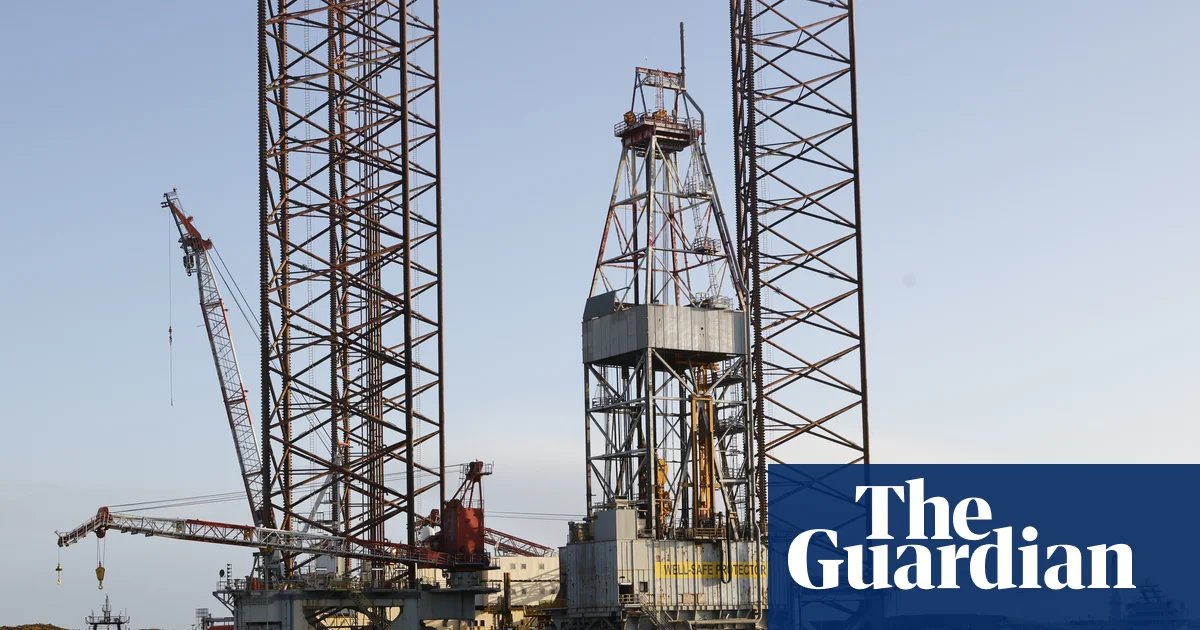
More drilling in the North Sea would do nothing to improve the UK’s energy security, former military leaders have said, as a new analysis finds no fossil fuel importer is safe from chokepoints in the global supply chain.
The government should focus on a rapid transition to a mix of wind, solar, tidal and nuclear energy to ensure the UK’s future security, the former military leaders told the Guardian, as well as a programme of energy efficiency and a “major renewal” of the electricity grid.
They made the comments as the Conservative party leader, Kemi Badenoch, launched a “get Britain drilling in the North Sea” campaign on Monday. It is the latest call from rightwing politicians and fossil fuel corporations to reverse the Labour party’s ban on new licences.
Retired R Adm Neil Morisetti, a professor of climate and resource security at University College London, said attempting to eke out the remaining oil and gas from the North Sea was “not the answer” to the challenges facing the UK.
“It will not bring down the price for consumers, nor will it deliver long-term energy security. The international markets will determine the price and destination; that is not energy independence,” he said.
Morisetti acknowledged that the UK would need oil and gas for years to come, but said the turmoil created by the wars in Iran and Ukraine had led to increasing uncertainty over supplies and rising prices.
He argued that the UK needed an energy strategy that was “focused on greater energy efficiency to reduce demand”.
“It needs to include a clear plan to rapidly transition away from fossil fuels to solar, wind, tidal and nuclear power, and a major renewal of the grid, with associated storage, to support the distribution,” he said.
A separate report from the E3G thinktank warns that “structural chokepoints” in the global supply of oil and gas mean that increasing the supply of fossil fuels anywhere will not improve a nation’s security. It says disruptions can arise from physical blockages to a small number of existing supply routes, but also from “paper chokepoints”, including the withdrawal of insurance.
The report says reducing a country’s reliance on oil and gas – through electrification, efficiency, grids, storage and domestic clean energy – provides the most durable way to reduce exposure to chokepoint risk.
Maria Pastukhova, a senior policy adviser at E3G, said: “Energy systems are a backbone of national security, but for many importers, that backbone depends on infrastructure and routes far beyond their control. Reliance on distant supply chains and chokepoints means disruption risk is built in. Clean energy systems are not immune to shocks, but they shift more of the system under domestic control and reduce exposure to geopolitical and market volatility. That is the strategic energy security lesson from this crisis.”
The Guardian reported on Saturday that hundreds of new North Sea licences granted by the Conservatives between 2010 and 2024 had so far produced just 36 days of gas, according to research by the energy transition campaign group Uplift and the energy consultancy Voar.
Tessa Khan, the executive director of Uplift, said this underlined the irrelevance of calls to “max out” the North Sea, describing them as “vapid, political game-playing at the expense of ordinary people”.
Lt Gen Richard Nugee, a retired army officer who held several key posts during his 36-year military career, told the Guardian that what had happened in Spain in recent months “was illustrative”.
“The majority of the time [the Spanish] electricity price is no longer set by fossil fuels but by renewables. The net effect is that they are less affected by the straits of Hormuz, and more prepared to stand up to President Trump,” he said.
Nugee said that was “a real case of sovereignty not dependency”, adding: “Going for gas is both lengthy and finite and dependent on factors outside the country’s control. Going for renewables gives greater independence, greater sovereignty, less vulnerability to attack and more opportunity.”
Amid growing calls for the government to row back on its ban on new North Sea oil and gas licences in recent weeks, experts point out that the North Sea is a “mature basin”, with its output declining by 75% since its peak. Issuing new licences would not bring down UK bills and would make almost no difference to gas imports in the short or long term.
Khem Rogaly, a co-director at the Transition Security Project, said relying on “expensive and volatile fossil fuels – with prices set by global markets we can’t control – makes British families vulnerable to shocks from US-led oil wars”.
He added: “Green energy delivered through public ownership can protect us from energy shocks while helping the UK develop a foreign policy independent of coercion by the US and its ‘energy dominance’ agenda.”
James Meadway, the director at the economic policy thinktank Verdant, said: “What is being revealed by the Iran war is that large, centralised systems are vulnerable to attack – most dramatically in the form of actual drone and other missile strikes, but also more subtly in forms of hybrid warfare and cyber-attack. Cyber-attacks on European power infrastructure have doubled in recent years.”
He called for more domestic solar generation, heat pumps and better insulation as part of a smaller-scale and more decentralised system. “This also applies to extreme weather events, which are obviously becoming more frequent – single, large generation systems and centralised grids are more vulnerable to extreme heat, floods and storms.”