dailynewsnblog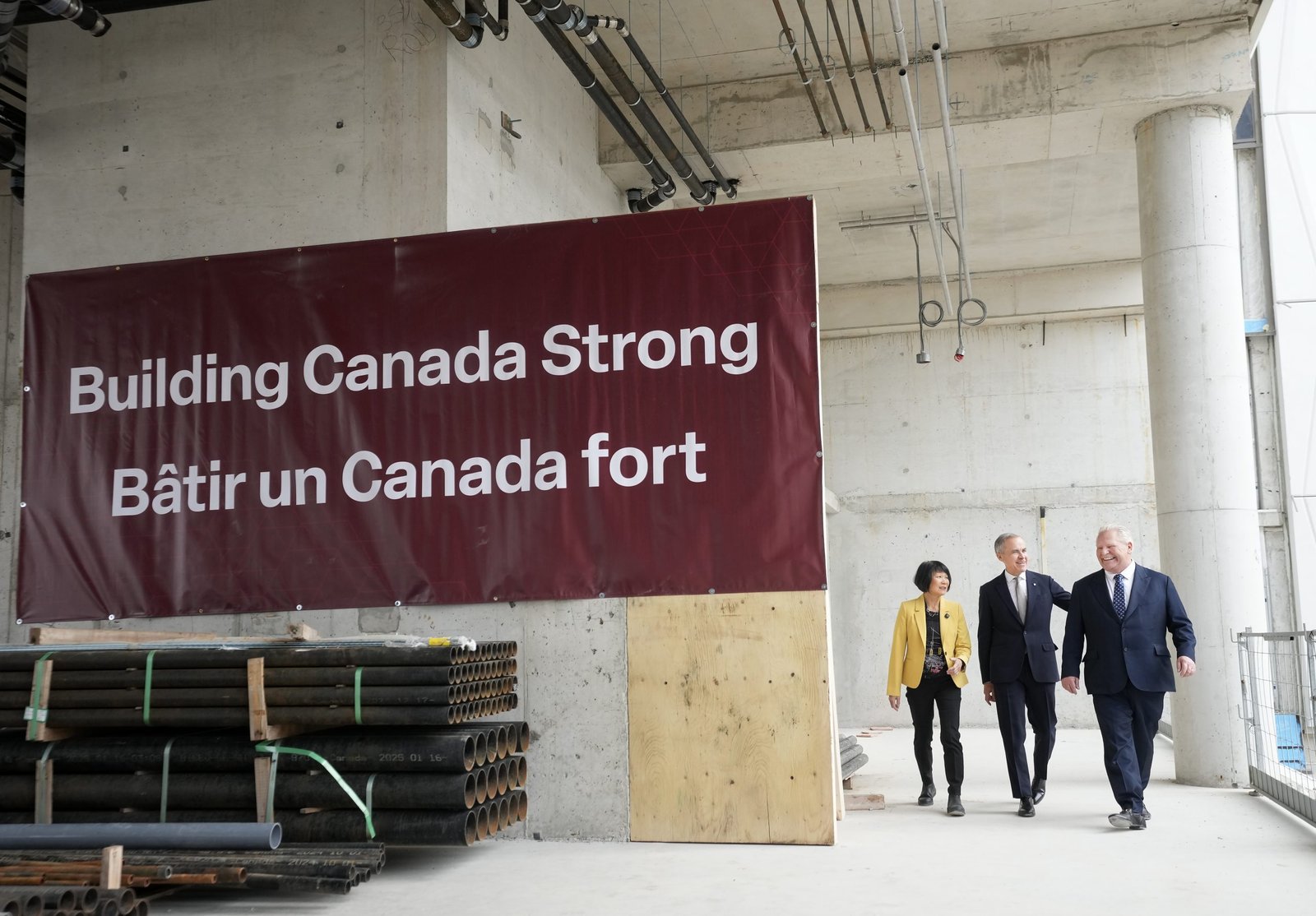
We start tonight’s evening brief with quick announcement from Prime Minister Mark Carney and Premier Doug Ford.
The federal and Ontario governments are pitching a multi-billion dollar plan to lower the upfront cost of building homes, but key questions remain about how the program will work in practice, and whether municipalities will fully buy in.
Standing in Toronto on Monday, Carney and Doug Ford announced a joint $8.8 billion commitment to offset municipal development charges, a fee widely blamed for driving up the cost of new housing.
Under the plan, both governments will each contribute $4.4 billion over the next decade through Ottawa’s new Build Communities Strong Fund. The funding is designed to allow municipalities to cut development charges by up to 50 per cent for three years, while still receiving replacement revenue from senior levels of government.
But experts say the effectiveness of the plan will hinge on the fine print much of which has yet to be released.
Barbara Patrocinio has more.

After a decisive leadership win, Avi Lewis says he isn’t planning a run for the House anytime soon.
Instead, he said he’ prioritizing talking directly with Canadians, promising to tour across the country to meet voters.
“We’re going to meet with Canadians, where they work on the shop floor, where they live in communities — we’re going to keep touring and travelling the country,” Lewis said at his first press conference as NDP leader on Monday.
“When the caucus and I feel that the party is at a point where I’m needed in the House of Commons, I will look for the first available, winnable seat and that moment is not now.”
Lewis won a first-ballot victory on Sunday with a platform built on affordability and a strong stance against fossil fuel development to address climate change.
At the same press conference, Don Davies — who was serving as the interim leader prior to this weekend’s convention — said the caucus is “100 per cent united” behind Lewis, and vowed to present a truly progressive alternative in the Commons.
More from Sydney Ko.

Also, the Indigenous Services Minister Mandy Gull-Masty says she’s reflecting on plans for promised stand-alone legislation on the second-generation cutoff, but wouldn’t provide a timeline for when to expect the bill.
She told reporters in Ottawa on Monday that she wanted to respect those communities that have called for changes to the policy, promising more details will be shared in near future.
“I’m having a reflection, and I’m hoping to bring forward what I intend to do as a minister very shortly,” she said in a response to a question from iPolitics.
Her comments comes as the government seems poised to request an extension to a court order to make changes to registration rules under the Indian Act.
A B.C. court last year gave Ottawa until April 2026 to extend status to First Nations people whose ancestors were enfranchised, but legislation that would make those changes is slowly progressing through the House of Commons. Bill S-2 was first introduced in the Senate, and passed in the Upper Chamber after it was amended to replace the second-generation cutoff with a one-parent rule.
Marco Vigliotti’s got this one.
In Other Headlines
Internationally
Elsewhere, the U.S. Homeland Security Department has lifted its total ban on reviewing asylum applications, though the pause remains in effect for about 40 countries.
The Trump administration in November paused the processing of some four million asylum applications filed to the U.S. Citizenship and Immigration Services, the agency that oversees the processing of applications for visas, naturalizations and asylum. The pause came as a part of a slew of restrictions on immigration after an Afghan national shot two National Guardsmen in Washington, D.C., on Nov. 26, 2025. One of the Guard members died the next day from her injuries.
At the time, the Trump administration called the move a national security necessity. Then-DHS Secretary Kristi Noem said the pause was indefinite while the agency figured out how to work through its backlog of nearly 4 million cases.
The hold on processing will remain for three dozen countries that have been labeled as “high risk” and have travel restrictions to the U.S. The list includes mostly countries in Africa, as well as Iran, Afghanistan, and Syria.
NPR has more.
Israel’s parliament, the Knesset, has passed a controversial bill that will instruct military courts to impose the death penalty on Palestinians convicted of killing Israelis in acts of “terror”, but will not impose the same penalty on Jewish Israelis convicted of kiling Palestinians.
The law, which enters into effect within 30 days, was approved on Monday in the 120-seat Knesset by 62 lawmakers, including Prime Minister Benjamin Netanyahu, with 48 voting against it and one abstention.
Its passage marks a major victory for Israel’s far right, with National Security Minister Itamar Ben-Gvir having pushed for its enactment as one of the main conditions of his Otzma Yehudit (Jewish Power) party’s coalition agreement with Netanyahu.
The Palestinian Authority called the bill “a war crime against the Palestinian people”, saying that it breached the Fourth Geneva Convention, “particularly the protections it guarantees for individuals and the safeguards for fair trials”.
Al Jazeera’s got this one.
In Other International Headlines
The Kicker
Elsewhere, in a plotline that feels ripped straight from late-night Reddit threads and maybe even the ‘Twilight Zone,” U.S. Vice President JD Vance is making headlines for his take on UFOs. Or rather, what he thinks they aren’t.
In a weekend podcast appearance, Vance said he’s “obsessed” with digging into unidentified aeireal phenomenona, but added he doesn’t believe they’re aliens at all. Instead he frames them as “demons” or “celestial beings.”
This is the kind of comment that lands at the intersection of national security, religion, and internet conspiracy culture, as Washington gears up for a potential release of long-promised UFO files. Whether that brings answers or just more questions remains very much up in the… air.
Find out more from The Guardian.