Oil price shocks usually lead to a recession


Stock market bulls should show a little more caution, given how past oil price shocks have impacted the economy.

Every US recession, excluding the COVID-19 pandemic, was preceded by an oil price shock, BCA Research chief global strategist Peter Berezin said in a new note (see chart below).

“The current macro environment is a toxic brew of many of the same vulnerabilities that haunted the global economy in the lead-up to past recessions: Rising oil prices, an unsustainable tech capex boom, elevated equity valuations, excessively high homes prices, and brewing stresses in private credit and other parts of the financial system,” Berezin wrote.

He added, “Stocks look increasingly oversold in the very near term but will still finish the year below current levels.”

The gray bars in this graph indicate periods of recession during oil price spikes dating back to 1970.
The gray bars in this graph indicate periods of recession during oil price spikes dating back to 1970. · BCA Research

Read more: How oil price shocks ripple through your wallet, from gas to groceries

Since the launch of Operation Epic Fury on Feb. 28, global oil prices have undergone their most violent surge since the 1970s. The conflict triggered a de facto closure of the Strait of Hormuz, a vital route for 20% of the world’s daily oil supply, causing an immediate and massive “war premium” to be baked into every barrel.

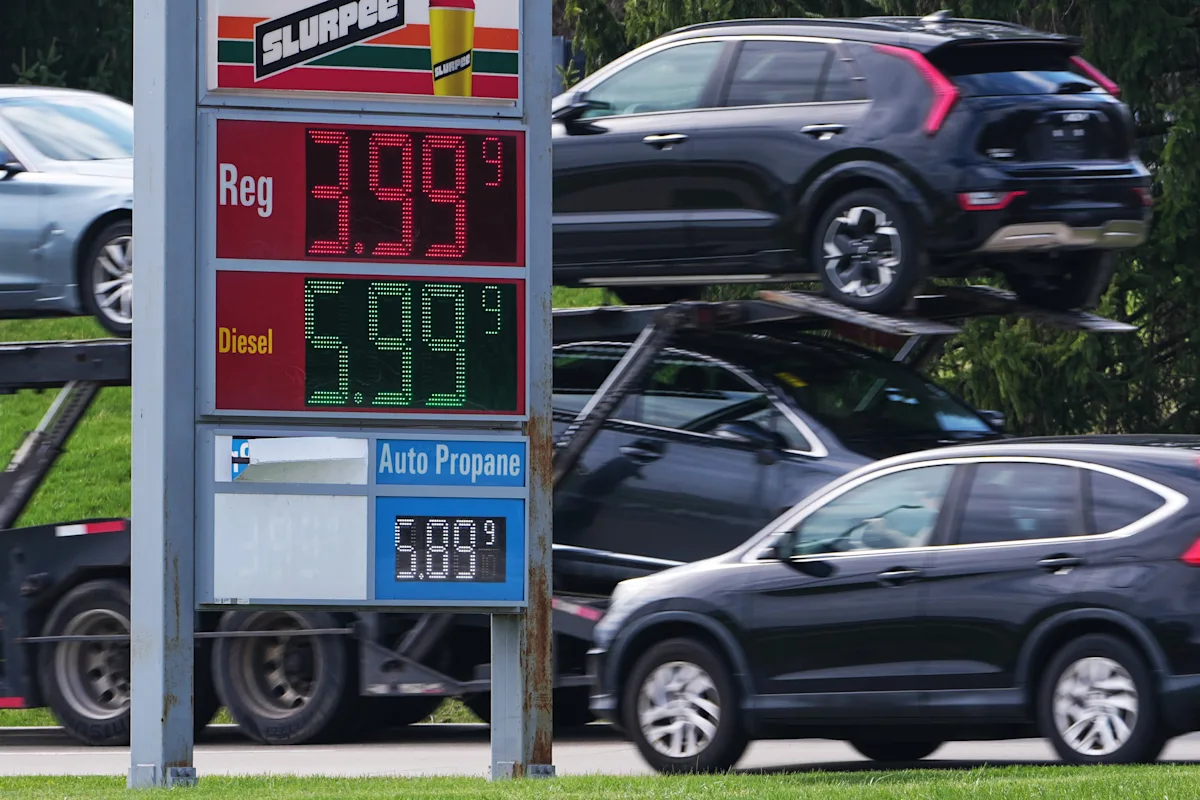
Brent crude oil (BZ=F) prices are up 45% to more than $100 per barrel, with Citigroup not ruling out $150 per barrel. US gas prices have, on average, crept up to $4 per gallon.

“[Higher gas prices are] absolutely recessionary in the short term,” former Trump administration insider Gary Cohn said on Yahoo Finance’s Opening Bid.

“There’s nothing more instantaneous to a consumer than standing there holding down the gas nozzle and watching the numbers tick on the pump,” he said. “And if they were paying $80 a week ago, and they’re paying $85 this week, and they were paying $60 a month ago, they know that ‘I lost $20 of disposable income in filling up this tank of gas,'” Cohn added.

Read more: What an extended war with Iran could mean for gas prices

A vehicle passes a gasoline price board at a filling station in Philadelphia, Friday, March 27, 2026. (AP Photo/Matt Rourke)
A vehicle passes a gasoline price board at a filling station in Philadelphia on March 27, 2026. (AP Photo/Matt Rourke) · ASSOCIATED PRESS

Numerous cracks in the economy and markets — in part triggered by surging oil prices — have begun to surface.

The University of Michigan’s preliminary consumer sentiment reading for March fell to 55.5, its lowest level of 2026. Interviews conducted before the strikes on Iran showed rising consumer optimism, but the data collected in the nine days following the military action “completely erased” those gains.

Expectations for personal finances fell 7.5% nationally, a drop that stretched across all income levels and political affiliations. Meanwhile, flash PMI manufacturing surveys for March indicate a sharp slowdown in activity.


The nonfarm payrolls report for March, set for release on Friday, is expected to show only 65,000 jobs created in the month. Experts are bracing for another negative surprise, similar to February’s print.

As of Mar. 29, the S&P 500 (^GSPC), Nasdaq Composite (^IXIC), and Dow Jones Industrial Average (^DJI) have all officially entered correction territory, each down at least 10% from their recent record highs. The Nasdaq was the first to succumb, on Mar. 28.

Economically sensitive restaurant stocks such as McDonald’s (MCD) have tanked over the past month amid indications that cash-strapped consumers are cutting back on visits.

“On the demand side, the high-frequency data from early March appears to be showing industry slowdown, and we think it is reasonable to interpret that as incremental pressure on a low-income consumer who was already stretched and spends on gas disproportionately more as % of income,” Bernstein restaurant analyst Danilo Gargiulo said in a note.

Brian Sozzi is Yahoo Finance’s Executive Editor and a member of Yahoo Finance’s editorial leadership team. Follow Sozzi on X @BrianSozzi, Instagram, and LinkedIn. Tips on stories? Email brian.sozzi@yahoofinance.com.

Click here for in-depth analysis of the latest stock market news and events moving stock prices

Read the latest financial and business news from Yahoo Finance


Source link

  • Related Posts

    Soybean Oil Surges With Iran War Adding to Biofuel Tailwinds

    The soyoil jump comes after the White House on Friday unveiled long-awaited biofuels blending standards that increase requirements for fuels made from crops. The mandate “materially increases biomass-based diesel demand…

    NASA prepares for Artemis II launch after delay

    IE 11 is not supported. For an optimal experience visit our site on another browser. Now Playing NASA prepares for Artemis II launch after delay 00:50 UP NEXT Usha Vance…

    Leave a Reply

    Your email address will not be published. Required fields are marked *

    You Missed

    Second Life Podcast: Priscilla Tsai

    Second Life Podcast: Priscilla Tsai

    New Mortal Kombat Kollection in 4K Now Up for Preorder

    New Mortal Kombat Kollection in 4K Now Up for Preorder

    Air Canada CEO to resign after backlash to video tribute of pilots killed in crash | World news

    Air Canada CEO to resign after backlash to video tribute of pilots killed in crash | World news

    Air Canada CEO to step down later this year in wake of criticism over lack of French

    Air Canada CEO to step down later this year in wake of criticism over lack of French

    Soybean Oil Surges With Iran War Adding to Biofuel Tailwinds

    April 4 – Bathrooms Bathrooms Bathrooms

    April 4 – Bathrooms Bathrooms Bathrooms