dailynewsnblog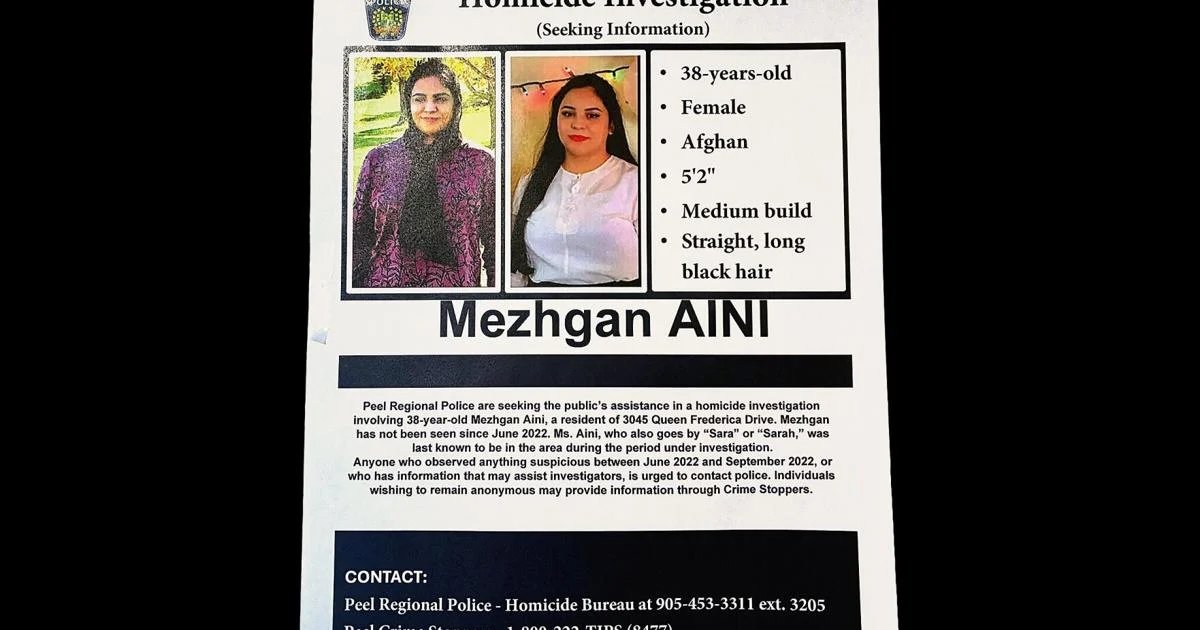
Mezhgan Aini had a husband and three children she cared about, family in Afghanistan who she talked to regularly, and a thriving seamstress business in Mississauga.
Mezhgan, 38, was reported missing by her sister in August 2025. Seven months later, Peel police issued a news release: The probe into her disappearance was now a homicide investigation.
The Star spoke to acquaintances in Mississauga, Peel police and Mezhgan’s sister and reviewed immigration hearing records related to the Aini family’s move to Canada, to piece together an account of Mezhgan’s last known movements in the case of a woman who touched many lives before suddenly vanishing.
Speaking to the Star from her home in Germany through an Afghan interpreter, Mezhgan’s sister Benafsha Ahmadi, 31, told the Star that before she disappeared Mezhgan spoke to her mother in Afghanistan about plans for a relative’s upcoming engagement party. It was the last time they would hear from her.
Police were in touch with the family early this month.
“They have not yet shared the full details with us,” Ahmadi said. “They have not told us exactly when, where, or how it happened.”
Mezhgan went missing five years after relocating to Mississauga from the United States. The family had sought refuge in Canada in August 2017, shortly after her husband was fired from his job as a counsellor to the Afghan Permanent Mission at the United Nations in New York City, following an incident where his wife was treated in hospital for injuries she sustained at their New York home, court records say.

Peel police say Mezhgan Aini was last seen in the vicinity of her Queen Frederica Drive apartment complex in June 2022.
Jason Miller
Police have identified a suspect
Mezhgan was last seen in June 2022 in the vicinity of her Mississauga home where she lived with her husband, Mohammad Yama Aini, and three children, now ages nine, 14 and 17, police said. She was not reported missing until August 2025.
Police have confirmed that they have identified a suspect but won’t provide additional details.
“Sometimes we still hope that maybe this terrible news is not real,” Ahmadi said, her calm demeanour concealing a tortured sadness over being so far away and cut off from her sister’s family.
She explained that in the summer of 2022 after all attempts to contact Mezhgan failed, her family contacted her sister’s husband, Mohammad, to ask him what happened to her, but as the months turned into years and they were unable to find out if Mezhgan was OK, Ahmadi said she decided to contact police.
Ahmadi said the police shared her phone number with her 17-year-old niece, but the family was only able to speak to her a few times, first via text, then on a call. During those conversations Ahmadi said her niece didn’t share much but said that she and her siblings were fine and in school and that she didn’t know where her mother had gone. Contact with her abruptly stopped in February.
Ahmadi said her sister was a “very kind and talented woman,” who sewed and enjoyed painting since they were children growing up in Afghanistan.
Residents at the Mississauga apartment building where Mezhgan lived with her family, told the Star that police have been canvassing there since the case was made public this month. Several Peel police posters with Mezhgan’s picture and information about the investigation were posted in the lobby.
When the Star visited the Aini family’s Mississauga apartment recently, the oldest of the three children answered the door and told a reporter that her father was not home.
When reached by phone minutes later and asked about his wife’s disappearance Mohammad responded “I’m sorry, I can’t talk,” before ending the call. Mohammad then sent a text message saying that “I appreciate you understanding our situation, which doesn’t allow me to have a conversation at the moment.”
‘Unlike the person that we knew’
Yaseen Mohammad said Mezhgan became his wife’s go-to seamstress after the two women connected at a Mississauga clothing store where Mezhgan worked in 2021.
Police have said that Mezhgan was a talented seamstress, who worked in the Afghan clothing industry. She worked primarily from home and had private clients, but also worked at stores in the area, police say.
Yaseen said by 2022, Mezhgan was working from home and his wife would bring clothing there for alterations. He said he accompanied his wife to several of those appointments. Mezhgan worked on her sewing machine in the bedroom of the modest apartment she shared with her husband and children, he said.
“She would do everything from just regular alterations to making whole dresses from scratch for formal events,” Yaseen said.
Mezhgan’s business was thriving.
“She had lots of clients,” he said. “She was getting a lot of traction with her business just because of how well she worked and she was doing well for herself.”
He said Mezhgan’s husband would usually be home when his wife attended appointments at the Aini’s home. The children were there as well.
Yaseen said Mezhgan was a person who “thought about her children and having a better home and trying to grow her business.”
He said in June 2022, his wife had dropped off some clothing to Mezhgan for alterations but several days passed and they did not get the typical follow up call from her. Attempts to contact her by phone went unanswered. He said that several weeks later, he and his wife received a call from Mohammad asking them to come and pick up their unfinished clothing.
“We got notified by the husband to come pick up your stuff because she’s not here anymore,” Yaseen said.

Benafsha Ahmadi, the younger sister of Mezhgan Aini, shared a picture of Aini that was taken after the couple relocated to Canada in 2017.
Submitted
No explanation was given for Mezhgan’s abrupt absence, he said, adding that at the time he and his wife were annoyed at what they thought was Mezhgan’s lack of professionalism.
“That’s unlike the person that we knew.”
Three years later they saw news reports about her.
“It’s really sad and it bothers us a lot,” Yaseen said.
’Where is she?’
The owner of one of the Mississauga clothing stores where Mezhgan worked, who did not want to be identified out of fear of her business being targeted, said that she was a lovely woman.
“I don’t know what happened, but she’s such a nice person,” she said.
She said Mezhgan started working at the store on a casual basis in 2019, after visiting the store with her husband to look for work. At first, she said Mezhgan didn’t know much English but she was a very skilled seamstress and customers soon gravitated to her. By 2021, Mezhgan was mostly working from home and the owner of the store would sometimes refer customers who needed alterations to her, she said.
By the summer of 2022, several customers, who were unable to contact Mezhgan, called her store to inquire if she knew anything about Mezhgan’s whereabouts.
“My customers keep coming, asking me, ‘where is she’, because she’s doing a good job,” she said.
“I called her many times and no answer.”
She said Mezhgan’s “husband called everyone and said that she’s not working anymore.”
She said she didn’t get a clear answer from Mohammad when she asked him where his wife had gone.
“He said she’s busy or something,” the store owner said.
She said she didn’t realize anything was wrong until Peel police visited her store to ask her about Mezhgan’s disappearance.
Move from New York
In August 2017, Mezhgan moved to Mississauga with her three children and her husband, Mohammad, who had served as a counsellor to the Afghan Permanent Mission at the United Nations in New York City, U.S. court records say.
The month before, Mezhgan had been treated at a hospital in Queens for injuries to the side of her face. There, hospital staff, “appeared to have had concerns” about whether Mezhgan’s injuries were inflicted by Mohammad. With the help of an interpreter, Mezhgan denied that her husband had harmed her when asked by staff. He later claimed she had tripped on a broom and fell.
On Aug. 12, 2017, court records state that he was fired from his position at the UN.
Within the month, the couple had moved to Canada and filed two separate refugee claims — one for Mezhgan and her children, and another for Mohammad — citing fears of political persecution if they were to return to Afghanistan. Mezhgan and her children were approved.
Officials later denied Mohammad’s refugee status, citing a belief he had committed a “serious, non-political crime” prior to their move, “namely aggravated assault.”
The Refugee Protection Division (RPD) accepted Mezhgan’s refugee claim, finding that she “would be physically and psychologically abused by her husband and she would receive no adequate protection from the Afghani state agencies” if she were to return to Afghanistan. This finding was made despite the fact that Mezhgan testified that neither she nor her children had ever been abused by her husband, court documents say.
Court files say Mohammad had indicated that his wife suffered from depression. However, the RPD took issue with a lack of documentation to verify it. Court records show that he had claimed that on the night Mezhgan tripped over the broom and injured herself she was having “mental health issues, was restless and unable to sleep,” and fell while attempting to leave their apartment.
Mohammad’s appeal
Mohammad was granted an appeal in 2021.
In October 2022, more than three months after Mezhgan was last seen alive, lawyers for the Ministry of Immigration and Citizenship argued for the courts to set aside a decision allowing Mohammad’s appeal. The ministry’s application was dismissed by the court.
Court records from the 2022 hearing show that the Refugee Appeal Division (RAD) found that the RPD had erred in impugning Mohammad’s credibility because his efforts to provide documentation related to the 2017 incident were unsuccessful. The appeal also said claims of abuse made in media reports about the New York incident were given too much weight.
The appeal division contended that the RPD had failed to consider a 2019 psychiatric report and letter from Dr. Clare Pain, “which provided compelling, credible and reliable evidence that the husband did not commit a serious, non-political offence,” during the 2017 incident. Pain confirmed that she had been meeting with Mezhgan, who had several psychiatric assessments over a 17-month period, at the Centre for Addiction and Mental Health (CAMH). In those meetings, Mezhgan maintained that no abuse occurred. She also told the psychiatrist that “she acquired a small skin wound on the right side of her face, which bruised, and that the claimant (Mohammad) has never hurt her or their children,” according to court records.
“No such issues were found, or suspected,” Pain wrote in her report. “In fact, we have never had any concerns about any type of violence with the Aini family.”
The appeal division found that “the psychiatric report provided an objective basis for believing that the respondent did not beat or abuse his wife (in 2017), or at any time.”
The appeal division noted that Mezhgan remained consistent in her story even when she was not in the presence of Mohammad. Moreover, she remained consistent even after being granted refugee status and having the security of not being sent back to Afghanistan, court files show.
‘He left us in darkness’
Once she arrived in Mississauga in 2017 Mezhgan reached out for assistance from local newcomer settlement services, said Fauzia Khan, the settlement manager, at the Afghan Women’s Organization Refugee and Immigrant Services. Mezhgan was alone when she visited the agencies Mississauga office, Khan said.
Khan said during the COVID-19 pandemic Mezhgan was attending online video language instruction for newcomers to Canada (LINC) classes to improve her English. Staff told the Star Mezhgan attended virtual sessions sometime between 2020 and 2021.
“We haven’t seen or heard from her since,” Khan said.
Communication with Mezhgan was normal in the years following her arrival in Canada, her sister Ahmadi said, but that changed in June of 2022.
“When we asked her husband about this, he first told us that Mezhgan was not well physically and mentally and that she had been admitted to hospital,” she said. Ahmadi said she isn’t aware of her sister having mental health issues.
Ahmadi said by the summer of that year contact with Mezhgan “suddenly stopped without any explanation.”
When the family asked about Mezhgan’s whereabouts Ahmadi said her husband initially told them that she was sick and that the doctor had told her not to use her phone and that when she felt better she would call. That call never came.
“He left us in darkness,” she said.
“At that time we did not know that she was missing or that something had happened to her,” Ahmadi said.
The family’s request for a photo of Mezhgan or to speak to the children, was met with excuses, Ahmadi claims.
“From the beginning we suspected that something bad had happened,” Ahmadi said. “Still, I was always very worried about my sister.”
“Because he is also related to our family and not a stranger, we believed what he said,” she said. “Months passed, and we still had no news from my sister.”
Mezhgan, who also went by “Sara” or “Sarah,” was reported missing by Ahmadi and her siblings and parents in Afghanistan.
‘No signs of life’
Peel police Det. Kevin Robbie said the missing persons investigation was upgraded to a homicide probe after police were unable to find any indication that Mezhgan is still alive.
Investigators combed through phone and banking records, examined her social media accounts and interviewed friends and family, but “there was no signs of life,” Robbie said.
“There’s some more evidence that we’ve uncovered that we’re not releasing to the media, which has guided it into the direction of us believing there’s foul play involved,” he said.
Robbie said “we do have a suspect but we’re not releasing the persons name.”
He said Mohammad has met with police and has been co-operating with the investigation.
“We’re hoping that we can identify further witnesses that can come forward to give us some information about what the family dynamic was at the time and any further information with respect to her life,” Robbie said.
Mezhgan is described as five-foot-two with a medium build and long, straight black hair. Anyone who saw suspicious activity between June and September 2022 in the area of the Aini’s residence, near Queen Frederica Drive and Dundas Street East, is asked to contact Peel police.
“We ask the Canadian authorities to make sure justice is done,” Ahmadi said. “I hope the truth will come out.”