dailynewsnblog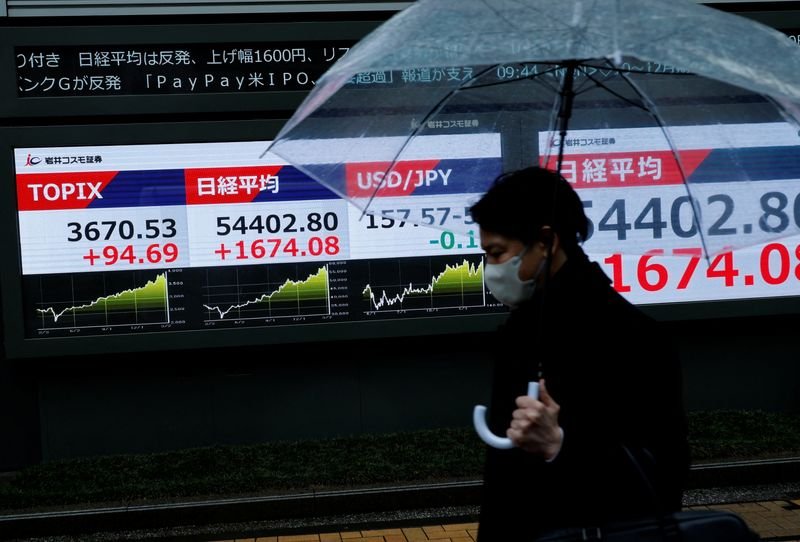
By Wayne Cole
SYDNEY, March 30 (Reuters) – Stock markets slid in Asia on Monday as investors dug in for a protracted Gulf conflict that already has oil prices heading for a record monthly rise, bringing a spike in inflation and the risk of recession to much of the globe.
Pakistan said it was preparing to host “meaningful talks” to end the conflict over Iran in coming days, even though Tehran accused Washington of preparing a land assault as the U.S. military builds up forces in the region.
The Financial Times late on Sunday quoted President Donald Trump saying the U.S. could seize Kharg Island in the Persian Gulf, from where Iran exports much of its oil, but also that a ceasefire could come quickly.
Yemen’s Iran-aligned Houthis also launched their first attacks on Israel since the start of the conflict.
“Iran’s control of the Strait of Hormuz, capacity to disrupt global energy and food markets, and sustained missile and drone capabilities give it little incentive to concede, pressuring the U.S. to escalate,” said Madison Cartwright, senior geo-economics analyst at Commonwealth Bank of Australia.
“We expect the war to run at least into June, with the risk tilted to a longer conflict.”
The clampdown on the strait has sent prices for oil, gas, fertiliser, plastic and aluminium surging, along with fuel for planes and shipping. Prices for food, pharmaceuticals and petrochemical products are all set to rise.
That is bad news for Asia, as much of the region is highly dependent on energy from the Middle East. Japan’s Nikkei shed another 3.4%, bringing losses for March to nearly 13%.
South Korea’s market was down 3.0% on Monday, while Chinese blue chips lost 0.2%. MSCI’s broadest index of Asia-Pacific shares outside Japan dropped 1.3%.
S&P 500 futures and Nasdaq futures pared their early losses to be a fraction easier. For Europe, EUROSTOXX 50 futures and DAX futures both fell 0.7%, while FTSE futures dipped 0.4%.
Brent crude rose 2.0% to $114.90 a barrel, bringing its gains for the month to almost 59% and outpacing the jump that followed Iraq’s invasion of Kuwait in 1990. U.S. crude climbed 1.8% to $101.39, making a monthly rise of 51%. [O/R]
“The longer the Strait remains closed, the sharper the drawdown in buffer supplies that could spark dramatic increases in the price of crude oil, natural gas and other commodities,” warned Bruce Kasman, global head of economics at JPMorgan.
“A scenario in which the Strait remains closed for an additional month would be consistent with oil prices rising towards $150/bbl and constraints on industrial consumers of energy supply.”