dailynewsnblog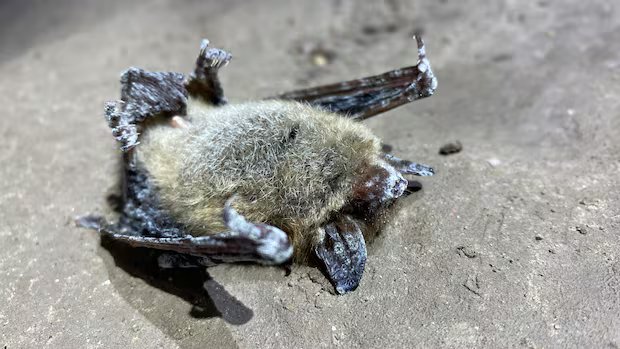

Listen to this article
Estimated 6 minutes
The audio version of this article is generated by AI-based technology. Mispronunciations can occur. We are working with our partners to continually review and improve the results.
A deadly fungus that has decimated bat populations across North America continues to proliferate in Alberta.
White-nose syndrome has been detected in the Rocky Mountains of Alberta for the first time, indicating a significant spread of the devastating disease since it was first confirmed to be in the province in 2024.
In North America, more than 6.7 million bats have died after being infected since 2006, according to the Center for Biological Diversity.
The disease is caused by a fungus that infects the mammals’ skin during hibernation. Rather than killing bats directly, the disease forces bats to awaken from hibernation, leading to starvation, dehydration and ultimately death.
The fungus that causes white-nose syndrome was detected in Alberta for the first time in 2022. Confirmation by the province of the disease’s symptoms followed two years later.
Evidence of white-nose syndrome was found in three caves in the Rockies during surveys by the provincial government and Wildlife Conservation Society Canada this year.
That includes the caves in Camodin and Wapiabi, both in central Alberta. Once popular with caving enthusiasts, both caves have been closed to the public by the provincial government since 2010 in an effort to stop white-nose syndrome from infecting bats hibernating there.
To discourage visitation, researchers say the location of the third cave won’t be disclosed.

“It’s not good news,” said Lisa Wilkinson, provincial bat specialist with Alberta Environment and Protected Areas.
Last year, a population survey in an Alberta bat habitat found an estimated population decline of 80 per cent.
“In eastern North America, where they have had large cave systems and they’ve been able to do pretty decent counts, they found the population declines of 90 per cent, 95 per cent or more. So, it’s not surprising,” Wilkinson said.
White-nose syndrome has infected bats in every Canadian province except British Columbia, where the fungus that causes the disease has been detected, but has not been found in any bat populations. The disease has also infected bats in at least 40 U.S. states.

Detections of white-nose syndrome symptoms in bat populations are a significant development compared to simply finding traces of the fungus.
“In low levels, the fungus doesn’t trigger the disease. We hadn’t seen any of the negative impacts, but obviously, over this last year, the fungus has grown and proliferated, and now it’s definitely affecting the bats and causing white-nose syndrome,” Wilkinson said.
“And to be honest, I wasn’t expecting it to be that bad. So, it was a bit of a surprise, and it’s a very hard thing to see as a biologist, right? You care about about the species you’re studying.”
WATCH | Alberta using probiotics in attempt to save declining bat population:

The province is using a new probiotic in an attempt to prevent a fungal disease that’s killed millions of bats across North America. (Photo credit: Jason Headley)
Last year, the province started using a probiotic treatment, which is applied via spraying bat houses during the summer.
That bacterial cocktail has shown promising results so far, including lower amounts of fungus detected on bats, as well as evidence of bats spreading the probiotic among each other.
“We can’t stop the spread of the disease, the fungus, or destroy it, or cure the disease on any kind of large scale,” Wilkinson said. “So, all the efforts are small scale to help reduce the impact of this disease.”
The province will be continuing its probiotic applications this year while capturing bats to assess their health condition.
2 bats endangered due to disease
There are nine species of bat in Alberta. The three that migrate south for the winter aren’t known to be susceptible to white-nose syndrome, while the six that hibernate in the province are. That includes the little brown bat and northern myotis, both of which are considered endangered by the federal government.
“Any bats that hibernate … are going to be vulnerable to this disease,” Wilkinson said. “So, we expect they’re all going to decline.”

Wilkinson acknowledged that complete eradication of the disease is unlikely, but that doesn’t mean there’s no hope.
“If we can get a few more bats to survive through the hibernation period without developing the disease, and coming back out and reproducing, we’re going to help reduce the impact of this disease and the population decline,” she said.
Getting help from the public
Cory Olson, co-ordinator of the Wildlife Conservation Society Canada’s Alberta Community Bat Program, says the public has a part to play in helping conserve the province’s bats.
For example, landowners can report bats roosting on their property, to help scientists and conservationists better understand the province’s bat populations.

Cadomin Cave is the largest known hibernaculum in Alberta. The cave has been closed to the public for more than a decade but, once a year, a small team of researchers slip inside to complete a census of the bats hibernating inside. The annual bat count is considered all the more critical as a deadly fungus known as white-nose syndrome puts bat populations across Canada at risk.
People can also submit bat guano (feces) to the Alberta Community Bat Program, which will get it tested in a laboratory to confirm the bat species.
“We get this really useful bit of information that we can use for monitoring bats, which is really important now that we’re losing bats to white-nose syndrome,” Olson said. “And it’s also a very valuable source of information when we want to reach out to people to see if we can use [those areas] as potential sites for administering treatments that we have for this disease.”
At the foundation of those efforts is giving bats a much-needed PR boost, Olson said.
“We have to have people appreciating bats and wanting to keep them in their community,” he said. “One of our goals was to spread the messages about bats — kind of dispel some of the myths that people have that make them resistant to wanting to help these animals.”