dailynewsnblog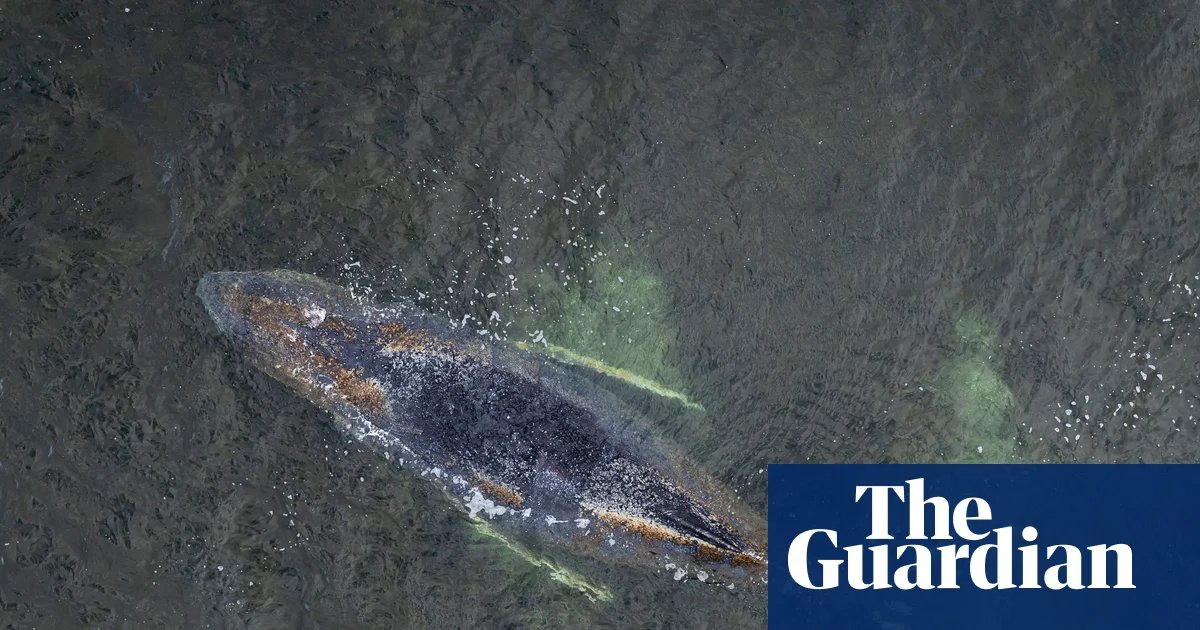
The fate of a humpback whale stranded in shallow bays off Germany’s Baltic coast hangs in the balance after several rescue attempts.
The roughly 10-metre-long (33ft) mammal appeared weakened and sick on Sunday and was struggling to find a route back to the Atlantic.
There was a 500-metre restricted area around the animal to give it a chance to rest and hopefully free itself, Till Backhaus, the environment minister of the state of Mecklenburg-Western Pomerania, told a news conference in the coastal town of Wismar.
“He would be able to do so if he regains his strength, and that is why we decided to leave him alone, allowing him to actually set off and then successfully leave this area,” Backhaus said.
“But we also have to assume that he is weakened. And he is also sick.” It is thought a fishing net may have injured the whale.
Humpback whales are not native to the Baltic and experts suspect that the young whale, thought to be male, followed a shoal of fish or became disoriented by the noise of a submarine.
It was first spotted in the Baltic on 3 March and reported stranded on a sandbank last week. Guests of a hotel in Niendorf heard its deep moans and alerted police.
Baltic waters lack the salt concentration and type of nutrition that humpbacks need to survive in the long term.
Authorities used an excavator to deepen a channel and boats to create waves to help free the mammal, which was nicknamed Timmy, after Timmendorfer Strand beach in Wismar Bay. News alerts about the drama have captivated the German public.
The whale freed itself from a sandbank on Friday and was escorted by a flotilla of vessels that hoped to guide it through German and Danish waters to the Atlantic. However, the whale became trapped on another sandbank.
“It is very noticeable that the animal is showing significantly less activity,” Stephanie Gross, of the Institute for Terrestrial and Aquatic Wildlife Research at the University of Veterinary Medicine Hanover, told AP. “Its respiratory rate has dropped considerably. The animal is not moving. It did not react even when we drove closer.”
Burkard Baschek, the director of the German Maritime Museum in Stralsund, said the whale needed to navigate narrow straits and about 310 miles to reach relative safety. “The chances of success are relatively slim,” he said.