dailynewsnblog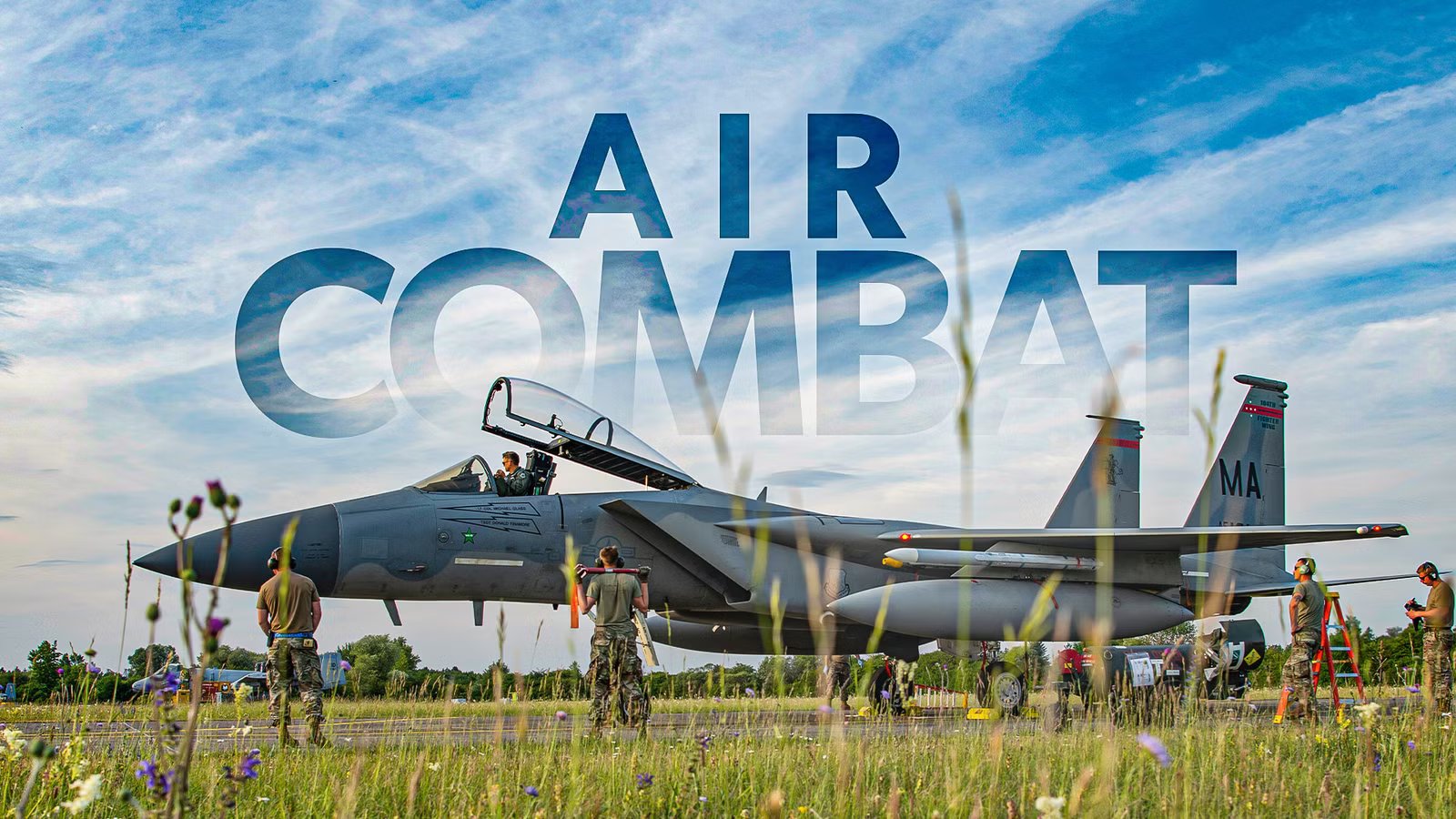
Air combat is changing faster than at any point since the transition from propellers to jets. After three decades of largely unchallenged Western air dominance, a genuine contest for the skies has returned, and the aircraft being built and upgraded today will define who wins it. From the squadrons of stealthy fifth-generation fighter jets rolling out of Chinese factories to the quiet revolution of networked warfare reshaping how Western air forces fight, the competition is global, urgent, and accelerating.
Drawing on fleet production data, open-source satellite imagery analysis, and recent operational reporting from RUSI and the Mitchell Institute, this list ranks the six aircraft that most consequentially define the future of air combat in 2026, not by raw performance figures alone, but by strategic influence, production momentum, and technological trajectory. The ranking spans four nations, three generations of fighter technology, and two sides of the most significant military aviation rivalry since the Cold War. For the US military and its allies, every aircraft here has direct implications for force structure, procurement, and doctrine.
F-15EX Eagle II
A Legendary Airframe

It would be easy to dismiss the  Boeing F-15EX Eagle II as a legacy aircraft dressed up in modern clothes. That would be a mistake. Declared operationally capable by Oregon’s 142nd Wing in July 2024, the Eagle II is built on a completely redesigned airframe rated for 20,000 flight hours, equipped with the Raytheon AN/APG-82(V)1 AESA radar, the BAE Systems EPAWSS full-spectrum electronic warfare suite, and a digital fly-by-wire flight control system. Its 29,500-pound payload capacity is the highest of any fighter in the Western inventory, nearly twice that of the F-35, and it can carry up to 22 air-to-air missiles simultaneously, more than any other US fighter currently in service.
The FY2026 defense budget tells the clearest story of how seriously the USAF takes this aircraft. The Trump administration allocated $3 billion to procure 21 additional Eagle IIs, growing the program of record from 98 to 129 aircraft, a significant vote of confidence at a time when the Pentagon is simultaneously funding the F-35, the F-47, and an expanding fleet of Collaborative Combat Aircraft. Israel signed a contract for 25 F-15IA jets in December 2025, and Boeing is proposing 54 to Saudi Arabia. Meanwhile, Boeing is already testing F-15EX interoperability with autonomous drone wingmen, giving a 4.5-generation airframe a pathway directly into sixth-generation manned-unmanned teaming doctrine.
The F-15EX sits sixth on this list precisely because it represents the most compelling argument that the future of air combat does not belong exclusively to stealth platforms. In a strategic environment where the USAF needs affordable mass alongside expensive low-observable jets, the Eagle II fills a role no F-22 or F-35 can replicate at its price point, a Mach 2.5 missile truck with the longest standoff air-to-air engagement range in the US inventory, hardened by decades of operational heritage and sharpened by the most advanced avionics Boeing has ever fitted to the type.

The F-15’s Staying Power: How A 1970s Fighter Remains Relevant In The Modern Era
More than 50 years after its first flight in 1972, the F-15 is still flying and being built.
Eurofighter Typhoon
A Clear Path To The 2060s

If you visit some major NATO exercise, chances are high that you will find Typhoons alongside F-35s, as a core element of the coalition’s air superiority package. The Eurofighter Typhoon is the backbone of the air combat fleets of the United Kingdom, Germany, Italy, and Spain, and its export roster includes Austria, Saudi Arabia, Qatar, Kuwait, and Oman, reflecting its credibility as a high-end air dominance platform. As of early 2026, the RAF alone operates 107 Typhoons in frontline service, with the drawdown of older Tranche 1 variants only beginning in spring 2025.
The upgrade trajectory is what makes the Typhoon genuinely future-relevant. The Phase 4 Enhancement program, with its system definition contract signed in 2024, will deliver new mission computers, a large-format cockpit display, the Striker II helmet-mounted sight, and the SAAB Arexis electronic warfare suite, the latter already confirmed for Germany’s 20 newly ordered Tranche 5 aircraft. Turkey signed a memorandum of understanding for 40 jets in July 2025, Spain ordered 25 more in late 2024, and Italy added 24. Production currently sits at around 12 aircraft per year, with Eurofighter CEO Jorge Tamarit Degenhardt confirming at the Paris Air Show in June 2025 that the rate would first climb to 20, and potentially to 30, contingent on export orders materializing. The type’s service life now extends to 2060 in consortium plans.
The Typhoon’s position as fifth on this list reflects the same constraint of its main rival, the Dassault Rafale: it is not a stealthy aircraft, and in high-threat environments, that matters. What separates it from its French rival on this list is scale and operational reach: more nations, more airframes, a larger industrial base, and a credible upgrade path tied directly into GCAP, the sixth-generation program shared between the UK, Italy, and Japan, with Germany publicly signaling interest in joining as of early 2026, though Japan remains cautious about any expansion that could delay development. The Typhoon is an indispensable bridge to the future.
Su-57 Felon
Proven Technology, But Production Tells A Different Story

The Sukhoi Su-57 Felon, Russia’s only operational fifth-generation fighter, has been flying real combat missions over Ukraine since at least 2022, launching Kh-69 cruise missiles and R-37M long-range air-to-air weapons from standoff range, testing new electronic warfare packages, and refining fifth-generation doctrine under real wartime conditions. By August 2025, Russia was deploying Su-57s in multi-aircraft formations, a significant operational step for a program that once struggled to put a handful of jets in the air simultaneously.
The hard numbers, however, tell a sobering story. IISS’s Military Balance 2025 listed just 22 operational Su-57s in service with the Russian Aerospace Forces, and 2025 deliveries were so constrained that analysts estimated zero to two additional aircraft were completed by year-end, with Western sanctions throttling avionics supply chains and conscripting skilled workers. Russia signed a 76-aircraft domestic contract in 2019 with a 2027 completion target; it is nowhere near on track. Flight testing of the new “Product 177” fifth-generation engine began only in December 2025, years behind schedule. Algeria is the first export customer, receiving jets in late 2025, a geopolitical signal more than an industrial milestone.
The Su-57 sits fourth on this list because its technology is genuinely relevant: a thrust-vectoring, low-observable, long-range missile platform that has been combat-tested in ways no Western fifth-generation aircraft has been. But its strategic impact is brutally limited by the scale of its production. A fleet of 20-odd aircraft does not reshape global air power. What it does is serve as a development laboratory, and the doctrine and weapons data being gathered over Ukraine will eventually feed into whatever Russia builds next.
F-22 Raptor
Remains The Undisputed Standard For Air Superiority

Twenty years into its operational life, the Lockheed Martin F-22 Raptor is still the aircraft everything else is measured against. Its combination of extreme stealth, supercruise capability, thrust-vectoring maneuverability, and integrated avionics remains unmatched in dedicated air-to-air combat. The “Raptor 2.0” modernization unveiled at the 2026 AFA Warfare Symposium adds faceted low-drag external fuel tanks and an infrared search-and-track pod, extending its combat radius to over 800 miles without compromising its very low observable signature, directly addressing the Indo-Pacific range problem.
But the Raptor’s defining characteristic is also its deepest flaw: there are not enough of them. Congress capped production at 187 aircraft in 2009, leaving the USAF with a combat-coded fleet of roughly 142 Block 30/35 jets as of 2026. At an operating cost of $85,325 per flight hour and a mission-capable rate that dropped to 40% in 2024, the math is punishing. Discussions are ongoing about upgrading 32 to 35 Block 20 training variants to combat code, which would push the usable fleet toward 178, but it would not get the Air Force anywhere near the 750 airframes it originally wanted.
The F-22 ranks third because it represents both the ceiling of what dedicated air superiority engineering has produced and a cautionary lesson about what happens when a program is killed too early. Its ongoing “Raptor 2.0” upgrade, costing roughly $8 billion, is proof that the Air Force still considers it irreplaceable until the F-47 arrives in meaningful numbers in the 2030s. The Raptor defines the benchmark, while the J-20 and F-35 define what comes after it.

How Lockheed Martin Fighters Stack Up Against Each Other In 2026
Lockheed Martin’s fighters continue to define the shape of Western airpower, but how do the F-22, F-35, and F-16 compare in evolving scenarios?
J-20 Mighty Dragon
Rewriting The Balance Of Power In The Pacific

The number that matters most in contemporary air power is not a performance figure — it is 300. That is approximately 300 J-20 Mighty Dragons are in service with the PLAAF by late 2025, according to analyst J. Michael Dahm of the Mitchell Institute, presenting satellite imagery data at the 2026 AFA Warfare Symposium.
Production has accelerated to an estimated 100–120 aircraft per year, and a RUSI assessment projected China could field 1,000 J-20s by 2030, a fleet that would dwarf the entire US F-22 program and approach the F-35 fleet in scale, with a jet optimized specifically for air-to-air combat. The J-20’s technology is evolving as fast as its numbers. The J-20A variant, displayed publicly in September 2025, features a redesigned fuselage section behind the canopy that reduces supersonic drag and accommodates new avionics. The indigenous WS-15 engine, finally entering serial production, gives the J-20A genuine supercruise capability. The two-seat J-20S, which debuted at Zhuhai in 2024 and appeared at China’s September 2025 military parade, adds a dedicated mission commander in the rear seat to control drone swarms and EW systems — making it the world’s first two-seat stealth fighter in operational service.
The J-20 sits second because it is the most credible peer threat Western air forces have faced since the Cold War: a stealthy, long-range, increasingly numerous aircraft purpose-built to threaten the tankers and AWACS platforms on which US airpower depends. Its 1,100-nautical-mile combat range and internal carriage of the PL-15 and PL-21 missiles make it an A2/AD asset as much as a fighter. It does not rank first simply because its Western counterpart has done something the J-20 has not: proved itself in real-world coalition combat at scale.
F-35 Lightning II
The Architecture Of Western Air Power

In 2025, an F-35A of the Royal Netherlands Air Force intercepted and destroyed Russian drones over Poland, the first time NATO-operated Lightning IIs had engaged airborne threats in NATO airspace. And in a milestone that will be studied in staff colleges for years, American F-35s participated in Operation Midnight Hammer, the coalition strike against Iranian nuclear sites, performing the sensor fusion and datalink roles that define what a networked fifth-generation aircraft brings to a contested environment. In that year, we also saw Lockheed Martin delivering a record 191 aircraft in 2025 alone, pushing the global fleet to almost 1,300 jets across 12 operating nations, production five times faster than any other allied fighter currently in manufacture.
But 2026 is revealing itself as the most operationally consequential year since entering service: during the 2026 Iran Crisis, F-35s kept intercepting drones, and one Israel Defence Forces F-35I “Adir” shot down an Iranian Yakovlev Yak-130 aircraft. Where the J-20 represents one nation’s air power, the F-35 represents a coalition’s. Twelve nations, including the US, UK, Japan, Australia, Norway, and the Netherlands, fly the same platform, share the same software updates, and train together to the same doctrine. An F-35 over the North Sea and one over the Pacific are nodes in the same network, and the TR-3 software completion in 2025 deepened that integration still further. The ongoing Block 4 upgrades continue to expand the jet’s electronic warfare and anti-ship capabilities, ensuring the platform evolves faster than any single-nation competitor can track.
The F-35 is not the fastest, the most maneuverable, nor the stealthiest aircraft in the sky: it sits in first position because it has already changed the way wars are planned, alliances are structured, and air forces are built. No other aircraft in service today operates at the intersection of technology, coalition integration, and the industrial scale that the Lightning II occupies. The future of air combat is not a single aircraft, but if it had to be, it would look a great deal like this one.