dailynewsnblog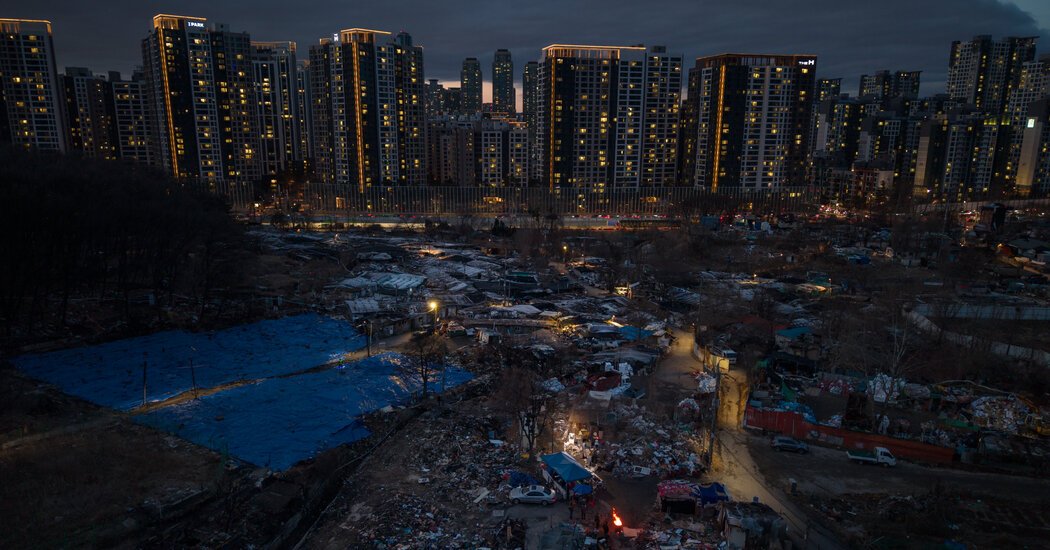
Lee Chang-wol lives on a sliver of some of the most coveted real estate in Seoul, in the city’s rich Gangnam district.
But her life does not exude any of the glamour of “Gangnam Style,” the K-pop smash that gave the upscale area global fame. For nearly four decades, she has made her home in a cramped, one-room hut that does not even have a toilet.
Ms. Lee, 85, lives in Guryong Village, a shantytown in the shadow of gleaming new towers, where a typical three-bedroom apartment costs the equivalent of $2.6 million. The city government, which is trying to clear the slum and develop the land, has offered $3,300 for her hut and told her to vacate by mid-June or face eviction. She has rejected the offer.
“I don’t know where I will end up when I leave this place,” Ms. Lee said. “Just living today is hard enough.”
The story of Guryong, a 71-acre, unauthorized settlement surrounded by some of the country’s richest people, symbolizes the yawning economic gap in Seoul and the struggle the poor face to own a home.
South Koreans invest their life savings in homeownership because housing prices, especially in Seoul, have risen faster than wages. And nowhere have apartment prices spiked faster and higher than in Gangnam. Owning a Gangnam apartment is synonymous with wealth and smart investment.
On a recent March day, Ms. Lee made her way down an alley so narrow that people must walk single file, ducking beneath frayed roofing and tangled electrical wires that drooped from low-slung huts on either side. Using a walker, she shuffled toward her windowless home, accessible only through a cramped threshold just a few feet wide, which doubled as her kitchen and washroom. Towering over her village, just across an eight-lane road, rose a wall of gleaming new apartment buildings.
When night fell, the towers glowed brightly while darkness shrouded Guryong, except for weak lights from some of the huts and a red neon cross shining from a village church. Smoke drifted from burning trash and coal briquettes.
Since 2023, Seoul has asked 1,107 households squatting there, some for four decades, to move out. Hundreds have left for subsidized temporary housing, and the city has promised to rent some of the 3,800 apartments to be built there to the area’s original residents.
But hundreds stayed put, demanding better terms. Some complain that the compensation offered for their shacks is too low to cover the rent for the new apartments in Guryong when it is redeveloped.
The city plastered Guryong with notices urging its residents to leave. But villagers erected a watchtower at its entrance, festooning it with defiant banners in red, black and yellow.
“We have lived here for 40 years. Recognize that!” one of them said.
To some, these people are greedy squatters holding prime real estate hostage. To others, they represent those left behind by South Korea’s meteoric economic growth taking their last stand for a chance to own a home in the neighborhood they built.
The village was created when South Korea began clearing out slums in central Seoul, on the other side of the Han River, in a race to beautify the city as it prepared to host the 1988 Olympics. Slum communities clashed violently with developers who moved in with heavy equipment, riot police or even gangsters; several people being displaced killed themselves.
The government later changed its tack, offering compensation for those being evicted from their homes.
Away from the center, new shantytowns sprouted in undeveloped areas like the Guryong valley. Squatters built makeshift shelters with salvaged materials — sometimes with the landowners’ permission, often without. Speculators followed, illegally erecting rudimentary housing and selling it to incoming settlers. When squatters left, they also sold their dwellings, giving rise to an informal housing market.
The city, however, refused to register the dwellings in the new shantytowns to prevent residents from seeking compensation if or when the areas were redeveloped. During the Olympics, Seoul built screens to hide Guryong from view.
“They were made officially invisible even if they lived there,” said Lim Mi-ri, an independent researcher on Guryong’s history.
Some residents have filed lawsuits to try to force the city to register their huts as human dwellings, which would give them a legal claim to one of the newly built units and access to bank financing.
“If the places where we have lived all these years are not human dwellings, what does that make us — dogs and pigs?” Ms. Lee asked.
Seoul also refused to provide basic services. Power and water lines stopped at the village entrance. Families built their own lines crisscrossing the village. When it rained, streets turned into quagmires.
“My daughter came home one day and said that her classmates had poured trash on her desk because they said our family lived in a garbage dump,” said Kim Young-gi, 91.
But the city’s down-and-outs kept moving in. Shunned by the rest of the city, Guryong built its own community, complete with grocery stores, hair stylists, hardware stores, several churches and an “autonomous council” that served up to 10,000 residents in the 1990s. They eked out a living as dishwashers, day laborers and garbage collectors.
In a council meeting in 1994, they vowed to “work hard” to ensure that “our children will not inherit our poverty,” according to minutes of the meeting. In the early years, when officials came to try to evict them, they hurled human feces at them.
Today, Guryong is a shrunken version of its old self. Some roofs have caved in and weeds are growing back to swallow them. Crows from nearby hills hop among abandoned furniture and other trash. But it retains its old look.
Outhouses dot the village for people like Ms. Lee whose homes are too small to include an indoor toilet. Pots for growing vegetables, cooking gas canisters and stacks of fresh and used coal briquettes lean against the walls. Glass-wool insulation and plastic tarps cover the roofs, which are secured by used tires.
Such flammable materials have made the village prone to fires. One in January razed part of the village, forcing 180 people to evacuate.
Ko Jae-ok, 86, a retired midwife, said she had saved every penny she could, taking a taxi only three times in her life. She had invested some of her savings in rare coins and hid them under her floor. Now they are missing after the fire, which destroyed her home.
“I could not save a single piece of property,” Ms. Ko said in tears. She now lives in a communal shelter in the village.
Baek Su-hyeon, 66, a thin man with missing teeth, has been sleeping in a tent near his scorched home, rejecting the city’s offer to take $4,000 and move to a rental, which he said he could not afford long term.
“It’s like robbing people who have nowhere else to go,” he said.