dailynewsnblog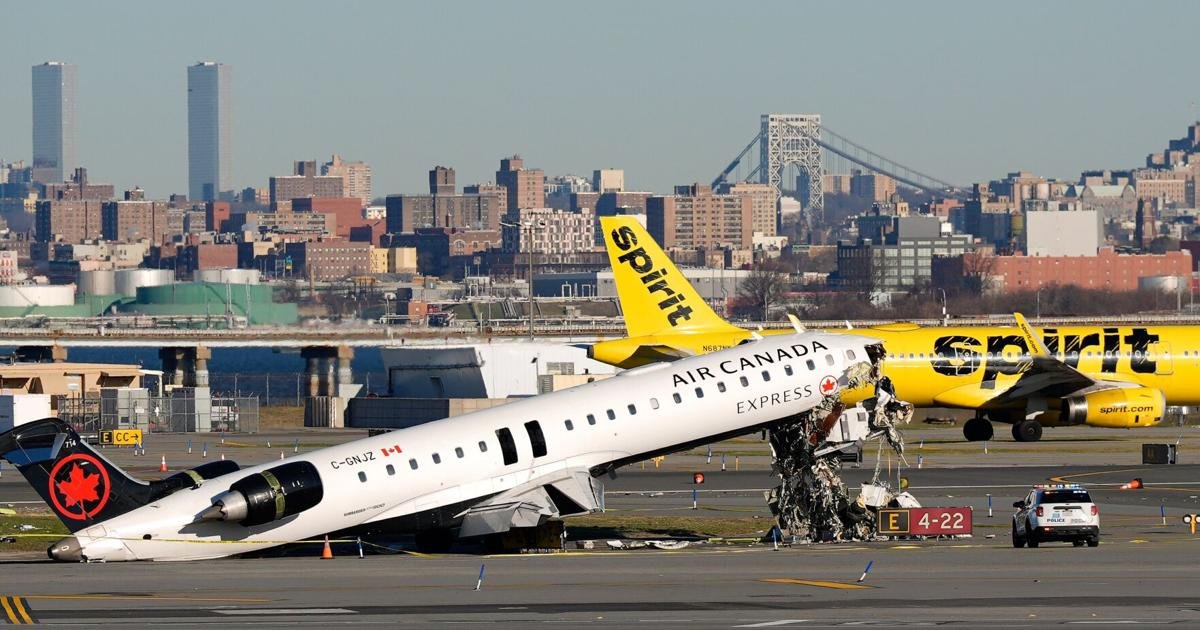
The hard braking came before anything else, a sudden push forward that slammed heads and knees into seat backs, smashing glasses and cutting foreheads, leaving imprints and bruises from where the seatbelt caught the hip and the torso. Then came the noise — a loud, terrible boom.
And with it, in an instant, the front of the plane disappeared. For a moment, there was calm. Then chaos and questions.
More than three dozen passengers and crew were hospitalized, and four remained there Friday. Two Canadian pilots — one who grew up fishing and playing Mario videogames, who learned to fly on bush planes in Quebec; another who went to high school in Ottawa, a tech-savvy kid who graduated from Seneca just three years ago and had been flying for Jazz ever since — are dead.

A memorial for Air Canada Jazz pilots Antoine Forest and Mackenzie Gunther, who perished when their plane collided with an emergency vehicle at New York’s LaGuardia Airport, in Montreal, on Thursday, March 26, 2026.
Christinne Muschi/The Canadian Press
The crash
The plane carried 76 people, including four crew members, and had been delayed nearly two hours in Montreal. It was just before midnight when they finally approached LaGuardia Airport.
The flight attendants’ carried out their typical landing speech: Re-buckle your seatbelts. Note the closest exits. Place your bags under the seat in front of you. Nothing was out of the ordinary.
Until they began to descend.
Captain Antoine Forest and first officer Mackenzie Gunther got the go-ahead from air traffic controllers to land on the runway. Finally, after their hours-long delay, they were on a “stable approach” to touchdown in New York City.
As the plane was landing, passenger Jack Cabot felt it veer left and right, like it was losing control, he told Business Insider. The 22-year-old college student put his head down between his arms and prayed.
In the darkness just before midnight, hours of rain had left a glossy sheen upon the LaGuardia runway.
In the tower, two air traffic controllers had just settled into the midnight shift. The light overnight staffing is standard practice at the airport — two people to do four jobs, a practice the National Transportation Safety Board had flagged at other airports in the past. And as the Jazz jet closed in on LaGuardia, controllers were dealing with another problem.
The aftermath of a collision between an Air Canada plane and a port authority fire truck on a runway at LaGuardia Airport in New York City.
Toronto Star with footage from Star wire servicesAnother aircraft, United Airlines Flight 2384, had already aborted takeoff twice, and now, there was an odour in the cabin. Not a smoke smell, but something weird. “Declaring an emergency,” the pilot told air traffic control. “Flight attendants in the back are feeling ill. We will need to go into any available gate at this time.”
A fire truck responding to the emergency requested to cross the runway. Within two minutes of clearing the Jazz jet to land on Runway 4, the controller gave the truck and the men inside it — Michael Orsillo and Adrian Baez — the all-clear.
“Truck 1 and company,” the controller said, “cross 4 at Delta.”
The fire truck tending to the United Airlines flight didn’t have a transponder. The key device would have alerted the airport’s safety system of the truck’s movements as it travelled around the taxiway.
The pilots likely could not have seen the truck until seconds before the collision, if at all, said Shem Malmquist, an assistant professor at Florida Tech and retired Boeing 777 pilot.
A number of factors play a role here: it was pitch dark and had been raining for hours, casting a mist over the dozens of lights lining the airport’s runways, said Philippe Doyon-Poulin, professor of industrial engineering at Polytechnique Montréal.
The cockpit voice recorder captured the moment Gunther transferred controls back to Forest, six seconds before the collision. Pilots are able to transfer controls throughout the flight but it’s unusual for it to happen after the plane has touched down on the runway — and at such high speeds.

Antoine Forest and Mackenzie Gunther have been identified as the pilots of the jet that crashed
Doyon-Poulin believes it’s possible Forest took control to try to steer the plane away from the truck.
“The minute the truck started to cross the runway,” Doyon-Poulin said, “there was nothing the pilots could do.”
“Stop, stop, stop, stop. Truck 1, stop, stop, stop,” the controller said, growing frantic. “Stop Truck 1. Stop! Stop Truck 1! Stop!”

Port Authority fire fighters and aircraft maintenance crews cut away debris from the wreckage of an Air Canada Express jet just off the runway where it had collided with a Port Authority fire truck Sunday night at LaGuardia Airport in New York.
Yuki Iwamura/AP
The fire truck likely weighed more than 30,000 kilograms, substantially bigger than city firefighting trucks, according to Louis Kurtz, an aircraft firefighting expert in Minnesota.
Meanwhile, the CRJ-900 jet was designed by Bombardier to follow the strict regulations of Transport Canada and the FAA. It would have been able to resist the impact from a bird strike or a stone hitting the windshield, TMU aircraft structure expert Zouheir Fawaz said, because that kind of damage is expected.
But it was also designed to be as light as possible, because less weight means less fuel costs. The engines, landing gear, wing structure and auxiliary power unit are heavy; the aluminum alloy panels in the nose and fuselage are light. They are only a few millimetres thick.
They were never designed to withstand a collision like this.
The truck crossed Runway 4 at Taxiway D with its lights flashing a bright red and blue, despite the controller’s panicked warnings. The plane came speeding down the runway.
Sparks, smoke and mist erupted. Hundreds of pieces of debris splattered all over the runway.
The truck appeared to roll on its side while the plane barrelled ahead down Runway 4.
The aftermath
Inside the fuselage, in a moment of chaos and panic, passenger Rachel Mariotti wondered if this was the end for her.
Then everything was still. Mariotti, sitting in the emergency exit row, turned to look at the man across from her. His head was bleeding. She began to realize the gravity of what happened, she later told FOX 5 New York.
Antoine Poncy was in seat 3F. He had been upgraded to the third row a week earlier, he told LaPresse. Looking around, he saw a woman in the front row with a mangled leg and another woman unconscious, her hair matted with blood. He tried to help her. He was relieved to discover she was still breathing.
Christopher Pal, a professor at Polytechnique Montréal, smashed his glasses on the seat in front of him, an impact that would leave him with a black eye. He asked those around him if they were injured and asked for someone to open an emergency exit, he recalled in an interview with CBC.
He didn’t know if there could be a fire. Some passengers smelled jet fuel, evaporating as it hit the elements.

Officials inspect the wreckage of a Port Authority fire truck just off the runway where it had collided with an Air Canada Express jet, Sunday night at LaGuardia Airport in New York.
Yuki Iwamura/AP
In some ways, the passengers were lucky. Fuel is stored in the wings, not near the cockpit. Had the truck collided with a wing, spilling gallons upon gallons of fuel into the air, perhaps no one would have made it out alive.
Rebecca Liquori, flying alone on the way home from her cousin’s baby shower, pulled the emergency exit open, she told News12 Long Island. Passengers slid down the wing as they fled. The wing was wet from the rain.
Liquori slid off and moved next to an emergency vehicle. Turning around, she finally saw what had happened to the plane.
The nose was gone, strewn across the runway. In its place was a dangling mess of wiring and aluminum and insulation, crumpled into an indiscriminate jumble of carnage. Within it, a door — the exit door, the one you see on your right as you stand face-to-face with the entrance to the cockpit.
Further away, passengers saw what used to be the fire truck. It was toppled, lying on its side, its body ripped apart. But its fluorescent green cab, the one Orsillo and Baez were in when they crossed the runway, remained intact.
Then Pal, helping passengers out from the emergency exit, saw the plane begin to tilt. The front end of the fuselage lifted up, just as a see-saw rotates around its fulcrum. Now, the open end of the fuselage pointed toward the sky.
The whole thing reminded Pal of a scene from a movie, of the ship sinking in “Titanic.”
Flight attendant Solange Tremblay was thrown from the plane when it crashed and found in the debris, her right leg fractured. She had worked for Air Canada for more than 20 years. Her survival, her daughter said, was a miracle.
Neither pilot survived
Forest flew his first plane when he was just 16, learning on bush planes before graduating to larger jets, his great aunt Jeannette Gagnier told the Star.
Growing up in Coteau-du-Lac, Que., Forest and his younger brother would spend their summers with Gagnier — whom they considered their grandmother — in Hawkesbury. They would fish throughout the day and curl up together to watch the television in the evenings until it was time to put the boys to bed.

Antoine Forest learned how to fly bush planes before graduating to larger jets.
Facebook
But it didn’t matter — Forest would always end up cuddled with his grandmother.
He spent a year living with Gagnier when he entered Grade 11 because he wanted to improve his English to better his chances of becoming a pilot. His efforts were successful and Forest became a pilot with Air Canada Express out of Montreal.
“He was always taking courses and flying. He never stopped,” Gagnier said.
At 16, Mackenzie Gunther started spending his summers in Ottawa working for Wahab Ghafari’s landscaping business, mowing lawns. He would keep coming back every year for nine years. Ghafari remembers him as passionate, smart and always lending a hand.
Gunther would teach Ghafari how to install lights and robotic mowers. He curated promotional materials, capturing photos and videos while flying the company’s drone. “I think he was the smartest guy I worked with,” Ghafari said.

Wahab Ghafari, centre, is pictured with Mackenzie Gunther, right, in a 2018 photo. Ghafari called him the “smartest guy” he worked with.
Wahab Ghafari
“One day, I’m going to fly Air Canada,” he told Ghafari whenever they took car rides to and from work together. And he would go on to fulfill that dream. Gunther joined Air Canada Jazz soon after graduating from Seneca College’s aviation technology program in 2023.
In the aftermath of the crash, four crew members and passengers remain hospitalized while dozens of others have already left, plagued with the memory of what happened. Many looked back to that fateful Sunday night, to Forest and Gunther’s lifesaving actions as a last act of heroism.
We won’t know what led to the tragedy for several months. The investigation is underway.
Three days after the crash, the plane was rolled into a secured hangar. The scene was cleaned up but debris remained. The runways have reopened, with almost no sign of the chaos that had taken place.
One thing remained. On Thursday afternoon, another Jazz plane took off from Newark, N.J. It flew 617 km to Ottawa, then another 205 km to Montreal. At each stop, it let off precious cargo.

Pilots line the road outside Air Canada headquarters as they wait for the repatriation of Air Canada Jazz pilot Antoine Forest, who perished when his plane collided with an emergency vehicle at New York’s LaGuardia Airport, in Montreal, on Thursday, March 26, 2026.
Christinne Muschi/The Canadian Press
In Ottawa, Gunther was carried off the plane in a wooden box by six men and received by a waiting family. In Montreal, pilots and flight staff dressed in black stood in the rain along a road not far from the runway.
They waited as the sun set, as their coats and shoes were soaked, until the cars drove by — the procession carrying the body of Antoine Forest back home.