dailynewsnblog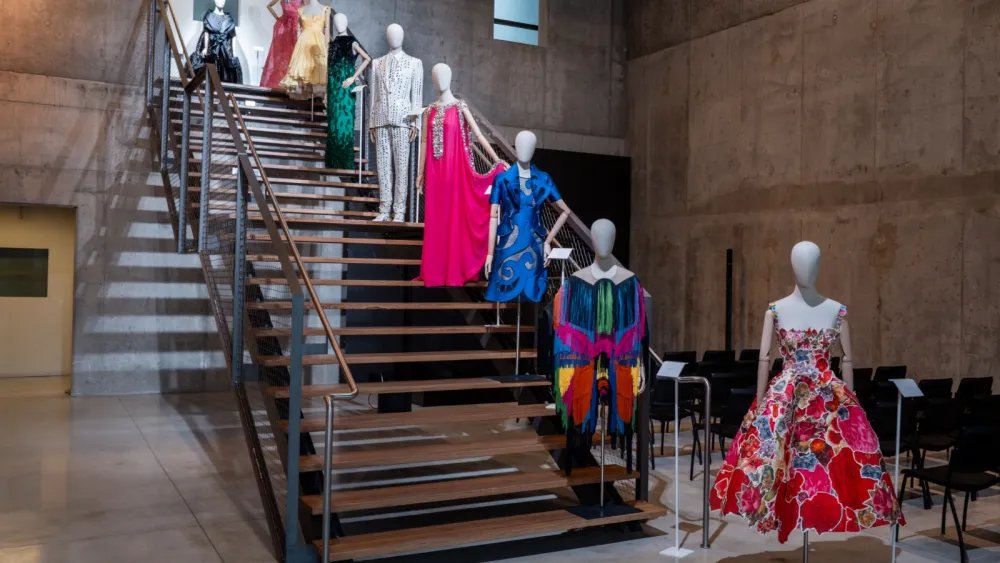
NOVENTA VICENTINA, Italy — “I was born with a needle in my hand and I will have a needle in my hand until my last day.”
Spoken by a student who is part of Staff International’s School of Craftsmanship in a short film shown at the company on Friday, the quote projected the passion that is the motor for so many young artisans and designers who wish to work in the fashion industry. There are increasingly more, according to Renzo Rosso, founder and chairman of Staff International’s parent OTB, which also comprises Diesel, Jil Sander, Maison Margiela, Marni, Viktor & Rolf and childrenswear manufacturing company Brave Kid.
Marking the 50th anniversary of Staff International and the beginning of the six-month training and professional program of its in-house School of Craftsmanship, the production and logistics company unveiled its first retrospective exhibition of 50 designs by the likes of John Galliano for Maison Margiela, Vivienne Westwood and Viktor & Rolf, among others.
Staff International, based in Noventa Vicentina, a three-hour drive from Milan, was described as the fashion group’s “jewel in the crown” by Rosso, who welcomed the minister of enterprises and Made in Italy, Adolfo Urso, along with numerous representatives from institutions and trade associations such as Carlo Capasa, head of the Camera Nazionale della Moda Italiana; Stefania Lazzaroni, chief executive officer of Altagamma, and Luca Sburlati, president of fashion association Confindustria Moda, among others.
Rosso touted the importance of Urso’s presence, which “shows how investing in these professions is a strategic leverage for the country, which accounts for more than 80 percent of the world’s luxury production.”
The strength of the Italian pipeline and production system “lies on the ability to transform an idea into an extraordinary product, thanks to the work of artisans and the dedication of our wonderful supply chain. For this reason, it is essential to educate younger generations, enhancing professions that require talent and commitment and that are capable of building the future of our country,” said Rosso.
He emphasized the value of craftsmanship and heritage but at the same time that of technology, which allows brands to raise their sustainability targets.
“Here, a unique expertise is developed, blending technical skills, creative and design insight, and knowledge of industrial processes, which are essential for turning the visions of creative directors and designers into iconic garments and accessories. At Staff International, talents are trained to interpret creativity, translate it and bring it to life.”

Students at Staff International with Carlo Capasa, Ubaldo Minelli, Renzo Rosso and Adolfo Urso.
For the first time, in 2026 the school will run two editions a year, further strengthening OTB’s commitment to developing increasingly strategic skills for the sector. One course just started this month and another will kick off in September, each with 10 students, and both will include product development, patternmaking and tailoring.
Since the launch of the school five years ago, more than 50 young talents have been trained, with over 85 percent hired within the OTB companies, underscored Rosso.
Ubaldo Minelli, CEO of OTB Group and Staff International, stressed the value of the School of Craftsmanship “because without training there can be no future for Made in Italy. It is our responsibility to support young creatives and to avoid dispersing unique skills.” At Staff International, four generations of professionals work side by side, “which helps protect an invaluable heritage of knowledge, experience and passion, passed on to young talent every day.”
Minelli said there is an increasing interest from the younger generations and, while not disclosing the amount of the investment, he pledged to continue to support the school “to guarantee continuity and fuel the system. We are custodians of Made in Italy, and we must emphasize it and project it into the future.”
Rosso saved Staff International from bankruptcy in 2000 and said that, coming from the denim industry with Diesel, ready-to-wear was always his dream.
“Staff International is a diamond, a gem that many have wanted to buy but I never wanted to part with it.”
Staff International over the years has also produced for brands including Marc Jacobs, Just Cavalli and Vivienne Westwood, among others, and still makes and distributes Dsquared2 collections. Rosso listed the designers Staff International worked with throughout its history, from Martin Margiela and Karl Lagerfeld, to Westwood, Galliano, Matthieu Blazy, Glenn Martens and Demna, to name a few.
“They all passed through here — imagine what kind of mark they left and we transmit this know-how to the students, in addition to our technology and innovative techniques,” he said, speaking in front of some of the looks designed over the years and on display. Cue the Marni hourglass floral dress by Francesco Risso worn by Simona Tabasco from “The White Lotus” at the Emmy Awards in 2004, for example, or the experimental pieces by Galliano for Maison Margiela.
“If you look at the tiniest details, the pleats, the embellishments on these garments, they are simply stunning, as is the way the artisans here know how to effectively interpret the designer’s creativity,” said Rosso.
“The OTB School of Craftsmanship best embodies our manufacturing tradition, an expression of Italian know-how: that of the Renaissance workshops, where masters passed on knowledge and talent to new generations,” said Urso. “It is from this connection between experience and youth that the strength of our Made in Italy is born — handed down from generation to generation — capable of combining quality, creativity and expertise while continuing to grow in global markets. Training, skills and the transmission of know-how are what the country needs most today. It is no coincidence that these are the themes at the heart of the 2026 edition of the National Made in Italy Day [on April 15], which focuses on the future challenges of our enterprises.”
Asked about the current scenario, Rosso trumpeted creativity as a way to continue to navigate the challenging macroeconomic environment. He said OTB is “well-structured,” and that most of the essential purchases for the group had been made before the war in the Middle East so that the company “is protected until 2027 and this shows how solid we are. It is a difficult moment for the industry because people are traveling less, which leads to limited foot traffic. To offset this, we are focusing on increased clienteling; it’s our most powerful tool.” He said that almost 40 OTB stores are currently closed in the Middle East.
The School of Craftsmanship is open to students holding diplomas from technical institutes, higher technical academies and specialist courses, as well as graduates of fashion degree programs from across Italy.
During the first three months, trainees focus on tailoring and garment construction and are then directed, in the following months, toward specialist pathways — collection product development, patternmaking and tailoring — according to their talents and the skills they have developed.