dailynewsnblog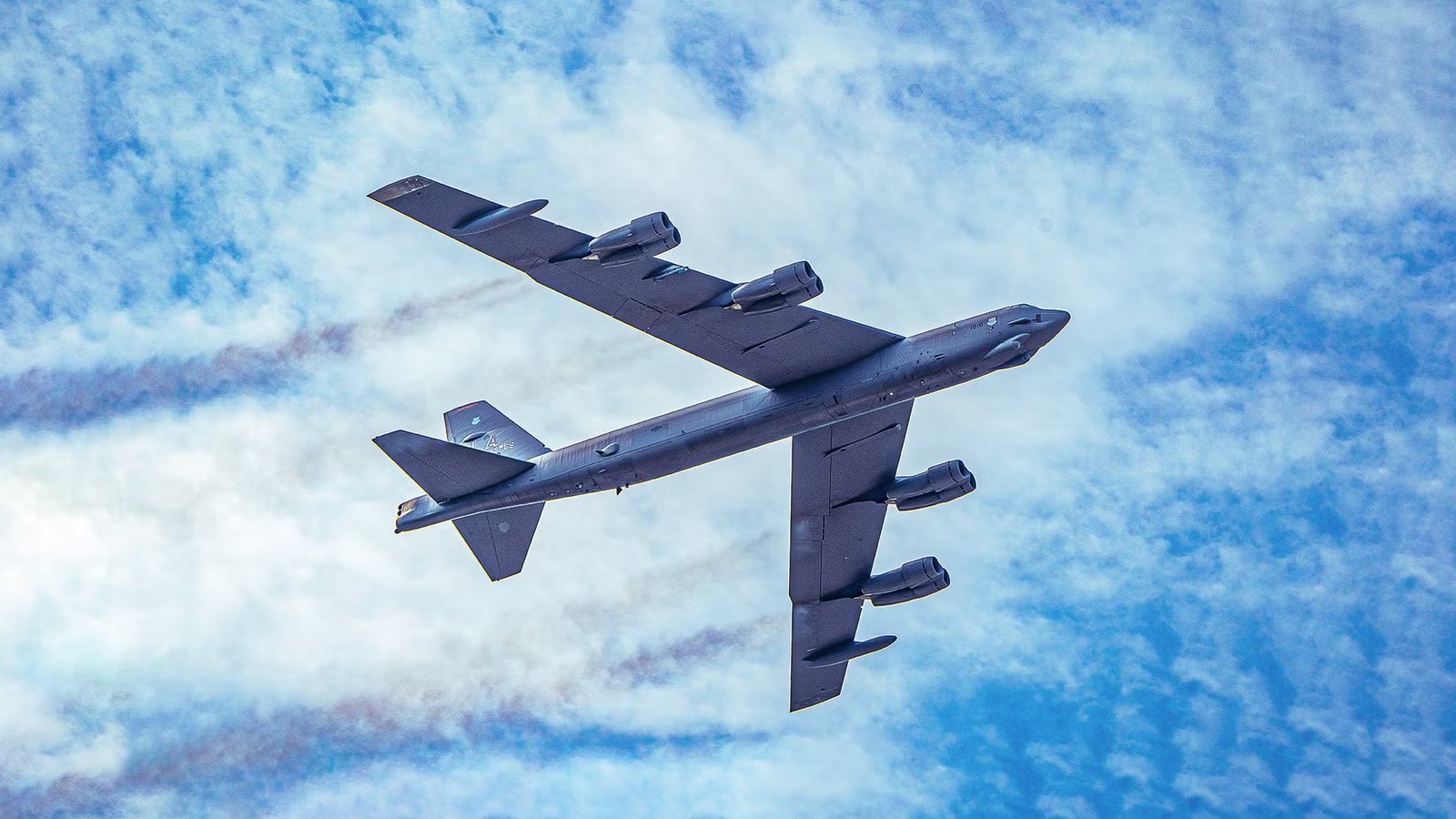
The  Boeing B-52 Stratofortress remains a frontline United States Air Force bomber in 2026 for one simple reason: no other aircraft combines a 70,000-pound (32,000 kg) payload, an 8,800-mile (14,200 km) unrefueled range, and the ability to launch next-generation weapons like the AGM-181 LRSO. This matters directly for the US: B-52Hs regularly launch global strike missions from Barksdale Air Force Base and Minot Air Force Base without relying on foreign basing, giving Washington a rapid-response strike option independent of overseas access. With 76 aircraft still in service and a full upgrade to the B-52J standard scheduled through the 2030s, the platform is set to remain a core part of US power projection well into mid-century. This analysis ranks seven key reasons why the B-52 remains irreplaceable, from raw payload and global reach to its nuclear role and sweeping modernization program.
An Arsenal Measured In Tens Of Thousands Of Pounds
No Bomber In The Western Inventory Can Match The B-52’s Raw Payload

The B-52H can carry up to 70,000 pounds (32,000 kg) of mixed ordnance, a figure that sounds almost absurd until you consider what that means in practice. That translates to combinations like up to 51 Mk 82 500-pound unguided bombs, or 20 AGM-86B cruise missiles, eight on an internal rotary launcher and twelve split across two underwing pylons, alongside precision-guided JDAMs, naval mines, and standoff weapons like the JASSM-ER, all from a single airframe. No other aircraft currently in the Western bomber inventory comes close to matching that volume of firepower in a single sortie.
This capacity earned the B-52 its informal role as the ultimate “bomb truck”, and the moniker Big Ugly Fat Fellow (BUFF). In conventional conflicts where air superiority has already been established, few assets can match the effect of a B-52 unloading dozens of precision weapons on a target array. During the Persian Gulf War and Operation Iraqi Freedom, the psychological and material impact of the B-52 strikes were immense, with individual aircraft capable of cratering entire grid squares. Despite being surrounded by increasingly expensive precision platforms, the ability to deliver mass fires from a single airframe continues to justify the B-52’s presence in the force structure, and ranks it firmly as the starting point of any conversation about why this aircraft refuses to go away.
A Combat Radius Limited Only By Crew Endurance
The B-52’s Range Makes It Truly Global In A Way Few Aircraft Are

The B-52H has an unrefueled combat range of over 8,800 miles (roughly 14,200 kilometers), a figure that already puts most aircraft to shame. Add aerial refueling to the equation, and the Stratofortress becomes truly unlimited in range, capable of striking any target on Earth without the need to land at a forward base. That kind of reach is an immense strategic asset, particularly in an era when access to overseas basing can never be taken for granted.
The B-52 demonstrated this global reach dramatically as early as January 1957, when three Stratofortresses completed a nonstop round-the-world flight, which was a record-setting demonstration of American airpower that reverberated through Cold War politics. Decades later, the calculus hasn’t changed. Today’s Bomber Task Force missions regularly see B-52s departing from Barksdale AFB in Louisiana or Minot AFB in North Dakota, completing round-trips of thousands of miles without ever touching foreign soil, then returning home.
This long-legged endurance also gives commanders strategic flexibility that shorter-range aircraft simply cannot provide. A B-52 can be recalled in flight, repositioned mid-mission, or held on airborne alert while a diplomatic situation develops, something a ballistic missile can not do. That controllability, paired with global reach, makes range far more than just a performance statistic: it’s a pillar of deterrence in its own right.

How Many Lockheed F-104 Starfighters Were Built?
Discover the verified production total and how NATO exports shaped this Cold War fighter’s legacy.
One Aircraft, A Dozen Different Mission Sets
The B-52’s Adaptability Across Roles Sets It Apart From Any Single-Purpose Platform

From the moment it entered service, the B-52 was built around flexibility and with space for future upgrades in mind. Today, the B-52H is certified for missions spanning strategic nuclear strike, conventional precision bombing, close air support, air interdiction, suppression of enemy air defenses, and maritime surveillance — all from the same airframe. It carries both the Litening and Sniper targeting pods, enabling it to identify and engage targets with a precision that would have seemed impossible for a bomber of its generation.
The maritime surveillance role, in particular, often surprises those who think of the B-52 purely as a land-attack platform. Stratofortresses regularly patrol the South China Sea and the waters around the Indo-Pacific, capable of carrying anti-ship missiles and surveillance equipment that make them a meaningful threat to naval surface groups. Combined with their ability to carry the Long-Range Anti-Ship Missile (LRASM), the B-52 adds a serious maritime strike dimension to a fleet otherwise associated with carpet bombing runs over Vietnam.
This multirole breadth is one of the B-52’s most underappreciated qualities. Where purpose-built aircraft like the B-2 are specialized and extremely expensive to operate, the BUFF can fill gaps across the mission spectrum, making it indispensable to combatant commanders who need flexible, persistent strike capability. Its adaptability, rooted in the original designers’ decision to build a large, structurally versatile aircraft, continues to pay dividends seven decades later.
The Only American Bomber That Can Carry A Nuclear-Tipped Cruise Missile
As The Airborne Leg Of The Nuclear Triad, The B-52 Is Irreplaceable Until The B-21 Is Fully Fielded

The United States nuclear triad relies on three independent delivery systems: land-based ICBMs, submarine-launched ballistic missiles, and the airborne bomber leg. The B-52H is central to that third pillar. Unlike the B-2 Spirit Bomber, which delivers gravity bombs and relies on stealth to penetrate enemy airspace, the Stratofortress is the USAF’s primary standoff nuclear strike platform, designed to launch nuclear-armed cruise missiles from well outside the reach of enemy air defenses.
The Air Force currently operates 76 B-52H bombers, and they remain certified to carry nuclear air-launched cruise missiles. The upcoming AGM-181 Long Range Standoff (LRSO) weapon, which was spotted on a B-52 in active test flights as recently as November 2025, will eventually replace the aging AGM-86 ALCM, extending the B-52’s nuclear relevance well into the future. The LRSO is designed to penetrate and survive advanced integrated air defense systems from standoff distances, giving the B-52 a meaningful nuclear role even against peer-level adversaries.
The B-21 Raider will eventually take on nuclear roles, but its production ramp-up is measured in years. Until there are enough Raiders to cover the full nuclear deterrence requirement, retiring the B-52 from that role is simply not an option. The bomber’s nuclear mission is an active, ongoing operational necessity.
The Cheapest Bomber To Fly
Low Operating Costs Make The B-52 The Most Economical Way To Deliver Massive Firepower

One of the least glamorous but most important reasons the B-52 remains in frontline service is cost. Compared to newer bombers, the Stratofortress is relatively inexpensive to operate, maintain, and upgrade. While stealth aircraft like the B-2 require specialized hangars, climate-controlled maintenance environments, and extensive low-observable coating work after many flights, the B-52 is a conventional aircraft with decades of maintenance experience behind it. Spare parts pipelines, trained crews, and established infrastructure already exist, which dramatically reduces operating costs compared to newer platforms.
While the B-52 is old, newer bombers are significantly more expensive to operate for different reasons. The B-2 Spirit, for example, requires intensive maintenance of its stealth coatings, specialized climate-controlled hangars, and extensive post-flight servicing to maintain its low-observable characteristics, making it one of the most expensive aircraft in the world to fly per hour. The Rockwell B-1 Lancer, although not a stealth aircraft, is a supersonic bomber with variable-sweep wings and complex systems that result in high maintenance demands and lower mission-capable rates. By contrast, the B-52 is mechanically simpler, subsonic, and supported by decades of logistics infrastructure and maintenance experience, allowing it to fly more hours at lower cost than either of the newer bombers. This cost efficiency allows the Air Force to use the B-52 for missions where stealth or supersonic speed are unnecessary, preserving more expensive aircraft for high-threat environments.
The economics become even more important when considering fleet size. The US Air Force operates dozens of B-52s, and upgrading existing aircraft is far cheaper than building large numbers of new stealth bombers from scratch. By modernizing engines, avionics, radar, and weapons systems, the Air Force can keep the aircraft operational for decades at a cost far lower than replacing the entire fleet. The B-52’s affordability is both a financial advantage and a strategic one.

Why The F-4 Phantom Won’t Be Retired Anytime Soon
A Cold War icon defies expectations, remaining relevant in the 21st century. Discover the secrets behind the F-4 Phantom’s enduring legacy.
The Missile Truck Of The Future — Hypersonics, LRSO, And JASSM-ER
The B-52’s Large Payload And External Hardpoints Make It The Ideal Launch Platform For Next-Generation Weapons

There is a clear strategic logic behind keeping a large, non-stealthy bomber in the fleet that awaits the modern B-21 Raider to enter service. In a contested environment, the B-21 is designed to penetrate defended airspace, while the B-52 will operate from a distance, delivering large volumes of standoff munitions. Today, that penetrating role is still performed by the Northrop Grumman B-2 Spirit, but over time it will be assumed at scale by the B-21.
The Stratofortress is being configured as the primary launch platform for a portfolio of standoff weapons that are designed to be fired from outside the engagement range of enemy air defense systems, meaning the bomber itself never needs to enter threat airspace.
The weapons integration portfolio is substantial. The B-52J is being cleared for the AGM-181 LRSO nuclear cruise missile, the JASSM-ER and its extended JASSM-XR variant for conventional standoff strike, the LRASM for maritime targets, and, in a significant development, the AGM-183A Air-Launched Rapid Response Weapon (ARRW) hypersonic missile, for which the Air Force requested $387.1 million in FY2026 procurement funding after reviving the program in 2025. Each B-52 can carry multiple such weapons across its six external hardpoints, giving each aircraft the ability to launch a concentrated wave of highly capable munitions simultaneously.
Critics who argue that the money should be spent accelerating B-21 production miss the point: the two aircraft are complementary by design, and the B-52’s massive hardpoint capacity gives the USAF a standoff arsenal that no other platform can replicate at scale.
A Path To The 2050s: Why The B-52J Program Still Matters
New Engines, Radar Upgrades, And Digital Systems Are Transforming An Eisenhower-Era Bomber Into A 21st-Century Weapon

The single most important reason the US Air Force still flies the Boeing B-52 Stratofortress is also the most forward-looking one: the service is investing heavily in a modernization program designed to keep the aircraft operational for at least three more decades. The Commercial Engine Replacement Program (CERP), awarded to Rolls-Royce in 2021, will replace all eight of the B-52H’s aging Pratt & Whitney TF33 engines with the new F130 turbofan, derived from the BR725 engine used on the Gulfstream G650. Testing and integration work continues through the late 2020s, with the new engines expected to significantly reduce fuel consumption, maintenance requirements, and operating costs while extending the aircraft’s range.
The engines are the centerpiece of the upgrade, but they are not the only change planned under the B-52J modernization effort. The aircraft will also receive new communications systems, updated avionics, improved data links, and weapons interface upgrades to support next-generation standoff weapons. The Air Force originally planned a large-scale radar replacement program but has since scaled back the scope of that upgrade to reduce costs and focus on the most critical capability improvements. Rather than completely transforming the aircraft, the modernization program is now focused on improving reliability, connectivity, weapons integration, and long-term sustainability.
Taken together, the B-52J program remains the definitive answer to why the Air Force continues to operate the Stratofortress. Replacing 76 bombers with an equivalent number of Northrop Grumman B-21 Raider aircraft would cost hundreds of billions of dollars and take decades. Upgrading existing aircraft with new engines, avionics, communications systems, and weapons integration extends the life of the fleet at a fraction of the cost of replacement. When the B-52J eventually reaches its 100th birthday in service, it will still be one of the most capable flying long-range strike platforms on Earth.