dailynewsnblog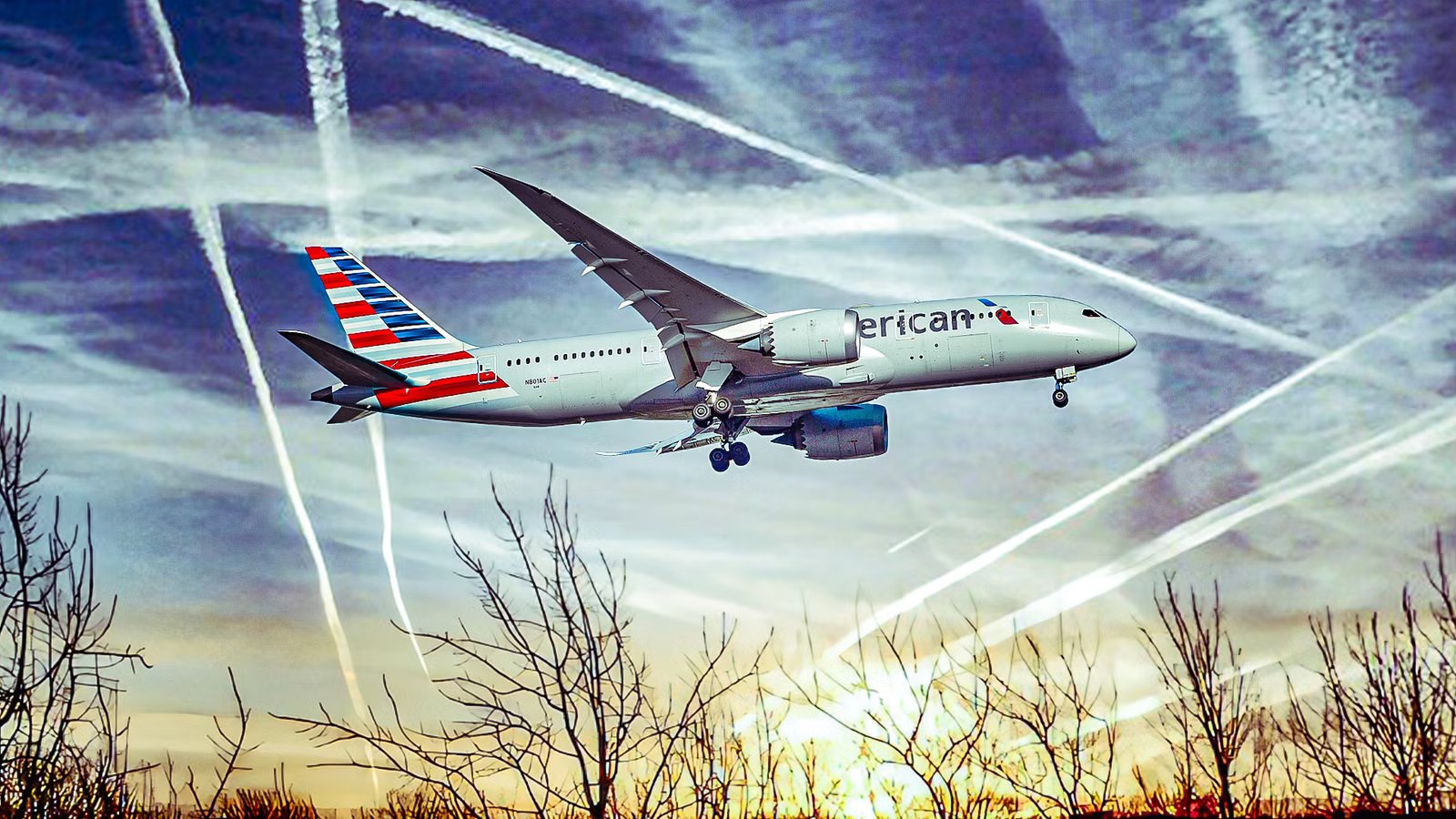
While the vapor trails produced by airliners don’t contain chemical agents sprayed for secretive reasons, they do pose a risk. Contrails are an effect that results from specific atmospheric conditions combined with elements from an aircraft’s engine exhaust, manifesting as long trails that form behind an aircraft. They can pose a significant threat to the environment, which is why airlines and manufacturers are looking for ways to combat it.  American Airlines, the US’ second-largest airline, is turning to artificial intelligence.
American is working with Google to utilize AI-forecasting tools to combat contrails. It’s currently trialing the system to determine its true functions and benefits, but the results thus far are promising. The tool is promoted as being scalable, meaning that it should be relatively easy for other airlines to implement these measures on a widespread basis. This represents one of the airline industry’s strongest measures yet to combat contrails, a major source of aviation pollution.
Overview Of Aircraft Contrails

Commercial airliners typically cruise between 30,000 feet and 43,000 feet, where the air is sufficiently thin that drag is significantly reduced and fuel burn is lower. Flying lower increases drag, while flying above these altitudes can result in significantly reduced lift, increasing fuel burn. In addition, flying at these altitudes allows planes to overfly rough weather. However, this is also the altitude where conditions are ideal for contrails, which are line-shaped vapor trails that form behind aircraft and result from an aircraft’s exhaust gases mixing with the outside air.
The two largest components of jet engine exhaust are carbon dioxide and water vapor, while chemical byproducts make up a smaller percentage. When hot, humid exhaust air comes into contact with thin, cold air at high altitudes, it raises the air’s relative humidity, essentially creating a cloud. This is a contrail, and the time required for the air to cool results in long trails. While you’ll typically find contrails at high altitudes, they occasionally occur at lower altitudes as well, depending on atmospheric conditions.
There are three major types of aircraft contrails: ‘short-lived’, ‘persistent non-spreading‘, and ‘persistent spreading‘. Each one has a greater impact on the environment than the last, and contrails as a whole are believed to be one of the aviation industry’s biggest contributors to climate change, as they trap heat in the atmosphere, much like a cloud. Therefore, manufacturers and airlines are prioritizing solving this issue, as the industry as a whole aims to reduce its environmental impact.
Using Artificial Intelligence To Reduce Contrails

American, based in Fort Worth, Texas, has been diligently working with Google to reduce the impact of contrails. This began with a 2023 study led by Google Research and Breakthrough Energy, which concluded that there were practical measures to help flights avoid generating contrails. This was backed up by further studies in 2024 and 2025 that focused on replicating and scaling the findings, with the goal of implementing contrail-avoidance strategies into flight planning systems.
American Airlines and Google are using artificial intelligence to generate contrail forecast maps, cross-referencing predictions with open-source contrail models developed by Breakthrough Energy. The forecasts are then added to its flight planning system, indicating to pilots where to change altitude and suggesting optional routes to avoid areas where contrails are more likely to form. This tool is directly integrated into software that American already uses, making it a low-risk, low-cost solution.
The initial 2023 trial saw a 54% reduction in contrails across 70 flights, with subsequent studies corroborating these findings. In a recent study published to arXiv from January to March 2025, researchers had 112 transatlantic flights follow contrail-avoidance routes and observed a 62% reduction in contrail production compared to a focus group, along with a 69% reduction in associated warming. What’s more, using contrail-avoidance routes did not result in a meaningful increase in fuel burn.

Are More Fuel-Efficient Aircraft Increasing Global Warming?
Contrails exist when water vapour from aircraft engines condenses and freezes at high altitudes.
The Next Steps For Contrail Avoidance

The results of the testing conducted by Google Research and American Airlines are impressive. The flights that follow contrail-avoidance routes produce significantly fewer contrails than those that do not, and what’s more, they burn little, if any, additional fuel, ranging from 2% more to roughly zero. For an airline to implement these routes systemwide, it’s estimated they may burn as little as 0.3% more fuel while avoiding contrails, at a cost of $5 to $25 per ton of carbon dioxide equivalent.
Following contrail avoidance routes only slightly increases an airline’s operating costs, and, what’s more, contrail forecasts can be directly integrated into existing software used by airline pilots and schedulers. It’s therefore a low-risk, high-reward solution for airlines to contribute to the aviation industry’s goal of becoming carbon neutral by 2050, an otherwise difficult goal given the realities of the industry and the difficulties of using alternatives to fossil fuels for aircraft.
To be truly effective, contrail avoidance needs to be followed by airlines on a wide scale, which shouldn’t be difficult given the low cost involved. Currently, Google Research and its partners are continuing to develop its forecast models, including by improving satellite-based verification, targeting high-impact contrails, and automating avoidance. While researchers can determine which areas have the potential to create contrails, it’s more difficult to narrow this down to specific flight paths, a key focus for future refinements.
The Climate Risks Of Contrails

At its core, the concept behind climate change is that human activity, including the release of greenhouse gasses, is causing Earth’s temperatures to rise at above average rates. Contrails are essentially artificial clouds, and they act similarly, as clouds trap radiation emitted by the Earth, while reflecting incoming solar radiation. The artificial increase in Earth’s cloud cover creates a blanket effect, trapping heat in the atmosphere and contributing to rising temperatures.
Different atmospheric conditions generate different types of contrails, with relative humidity being the largest factor. A short-lived contrail is thin and dissipates close to the aircraft, with the tail closely following it. These contrails generally have a low effect on the environment. A persistent non-spreading contrail remains long after an aircraft has passed over a given area, but still retains its thin shape. A persistent spreading contrail can remain for hours or days and spreads out into the atmosphere, appearing similar to a cirrus cloud. These contrails have the greatest impact on global warming.
|
Altitude Level |
Cloud Types |
|---|---|
|
High-level |
Cirrus, Cirrostratus, Cirrocumulus |
|
Mid-level |
Altostratus, altocumulus |
|
Low-level |
Stratus, stratocumulus, cumulus |
|
Multi-level |
Nimbostratus, cumulonimbus |
Contrails are believed to have a similar or greater effect on the environment than the aviation industry’s direct carbon dioxide emissions. The effects of contrails are especially strong at night, when there’s less incoming solar radiation, and during the winter season. As a whole, a minority of flights account for a significant proportion of global contrail production.

Airlines Issue Statement On Growing Concern Facing Passengers
Ultimately, the continued investment of SAF for airlines will eventually cause airfares to rise.
Other Efforts To Reduce Contrail Production

Other polluting agents in aircraft fuel, such as soot, act as a platform for contrails to form, and Sustainable Aviation Fuel ( SAF) aims to address this, among other climate challenges. A cleaner replacement for jet fuel, this biofuel produces significantly less soot, thereby eliminating contrails in some instances and generating smaller contrails in other instances. SAF is becoming more widespread across the industry, prominently advocated by carriers such as All Nippon Airways, United Airlines, and Virgin Atlantic, and offers several other benefits that reduce the industry’s net emissions.
Aviation is extremely sensitive to changes in propulsive efficiency, given the importance of weight, and it’s therefore not easy to switch to electric propulsion, as batteries weigh significantly more than fuel while providing less energy. Advances in hydrogen propulsion, however, would lead to drastic reductions in the industry’s carbon emissions. Regarding contrails, however, hydrogen engines emit more water vapor than current jet engines, so contrails could still form, but under different conditions.
|
Milestone |
Date |
Airline |
Route |
Aircraft |
|---|---|---|---|---|
|
First commercial flight with SAF |
February 24, 2008 |
Virgin Atlantic |
London Heathrow to Amsterdam |
Boeing 747-400 |
|
First commercial flight with 100% SAF in one engine |
December 1, 2021 |
United Airlines |
Chicago O’Hare to Washington-National |
Boeing 737 MAX 8 |
|
First commercial flight with 100% SAF in both engines |
November 28, 2023 |
Virgin Atlantic |
London Heathrow to New York-JFK |
Boeing 787-9 |
Research is ongoing on the effects of hydrogen engines on contrail production, and it remains to be seen whether hydrogen propulsion can work in commercial aviation. Furthermore, there remains some contention about the full environmental impact of contrails, how they form, and the best methods to avoid generating them. As a whole, the industry is increasingly taking steps to reduce its contribution to global climate change, which is currently estimated at over 4% when accounting for non-CO2 effects such as contrails.
Manufacturers are also working on methods to avoid contrail generation. Airbus, for instance, is studying new technological innovations, such as humidity sensors, which can help airliners avoid conditions favorable to contrail formation. Meanwhile, Airbus’ Blue Condor project, part of its larger ZEROe initiative, aims to measure how hydrogen engines produce contrails compared to conventional engines. The entire aviation industry is working on individual solutions to reduce contrails as much as possible, while also tackling other issues such as carbon emissions.