dailynewsnblog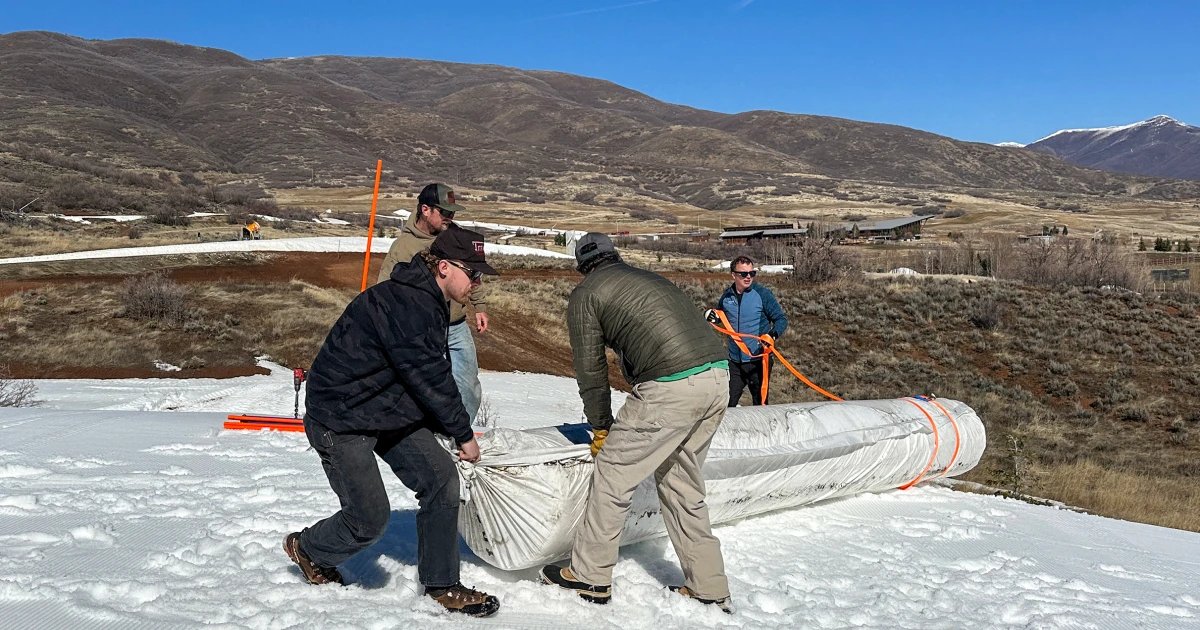
Amid the West’s worst snow drought in modern history, several ski areas are attempting a novel approach: Storing up artificial snow and preserving it until next ski season.
Known as “snow farming,” the practice involves making snow when conditions are ideal — in cold, dry weather— and piling it two to three stories high, then covering the mound with a large, insulated mat to shield it from sun and rain. When a ski resort wants to open in the fall, it can spread the snow back over runs, rather than relying on the weather.
The technology is more common in Europe but finding a foothold in the United States as snowfall has become less reliable. This year, small ski areas in Wisconsin, Idaho and Utah are trying their hand at snow farming — a sign that new, work-intensive interventions are becoming a necessity as the ski industry grapples with climate change.
“It’s going to extend the viability of skiing, especially for some of the resorts that are going to be on the margin as we have warmer winters and we get less snow,” said Nate Shake, the director of mountain operations at Bogus Basin ski resort near Boise, Idaho, where snow farming is underway for a second season.
Soldier Hollow Nordic Center, a venue near Salt Lake City originally built for the 2002 Winter Games, is trying the approach for the first time. Finding a way to maintain reliable snow is especially critical for the area because Salt Lake City is scheduled to host the Winter Olympics in 2034.

15,000 square feet.Courtesy Utah Olympic Legacy Foundation
Soldier Hollow is slated to be a venue for cross-country ski events again. But if conditions in eight years are as bad as they were this season, the Games’ success there could hinge on the snow farming tests now underway.
“It’s contingency planning for a bad winter in 2034,” said Luke Bodensteiner, the general manager of Soldier Hollow.
Bodensteiner, who competed in the Winter Olympics in 1992 and 1994, said this year’s dismal snowpack was the worst in memory. Holding cross-country ski events “would have been a challenge if this were an Olympic year,” he said.
How to ‘farm’ snow
Bodensteiner’s team spent roughly $300,000 on a snow farming system from a Finnish company called Snow Secure.
The company sells white polystyrene mats that fold like an accordion, are about 2½ inches thick and can be installed in a day. The mats are essentially weatherproof insulation, somewhat akin to the insulation used in housing. They’re designed to cover a snow pile about the length of a football field from top to bottom.

The company’s customers generally wait for cold, dry conditions to make snow using snow guns, pile that snow up several stories high, unfold the mats, cover the pile completely and anchor the system down with weights.
“It’s a little bit like a battery. The more snow you can put under that insulated system, the longer it’ll hold that cold in,” Shake said.

Antti Lauslahti, the CEO of Snow Secure, said the stored snow will typically lose about 20% of its mass over the course of a summer. But the process allows ski areas to make snow in conditions that lead water droplets to freeze more rapidly.
“The snow quality is better when you make it in cold weather,” he said. “You make it really fast, you make a really good quality and you use less energy.”
Snowmaking has been popular since the 1970s, but it is an inefficient use of water in warmer weather, like the beginning or end of a season. Making snow in marginal conditions usually requires 70% to 80% more energy, Lauslahti said.
“If it’s 27, 28 degrees and you leave a snow gun on overnight, you might have a pile under that under that gun that’s maybe 2 feet deep,” Bodensteiner said. “If it’s single digits outside, and you turn on that same snow gun, you’ll end up with a pile that’s 8 feet deep.”

Lauslahti said some in the U.S. worried that summer temperatures would climb too high for the system to be effective, but so far it has worked.
Last year, Bogus Basin was one of three North American areas to pilot a Snow Secure program. During the summer, a monitoring system recorded temperatures up to 119 degrees Fahrenheit on the exterior of the mat system, but it kept the snow at an average of 37 degrees, Shake said.
In October, crews unpeeled the mats and found about 80% of the snow had survived. Even though Bogus Basin had its warmest November on record, it was able to open that month.
“We opened on the snow that we saved,” Shake said, adding that without snow farming, “we wouldn’t had a Thanksgiving opening at all.
A record-breaking snow drought
This winter has been a stunner for Western states.
By mid-March, every major basin in the West was experiencing its warmest or second-warmest winter on record and had a snow deficit, according to the U.S. drought monitor. Then, a record-breaking heat wave last week zapped much of the remaining snow, raising wildfire concerns and spurring water-use restrictions in places like Denver. Several states — including Colorado and Utah — reported their lowest snowpacks on record.
Some ski areas never opened or offered limited operations. Many resorts are closing early, before April begins.
“Everybody in the industry is cognizant of the fact that winters are getting shorter and warmer,” Bodensteiner said.
Soldier Hollow was built at about 5,600 feet above sea level to comply with Olympic regulations. That’s rather low for skiing in Utah, so the facility often rides the line between freezing and not, making it sensitive to climate shifts.

Because of that, Soldier Hollow is increasingly reliant on artificial snow. It has invested in snowmaking technology, including 20 “fan guns” that can be moved around to blow snow onto trails and 40 robotic, stationary “sticks” that make snow at fixed positions.
“Roughly half the season is on man-made snow,” Bodensteiner said.
He hopes that with the snow farming experiment, Soldier Hollow will be the first Nordic skiing venue to open next fall. The facility is also planning upgrades to its snowmaking equipment. If Snow Secure works, Bodensteiner wants to expand the system.
“If we get the results that we think … in the summer of 2033, we’ll probably have three to four of these piles going around the venue,” he said.