dailynewsnblog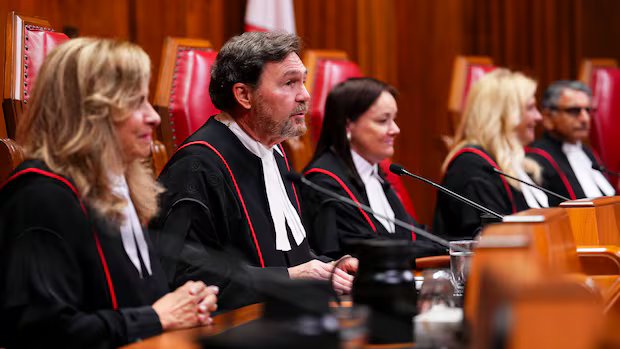
Seven judges of the Supreme Court of Canada are now considering the fate of Quebec’s controversial secularism law, Bill 21, which bans some civil servants, including teachers, from wearing religious symbols on the job.
A decision isn’t expected for at least several months.
Four days of arguments — exceptionally long for a Supreme Court case — dealt mostly with complex questions regarding the mechanics of Canada’s notwithstanding clause.
Such arguments have a tendency to be — with all due respect to the court and the lawyers who made eloquent and thorough presentations — a bit dense and hard to understand.
But there were some key moments from the hearings that demonstrate how important this case is for Canadian democracy, and how passionate the feelings behind that debate are.
1. ‘Mini-Trump in Canada’
Many lawyers at the hearings raised the idea that unlimited use of the notwithstanding clause could potentially empower authoritarian politicians to put extreme limits on fundamental rights.
Frédéric Bérard, lawyer for the Fédération autonome de l’enseignement (FAE) teachers’ union, said that many western countries are seeing growing authoritarian movements, and that Canada was not immune.
“What if there was ever a mini-Trump in Canada?” Bérard asked the judges.
“Everything that’s happening in the United States, or almost everything, could happen here in a perfectly constitutional manner due to the current use and practice of the notwithstanding clause.”
Chief Justice Richard Wagner later raised this with Isabelle Brunet, the lawyer for the attorney general of Quebec.
“Let’s say a tyrant — I won’t name names — who has no respect for the separation of powers, who has no respect for equality between men and women, would suddenly pass, with the help of accomplices, legislation that would undermine the very foundations of our values,” Justice Wagner said.
“What is your response to this kind of argument?” he asked Brunet.
To that, Brunet replied: “We must have faith in our democracy.”
“We have to assume our governments will act in the public good. We can’t assume the opposite,” she said.
2. ‘Outrageous’ comments on diversity
Justice Wagner took issue with something raised by Julius Grey, the lawyer for the group TALQ, which represents anglophone community organizations in Quebec.
In Grey’s legal brief submitted to the court, he suggested the English-speaking minority in Quebec is much more diverse than the French-speaking community.
“I find those comments almost outrageous,” Justice Wagner said.
“You can go to any French-speaking school in Montreal and you’ll find children from many origins,” he said. “I don’t think that the English-speaking community in Quebec has the monopoly on diversity.”
Grey responded that what he was meaning to say in his legal filing was that the English-speaking community had a different view of secularism.
3. Don’t forget real people
In such dense legal arguments, it can be easy to forget the people directly affected by Bill 21.
Sahar Talebi, who represented the Canadian Council of Muslim Women, reminded the court of that.
“Muslim women in Quebec are the face of Bill 21’s exclusion. They face increased prejudice, harassment and hate crimes,” Talebi said.
“Their bodies, their clothing choices, and religious identities are consistently weaponized, policed, and forbidden in certain spaces. These are profound, long-term detrimental impacts.”
Allan Rock, a former federal justice minister who represented the intervenor group the Samara Centre for Democracy, mentioned the case of Montreal lawyer Gregory Bordan.
“Despite practising since 1988, he can no longer take public mandates because, as an Orthodox Jew, he wears clothing associated with his faith,” Rock said.
“We respectfully suggest that we must keep those individuals and the impact on them in mind.”
Megan Stephens, representing the intervenor group the Barbra Schlifer Commemorative Clinic, also touched on this.
“A publicly-funded, hijab-wearing lawyer from Quebec could not appear in this court to make these submissions,” she said.

Joe Ortona, chair of the English Montreal School Board, spoke to media ahead of the hearings over Quebec’s secularism law Bill 21 at the Supreme Court of Canada. Ortona said Bill 21’s ban of religious symbols for public sector employees is ‘a restriction that has no bearing on the quality of education that students receive in the classroom.’
4. Extreme examples
Lawyer Guy Pratte, arguing for the attorney general of Canada, raised a fairly extreme example when countering the argument of Quebec and some other provinces that there are no limits on how they can use the notwithstanding clause.
“Are they claiming — not that they would adopt such a law — but that they could adopt laws that would reinstate arbitrary execution, slavery, or that would attempt to categorically and absolutely eliminate any right to equality?” Pratte asked the court.
“The answer is obviously — I hope they will tell you — no,” Pratte said.
“It’s not a question of whether they want to do it, are inclined to do it, it’s what they can do.”
Later, Jonathan Blair, lawyer for the intervenor group the Community Legal Assistance Society, argued that some of the worst atrocities of the 20th century were the result of discriminatory legislation such as Bill 21.
Both Justice Wagner and Judge Malcolm Rowe responded to that suggestion.
“You have less confidence in the good sense and the goodwill of Canadians than I do,” Rowe said. “We’re not teetering on the edge of the precipice of fascism. That’s not the reality,” he said.
Justice Wagner added, “I don’t think this case will be disposed of by extremist or catastrophic scenarios.”
5. Courts vs. social media
Much of the debate this week centred on whether courts should get a chance to weigh in on controversial pieces of legislation once the notwithstanding clause has been invoked.
George Avraam, lawyer for intervenor group the Canadian Constitution Foundation, argued that’s not necessary.
“There are different ways to hold legislatures to account,” Avraam argued.
“Opposition parties, grassroots, academic writings, editorials, social media, protests,” he suggested.
Allan Rock argued that, particularly for minority groups with limited political influence and resources, these aren’t enough.
“Most public discussion now takes place on social media, which is contaminated by toxic content and is often exclusionary,” Rock said.
“For many, particularly minority groups, a courtroom is the only forum where evidence matters, where fairness governs, where every voice is heard.”
6. What is secularism anyway?
The court was forced to grapple this week with something that has plagued the debate about secularism in Quebec for years: what is secularism, and how do you define it?
Marc-André Fabien, lawyer for the Hamshuchas Hadoirois International Association, a group representing Hassidic Jewish communities, argued that in Canada, no government can simply declare its society secular without amending the Constitution.
Judge Nicholas Kasirer said secularism can have many definitions, and he asked Fabien what he meant by secularism.
“Many people make this confusion between a secular state and neutral state,” Fabien said.
He argued Canada has a tradition of neutrality when it comes to religion, but that secularism is a step too far.
“State employees are no longer allowed to wear religious symbols. We’re no longer talking about neutrality, we’re talking about prohibition,” Fabien said.
He referenced a previous Supreme Court decision that prevented the City of Saguenay from opening its city council meetings with a Christian prayer.
Fabien said following that decision, Saguenay city council meetings opened with a period of reflection, which respects people of all faiths or people of no faith.
He said this is the type of neutrality he’s talking about.
Even Wes McMillan, a lawyer for the BC Humanist Association, a pro-secular group, argued Quebec’s definition of secularism in Bill 21 goes too far.
“When politics dominates religion, it’s authoritarian. When religion dominates politics, it’s theocratic. Canada is neither authoritarian nor theocratic,” McMillan said.
“The decision in this case could carve a clear path for the imposition of state religion or state atheism. Either would be anathema to what Canada is and stands for.”