dailynewsnblog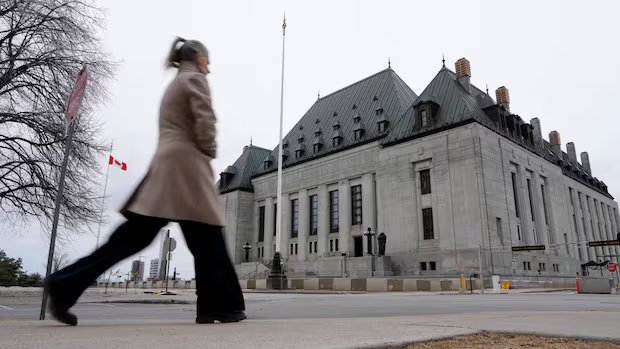
Ongoing arguments in the Supreme Court challenge to Quebec’s secularism law, Bill 21, have exposed a national divide over the role of courts in interpreting the notwithstanding clause.
Bill 21 prevents some civil servants, including teachers, from wearing religious symbols at work.
Quebec invoked the notwithstanding clause pre-emptively when it drafted the law, in an attempt to shield it from court challenges.
The clause – Section 33 of the Charter of Rights and Freedoms – allows provinces to adopt legislation even if that legislation violates certain Charter rights.
At the Supreme Court Wednesday, the federal government — along with Manitoba and B.C. — argued even when the clause is invoked pre-emptively, courts should still have the right to issue non-binding judgments as to whether a law violates the Charter — even if those judgments have no legal power to strike down the law.
Quebec, along with Alberta and Ontario, vigorously oppose that idea.
This national split played out in real time in court arguments Wednesday.
“Ontario’s position is that once Section 33 has been invoked, courts should not provide opinions on whether the law would have been constitutional if that invocation had not been made,” Doug Downey, Ontario’s attorney general, told the court.
Deborah Carlson, lawyer for the attorney general of Manitoba, countered that position in her presentation to the court.
“There is nothing in Section 33 that precludes post-enactment judicial scrutiny,” she said.

Much of the legal debate around Quebec’s Bill 21 centres on the province’s use of the notwithstanding clause in the text of the law, which was meant to prevent it from court challenges. Those opposing the law argued it sets a precedent for wider use of the clause, which can temporarily override parts of the Charter.
Should courts have a say?
Groups challenging Bill 21 in court have argued that the notwithstanding clause was never meant to be used pre-emptively.
Traditionally, in cases where the clause has been invoked, provincial governments have passed a law, the law is challenged in court, the court strikes down the law ruling it unconstitutional, and only at that point would a province invoke the clause.
Opponents of Bill 21 say it’s fundamental that courts identify which Charter rights are being violated before provinces can invoke the clause.
Quebec’s main argument against that is that there’s nothing written in the Charter that says the clause can’t be invoked pre-emptively.
Lower courts have upheld that argument.
Some challengers of the law are asking the Supreme Court, even if it upholds the notion that the clause can be used pre-emptively, to allow courts the discretion to weigh in with non-binding rulings.
‘Dispassionate arena’
The idea is supported by the federal government, Manitoba and B.C.
They say such rulings could help voters understand how governments are using the notwithstanding clause.
“What the court’s decision is doing in these circumstances is providing information to the electorate, and expert guidance to say what is the impact of a particular piece of legislation on the affected persons’ Charter rights,” Carlson, the lawyer for Manitoba’s attorney general, told the court.
“I would suggest that is something that is well within the jurisdiction and the scope of a court’s expertise.”
One of the Supreme Court justices, Malcolm Rowe, challenged Carlson, suggesting that would force courts into taking a political stance.
“Should we just sort of not engage in it because we want to maintain a certain separation between what the courts do and what happens in the political arena?” Rowe asked Carlson.
Carlson suggested that in times of passionate public debate, courts have an important role.
“There may be immense benefit in having constitutional issues explored in the dispassionate arena of a judicial hearing in the context of an open, fair and thoughtful process, where there is a full testing of facts and evidence that can go far, far beyond what you’re likely to get on your social media feed,” Carlson argued.
Guy Pratte, the lawyer for the attorney general of Canada, also weighed in on Rowe’s concern about political interference.
“Constitutional law courts, particularly those dealing with the Charter, will never do anything if we’re concerned about political circumstances, because there are always political consequences to your decisions,” Pratte told the judges.
“I respectfully submit that we should not confuse the possible political consequences of a judicial decision with the fact that it remains a judicial decision.”
‘Constitutional and logical anomaly’
The attorney general of Ontario agreed with Quebec’s position, supported by Alberta and Saskatchewan, that such court rulings would be “useless.”
“The courts should not be engaging in this academic exercise,” Downey told the judges.
“It would be asking challengers and governments to create a complete record and go through years of litigation,” he said. “And for what? For a process that cannot result in a legally binding decision.”
The lawyer for Alberta’s attorney general, Malcolm Lavoie, picked up on a concern raised by Quebec on Tuesday before the court: that such non-binding rulings would create confusion.
“It would require this court to hold that a law can be operative yet invalid. That would be a constitutional and logical anomaly that has no place in a society governed by the rule of law,” Lavoie told the court.
Dozens of other groups intervening in the case also began to make arguments Wednesday.
The arguments continue Thursday, with a decision expected to take months.