dailynewsnblog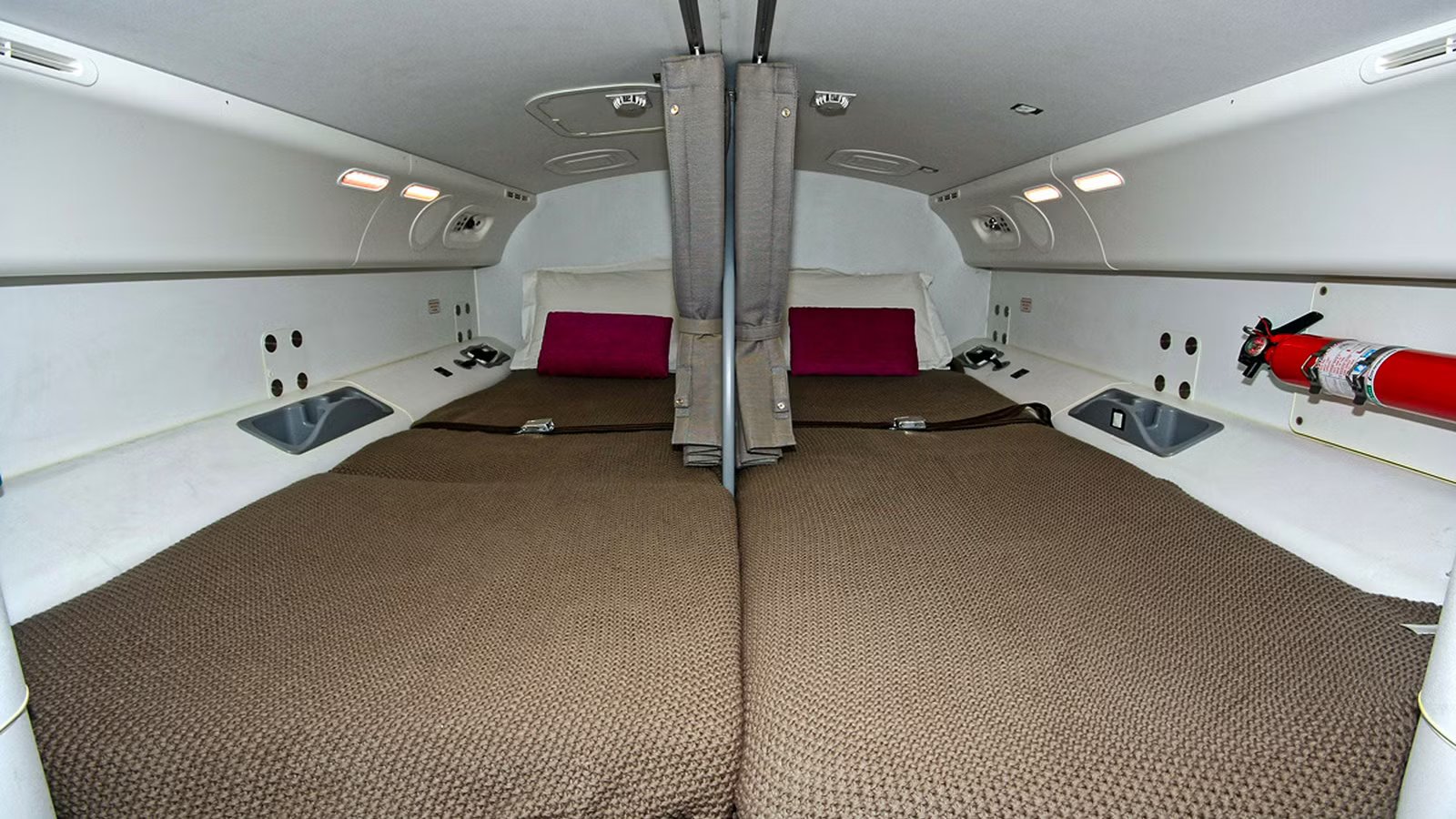
Commercial aviation is designed to feel seamless. From the moment passengers step onboard, everything they see, including the seats, galleys, lavatories, and overhead lockers, has been carefully arranged to create a predictable, comfortable experience. But behind the clean lines and familiar layout lies a surprisingly complex machine, one filled with hidden compartments and restricted-access spaces that most passengers will never even realize exist.
Modern aircraft are not just cabins with wings; they are multi-layered environments where crew members work, rest, and manage the flight in ways that remain almost entirely invisible. Some of these areas are cleverly disguised, others are physically out of reach, and all of them serve a specific purpose. Let’s take a closer look at five hidden areas inside modern passenger aircraft that passengers never see.
Crew Rest Compartments Above The Cabin
Hidden space for crew rest

On many modern widebody aircraft, one of the most fascinating hidden spaces sits directly above passengers’ heads. Widebody aircraft like the Boeing 787 and Airbus A350 feature dedicated crew rest compartments built into the upper fuselage, an area that is completely invisible from the main cabin.
To passengers, the entrance usually appears as a small, nondescript door near the galley. It might look like a storage closet or an extra lavatory, but behind it is typically a narrow staircase or ladder leading upward into a separate, hidden level. This design preserves the illusion of a single continuous cabin, even though an entirely different space exists just overhead, and airlines often position these entrances in low-traffic areas to keep the movement of crew members discreet, further reinforcing the sense that nothing unusual is happening.
Inside, the compartment resembles a compact sleeping pod system, with bunks arranged in tight rows, each with a mattress, reading light, air vent, and privacy curtain. The environment is carefully controlled to reduce noise and vibration, allowing flight attendants to rest properly during long-haul flights. On aircraft like the Boeing 787, there can be six to eight bunks, depending on configuration, along with safety restraints and oxygen systems in case of turbulence or decompression.
Despite the tight quarters, crew members often describe these areas as surprisingly comfortable. Once inside, there are no windows and no visual connection to the cabin below, creating a cocoon-like environment that makes it easier to disconnect. Some compartments even include temperature controls and subtle lighting adjustments to simulate nighttime conditions. For passengers walking down the aisle, there is no indication that just a few feet above them, an entire hidden sleeping area is in use, quietly supporting the operation of the flight.

Which Widebody Aircraft Have Dedicated Crew Rest Areas?
The secret areas hidden on a long haul aircraft, for the crew to get some much needed rest.
Pilot Rest Areas Near The Cockpit
Secluded rest area for pilots

Separate from the cabin crew facilities, pilots have their own dedicated rest areas, usually located close to the cockpit. These can be found on aircraft such as the Boeing 777 and Airbus A380, both of which are designed for ultra-long-haul operations requiring multiple flight crews.
The entrance to these compartments is typically even more discreet than the main crew rest areas. On some Boeing 777 variants, a hidden door near the cockpit leads to a small staircase that goes up to a compact sleeping space, while on the Airbus A380, the pilot rest area is positioned just behind the cockpit, tucked away from both passengers and the main cabin crew, sometimes accessed through what appears to be a standard service door.
These rooms are smaller than the cabin crew rest compartments, often containing just one or two bunks and sometimes a reclining seat. However, they are usually better insulated from noise and activity, reflecting the need for pilots to achieve deep, uninterrupted rest before returning to duty. In some configurations, there may also be a small workspace or communication panel, allowing resting Pilots to stay loosely connected to flight operations if needed.
Passengers never see this space, and even frequent flyers may not realize it exists, as from the outside, the area blends seamlessly into the forward cabin structure, with no signage or visual cues to indicate its purpose. This careful concealment is part of a broader design philosophy to keep operational complexity out of sight while maintaining a calm, orderly passenger environment, even on the longest of flights, such as Singapore Airlines’ Airbus A350-900ULR flights between  Singapore Changi Airport (SIN) and New York John F. Kennedy International Airport (JFK).
Lower Deck Crew Rest Areas
Crew rest area beneath the cabin

Not all hidden sleeping areas are located above the cabin, and on some aircraft, particularly older widebodies or certain high-capacity configurations, crew rest compartments are located below the main deck. A good example is the Boeing 777-300ER, which can be equipped with a lower-deck crew rest module accessed via a staircase.
This staircase is usually hidden behind a door in the galley, making it easy to overlook. Once below, the space feels more enclosed than overhead compartments, as it sits within the aircraft’s cargo area, but despite this, it is fully equipped with bunks, lighting controls, and ventilation systems to meet safety and rest requirements. The layout can vary, but it often resembles a compact dormitory, with narrow sleeping berths arranged along a central aisle.
On the Boeing 747, for example, different airlines have historically used a mix of solutions, including lower-deck rest areas and curtained-off sections within the main cabin. These curtained areas might be visible to passengers but are designed to provide a degree of privacy and separation for resting crew. In some cases, premium cabin seats have even been repurposed for crew rest on shorter long-haul flights.
The variation in designs highlights how airlines adapt to different aircraft layouts and operational needs, but whether above the cabin or below it, the goal remains the same: to create hidden, functional spaces that allow crews to rest without disrupting the passenger experience. These compartments also demonstrate how every available inch of space on an aircraft is carefully considered and utilized, even in areas passengers would never think to look.

Inside The Airbus A350-1000’s Secret Crew Rest Areas
From overhead bunks to cockpit rest areas, here is how the A350-1000 supports its long-haul crews.
The Avionics Bay Beneath The Cockpit
Core systems hidden below

Far below the cockpit, and completely out of sight of passengers, lies one of the most important hidden spaces on any aircraft – the avionics bay. This compartment is present on nearly all large aircraft, including the Airbus A320 and the Boeing 737, even though passengers would never know it exists.
The avionics bay houses the electronic systems that keep the aircraft running, including navigation computers, communication equipment, flight control electronics, and various monitoring systems. It is typically accessed via a hatch in the cockpit floor or an external panel when the aircraft is on the ground, meaning it is almost never seen by anyone outside maintenance crews.
Inside, the space is cramped and highly technical, filled with racks of equipment, wiring, and components that are critical to flight operations. The layout is designed for efficiency rather than comfort, with labeled panels and modular systems that allow technicians to quickly diagnose and repair issues. Cooling systems are also essential here, as the equipment generates significant heat during operation.
During flight, passengers are completely unaware of the avionics bay beneath their feet, as there are no visible clues in the cabin, and no interaction with the space. Yet it functions as the aircraft’s hidden nerve center, quietly supporting everything from autopilot functions to onboard communications. Its existence underscores just how much of an aircraft’s complexity is concealed below the surface.

How Cabin Crew Rest & Sleep On Transoceanic Flights
Unveiling the hidden world of cabin crew rest on ultra-long-haul flights.
Landing Gear & Wheel Well Compartments
Where the wheels retract

Among the most extreme hidden spaces on an aircraft are the landing gear bays, also known as wheel wells. These are found on all aircraft types, from narrowbodies such as the Boeing 737 to widebodies such as the Airbus A380.
The wheel well is where the landing gear retracts after takeoff, folding neatly into the aircraft’s structure to reduce drag and improve fuel efficiency. These compartments are sealed off from the passenger cabin and are completely inaccessible during normal operations, with heavy doors closing around the gear once it is retracted.
While they serve a purely mechanical purpose, wheel wells occasionally come into public attention due to rare stowaway incidents, and the conditions inside are extremely dangerous, with freezing temperatures, low oxygen levels, and the risk posed by moving mechanical components. These cases highlight just how inhospitable and isolated this hidden area truly is, far removed from the controlled environment of the passenger cabin.
From a structural standpoint, the design of the wheel well must balance strength, weight, and space efficiency, and engineers carefully integrate these compartments into the aircraft’s frame, ensuring that the landing gear can deploy and retract reliably thousands of times over an aircraft’s lifespan. For passengers, however, it remains entirely invisible. Even during boarding, when the landing gear is in plain view, the compartment itself is hidden behind panels and structural elements, reinforcing the idea that much of an aircraft’s functionality exists far beyond what can be seen.