dailynewsnblog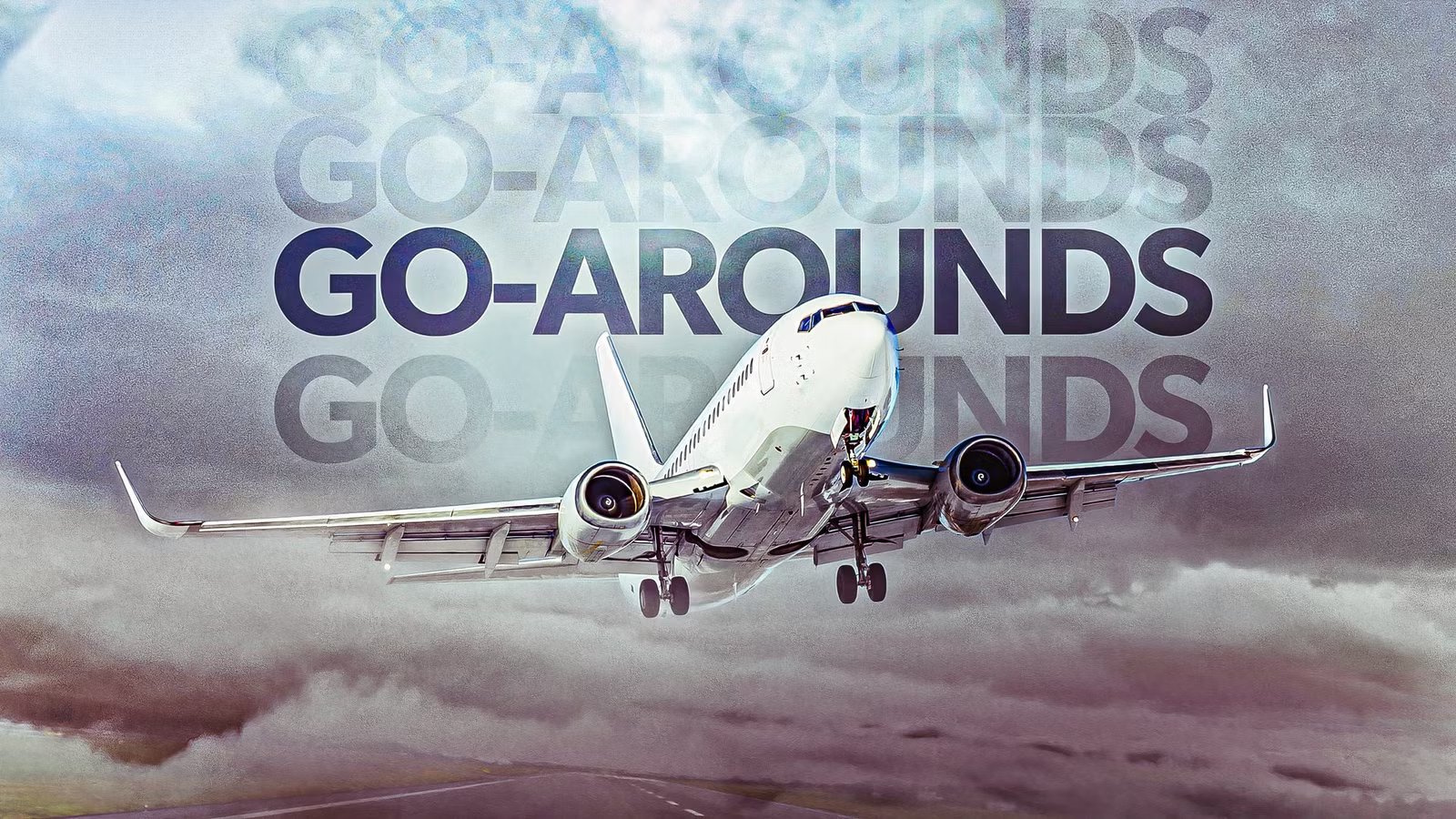
A commercial jet performing a go-around just seconds before landing is not a rare emergency, but it is a standard safety maneuver executed thousands of times each year. Airline pilots like those flying the Boeing 737 and Airbus A320 typically perform two to three annually, often due to unstable approaches below 1,000 feet or air traffic spacing issues. The core reason is simple: if an aircraft is not fully stabilized, for example, on speed, on glide path, and correctly configured, the landing must be abandoned immediately to avoid far greater risk.
Based on official FAA Airplane Flying Handbook procedures, real-world airline operations, and pilot reports, a go-around involves applying full thrust, pitching up, retracting the landing gear, and following a predefined missed approach path within seconds of the decision. These procedures are standard worldwide, making them directly relevant to millions of passengers flying every day.
We will analyze all aspects of the maneuver: why pilots decide to go around; what happens inside the cockpit, as told in a real-world pilot interview; how  Boeing and Airbus procedures differ; how general aviation handles missed approaches; and why naval carrier “wave-offs” are among the most demanding in aviation.
When A Landing Doesn’t Go According To A Plan

A go-around, also called a missed approach during IFR operations, occurs when pilots decide not to continue the landing and instead climb away to reposition for another attempt. It can happen at virtually any point in the approach, even moments before touchdown, for numerous reasons that vary widely. Weather is a major factor: low visibility, strong crosswinds, or wind shear can quickly destabilize an approach. Air traffic spacing is another common cause, especially at busy airports where a slower aircraft ahead can compress separation. And sometimes, the reason is completely unexpected: a vehicle on the runway, wildlife, or a last-second instruction from air traffic control.
At the heart of this decision lies the concept of a stabilized approach. An aircraft must be properly configured for the landing, aligned with the runway, on the correct descent path, and at a safe speed at a defined altitude. If these conditions are not met, continuing the landing significantly increases the risk. That is why standard operating procedures across the industry mandate an immediate go-around when stability criteria are violated.
However, data shows that pilots do not always follow this rule. According to Skybrary, between 3% and 4% of all approaches are classified as unstable, but only around 3% of those actually result in a go-around. In practical terms, this means that roughly 97% of unstable approaches still result in landings, despite clear airline Standard Operating Procedures requiring a go-around. The figures highlight a persistent gap between training and real-world execution, reinforcing why early, decisive action remains one of the most critical elements of approach safety.
Inside The Cockpit: The Go-Around Sequence

From the cockpit, a go-around is a precisely planned maneuver. The decision itself is often made in a split second, but what follows is a sequence practiced repeatedly in simulators for hundreds of times.
The fundamental priorities are often summarized as “aviate, navigate, communicate.” First, the aircraft must be flown safely—establishing a climb, maintaining speed, and ensuring proper configuration. Only then do navigation and communication tasks follow.
On modern airliners, the maneuver typically begins with selecting takeoff/go-around (TO/GA) thrust. This increases engine power and activates flight guidance systems designed for climb-out. Pilots then pitch the aircraft upward, confirm a positive rate of climb, retract the landing gear, and begin cleaning up the aircraft by retracting flaps in stages.
Here is the only structured breakdown needed to understand the flow:
Typical Go-Around Flow (Airliners)
- Apply go-around thrust
- Establish climb attitude
- Confirm positive climb → retract gear
- Follow missed approach guidance
- Retract flaps gradually
- Communicate with ATC
What makes this sequence challenging is the rapid change in aircraft energy. With engines at high power and weight reduced from fuel burn, the aircraft can accelerate quickly. Pilots must carefully balance pitch and power, as too much pitch risks losing speed, while too little can lead to excessive acceleration. Airbus guidance highlights that managing this energy transition is one of the most critical aspects of a successful go-around.
At the same time, Cockpit workload spikes. One pilot flies the aircraft while the other monitors instruments, calls out deviations, and handles communication. The maneuver may only last seconds, but it demands complete coordination, focus, and discipline.

What It Takes To Get A Big Jet Airborne: From Check-In To Gear-Up
Captain Chris reveals the secrets behind the perfect departure.
A Pilot’s Perspective: Real-World Go-Arounds

Carlos Alberto Valdez
For all the structure and training, real-world go-arounds remain memorable events. They are not routine enough to become mundane, and each one carries its own unique circumstances.
 Alaska Airlines Boeing 737 First Officer Carlos Alberto Valdez told Simple Flying:
“A pilot practices missed approaches a million times in training but they happen somewhat rarely in real life. I would say I do maybe two or three per year. The most common causes are weather or aircraft spacing. The 737max has an incredibly high approach speed, especially on gusty days, I’ve had to execute a few missed approaches because another jet was vref 20knots slower than my vref. Here’s a technique many pilots use: If a situation occurs where a go-around is imminent, pilots will often brief the missed approach procedure to have it fresh in their minds. The funniest missed approach I’ve ever had was in a small airport in Florida where I did my flight training, while I was on final I noticed an alligator sitting on the runway basking in the sun.”
That anecdote highlights an important truth: pilots are always mentally prepared for the possibility of a go-around. Even on a perfectly stable approach on a sunny day, the missed approach procedure is reviewed and kept fresh in mind. This mental rehearsal reduces reaction time and helps prevent errors when a go-around becomes necessary.
In many ways, unpredictability defines the experience. One go-around may be triggered by a gust of wind, another by traffic spacing, and another by something as unusual as a wild animal on the runway. But the response is always the same: immediate, disciplined execution.
Boeing 737 vs Airbus A320: How Airliners Handle TO/GA
Although the concept of a go-around is universal, the way it is executed differs subtly between aircraft types, particularly between Boeing and Airbus philosophies.
On the Boeing 737 (both NG and MAX), the maneuver is largely pilot-driven. Pressing the TO/GA switch engages the flight director and, if the autothrottle is active, commands go-around thrust; a second press increases thrust further. If the autothrottle is not engaged, thrust must be applied manually. The autopilot typically disconnects, though in many cases the aircraft is already being flown manually at this stage. While TO/GA is generally available even late in the approach, at very low altitude, pilots must react instantly, and manual thrust application may be required before automation fully responds.
The Airbus A320 family approaches the same maneuver differently. Rather than pressing a button (there is no TO/GA button on Airbus!), the crew advances the thrust levers to the TOGA detent, which typically does not disconnect the autopilot. The flight management system transitions into go-around modes: SRS (Speed Reference System) commands a pitch for a safe climb, while GA TRK provides lateral guidance based on the aircraft’s current path. Although go-arounds are designed to be initiated in landing configuration, advancing to TOGA will still produce thrust even if flaps are retracted, though guidance and energy management may not behave as expected. At the climb thrust altitude, the FMA displays “LVR CLB”, prompting the crew to reduce thrust. As Airbus emphasizes in its operational philosophy, monitoring the FMA throughout remains essential.
Despite their differences, both aircraft demand the same discipline, known as the rule of “3 Ps”: correct pitch, correct power, and continuous performance monitoring. For all aircraft, the greatest risk is not the maneuver itself, but delayed decision-making—something safety data consistently identifies as a contributing factor in approach and landing accidents.

The Striking Differences Between The Airbus A320 & Boeing 737 Cockpits
Explore the striking Airbus A320 vs. Boeing 737 cockpit differences, from sidesticks to noise, and learn how pilots see these iconic flight decks.
From Training Fields To Light Aircraft: General Aviation Go-Arounds

While airline operations receive the most attention, and these are the go-arounds that most passengers might experience during their trips, this procedure is arguably even more vital in general aviation. In smaller aircraft like the Cessna 172, pilots operate with fewer automated systems and often land on shorter or less-controlled runways.
The basic procedure remains similar: apply full power, establish a climb, and retract flaps incrementally. However, the margin for error is smaller. Retracting flaps too quickly can reduce lift and cause the aircraft to sink dangerously close to the ground. Maintaining directional control is also critical, particularly in crosswind conditions.
FAA training materials stress that many landing accidents in light aircraft stem from attempts to “salvage” a poor approach. Pilots may try to force the aircraft onto the runway despite being too high, too fast, or misaligned. In such cases, a go-around must be the only correct decision. This is why instructors emphasize a simple mindset early in training: there is no penalty for going around; it is not a failure but a safety-related decision, and safety always comes first.
The Ultimate Challenge: Carrier “Wave-Offs” In Naval Aviation

If go-arounds in commercial aviation are demanding, they reach an entirely different level in naval aviation. On aircraft carriers, the equivalent maneuver is known as a “wave-off,” and it takes place in one of the most unforgiving environments imaginable.
Carrier landings already require extreme precision. Pilots must guide high-performance jets such as the Boeing F/A-18 Super Hornet onto a moving deck, often at night, sometimes in stormy weather, with minimal visual references. The margin for error is measured in feet. If the approach is not perfect, a landing signal officer will command a wave-off, and the pilot must instantly apply full power and climb away.
Unlike a typical runway go-around, there is no long strip of pavement beneath the aircraft. The deck is short, the sink rate is high, and the aircraft may be only seconds from touchdown when the decision is made. Any delay in applying power or correcting pitch can have severe consequences. Even when everything appears to go right, there is another critical scenario unique to carrier aviation: the “bolter.” This occurs when the aircraft’s tailhook fails to catch an arresting wire, or the cable does not properly stop the jet, forcing the aircraft to continue off the angled deck and take off again immediately. In this case, the pilot is already at full power before touchdown, anticipating the possibility, and must transition seamlessly from landing to climb within seconds.
Yet, even here, the philosophy remains unchanged. A wave-off or bolter is an expected and trained outcome in a system designed around redundancy and rapid reaction. Naval aviators rehearse these scenarios relentlessly, reinforcing the same lesson seen across all aviation: whether flying a carrier-based fighter or a commercial airliner, the safest decision is always the one that prioritizes control, energy, and the willingness to go around without hesitation the moment it becomes unsafe.
The go-around remains one of aviation’s clearest demonstrations that good judgment, not commitment to landing at all costs by compromising safety, is what ultimately defines professionalism in the cockpit.