dailynewsnblog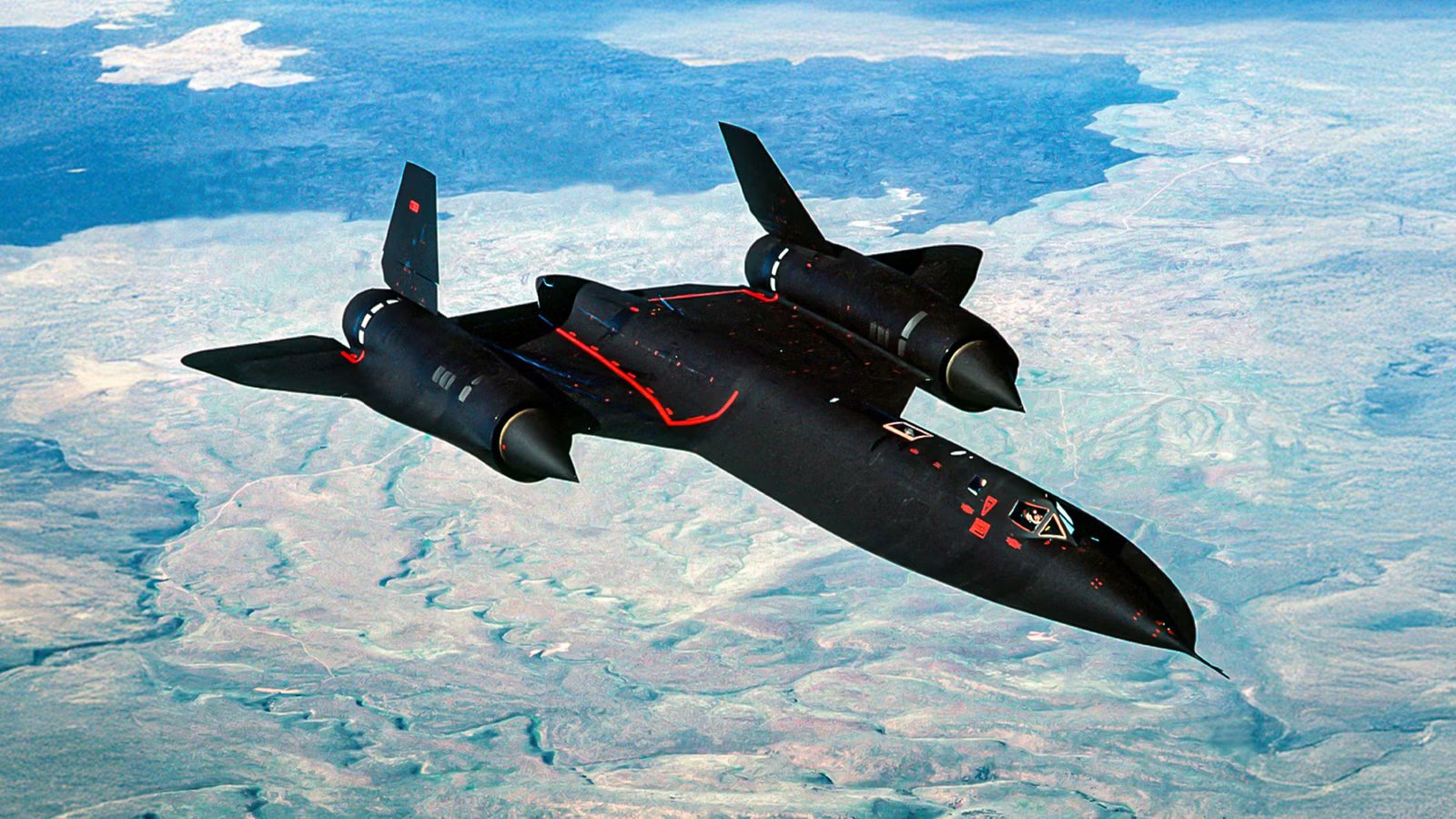
Lockheed Martin is responsible for producing some of the greatest aircraft ever made. It’s the Skunk Works division, under the leadership of Kelly Johnson, that designed and engineered marvels of aerospace that remain legendary to this day. Specifically, the SR-71 Blackbird is one of the most famous on a long list of iconic names to roll out the doors of the Skunk Works factory.
To this day, the Blackbird remains the fastest manned, air-breathing aircraft ever to enter service. It was constructed with a unique titanium airframe and skin optimized for the high speed of its Mach 3 mission, which notoriously bled jet fuel all over the runway as it prepared to get in the air. Invented amid the Cold War arms race, the Blackbird was designed with cost as no object to accomplish a mission with stakes so high that there was zero room for compromise. While a standard commercial airliner cruises at a modest 530 mph (852 kph), the Blackbird blazes past at four times that speed, allowing it to cross the entire United States, from Los Angeles to Washington, D.C., in just over an hour. The Lockheed SR-71 Blackbird has an official top speed of 2,193 mph (3,529 kph Mach 3.3), though unofficial pilot reports suggest it could exceed Mach 3.5, according to BGR.
Faster Than A Speeding Bullet

The SR-71 Blackbird’s speed is easily illustrated by the fact that it could literally outrun a ‘speeding bullet.’ Traveling at over 3,200 feet per second, the SR-71 was faster than a shot from the iconic Springfield ‘thirty-aught-six’ sniper’s rifle. The Blackbird was so extreme that its primary defense against surface-to-air missiles was not stealth or jamming, but simply accelerating, as it moved at a staggering pace of more than half-a-mile-per-second.
United States Air Force pilot accounts and historical data back up the SR-71’s reputation as effectively untouchable. It operated in a flight envelope where enemy missiles lost most of their performance. Despite approximately 4,000 missiles being fired at the fleet over its 25-year service, not a single aircraft was lost to enemy action.
Surface-to-air missiles (SAMs), like the Soviet SA-2, used nearly all their rocket fuel just to reach the SR-71’s cruising altitude of 80,000–85,000 feet. By the time they reached that height, they were often out of fuel and had no kinetic energy left to maneuver or catch up. Soviet pilots, like defector Viktor Belenko, who flew the MiG-25 Foxbat interceptor, recounted that even if a missile was fired head-on, the closing speed was so extreme that guidance systems could not adjust quickly enough to track the Blackbird, as the Aviationist wrote.
Holy Grail Of Air Speed: The SR-71

The SR-71 Blackbird holds several world records, many of which remain unbroken over 45 years later. Its most famous achievements were set in July 1976 during official record attempts and in March 1990 during its record-shattering final retirement flight, according to the SR71Blackbird.com records. Even before these legendary streaks, SR-71 set a world record for endurance flight in 1971 when Major Thomas Estes and Dwayne Vic flew over 15,000 miles in 10 hours and 30 minutes with multiple mid-air refuelings along the way.
In 1976, near Beale Air Force Base in California, the Blackbird set an absolute speed record at 2,193 mph (3,529 kph) and an absolute altitude record at 85,068 feet. It also achieved a record on a closed circuit with a 2,092 mph average speed over a 1,000 km distance. Already, in 1974, the Blackbird set the record for fastest transatlantic crossing, which still stands today, at 1 hour and 54 minutes with an average speed of 1,806 mph.
On its final flight from Palmdale, California, to the Smithsonian’s Udvar-Hazy Center in Washington, D.C., the Blackbird set four speed records in a single trip. The SR-71 set the record for flight time from Los Angeles to DC at 64 minutes and 20 seconds with an average speed of 2,144 mph (3,450 kph). It also set the transcontinental record as well as the record from Kansas City to DC and St Louis to Cincinnati.
Blackbird: The Skunk Works Masterpiece

The once clandestine Skunk Works division spearheaded the development of the SR-71. Now famous for producing some of the most groundbreaking new aircraft designs in aviation history, this legendary group of aeronautical engineers was headed up by Kelly Johnson. The group worked in extreme secrecy while enjoying minimal bureaucratic oversight, as their work was so vital to national defense.
Conceived for the Central Intelligence Agency (CIA) under the name A-12 Oxcart, this jet was the first in the family to achieve Mach 3. It was smaller and faster than the SR-71 and only carried a single pilot. The SR-71 was technically the longer, heavier two-seat variant built for the US Air Force. It was designed to carry more fuel and advanced reconnaissance sensors.
|
Specification |
Lockheed SR-71 Blackbird |
|
Max Speed |
Mach 3.32 (2,193 mph / 3,530 kph) |
|
Service Ceiling |
85,069 feet (25,929 meters) |
|
Thrust |
34,000 pounds (per engine) with afterburner |
|
Powerplant |
2 × Pratt & Whitney J58 axial-flow turbojets |
The Blackbird program alone pioneered several breakthroughs in aviation engineering. The Skunk Works team had to essentially invent a new branch of metallurgy to make the Blackbird possible. Since aluminum melts at Mach 3 speeds, the plane was built from over 80% titanium. In a bizarre twist of fate, the US had to use CIA shell companies to covertly buy the raw titanium from the Soviet Union, the very country the plane was meant to spy on.

Top 5 US Military Surveillance Aircraft That Made History
The legacy of the US military developing some of the world’s most iconic and successful surveillance aircraft looks set to continue into the future.
Grand Master Of Speed, Trailblazer Of Stealth

Although its design clearly emphasized speed as the highest priority, the SR-71 was also the world’s first aircraft to incorporate a reduced radar cross-section (RCS) design from inception. This form of low radar observability technology has since evolved to create the modern fifth, and even sixth-generation, warplanes of today, like the F-22 Raptor, F-35 Lightning II, B-2 Spirit, and B-21 Raider.
Modern stealth aircraft use computer-aided design, but the Blackbird used early geometric principles and new materials. These innovative measures cut its radar signature down by 90% as opposed to comparable aircraft of the era, according to Aviation Week. The Blackbird used a specialized ‘iron ball’ paint containing iron ferrite. This coating converted incoming radar energy into heat, dissipating it before it could reflect back.
One of the key features was the ‘chines’ or sharp, blade-like edges that extend from the nose and along the sides of the fuselage. The chines were originally meant as an aerodynamic feature that improves stability, but were found to deflect radar waves away from the rest of the airframe. The two vertical stabilizers were also tilted inward at 15 degrees. This prevented them from acting as corner reflectors, which would otherwise bounce radar signals directly back to enemy receivers.
Along the leading edges of the wings and chines, engineers used alternating wedges of titanium and composite plastic. These sawtooth shapes trapped radar waves, bouncing them internally until their energy was absorbed. Despite these innovations, the Blackbird was never truly invisible. Its massive heat signature at Mach 3 made it easy to track with infrared sensors, and its large engine inlets remained significant radar reflectors. Ultimately, its stealth was intended to give enemy radar operators just a few seconds of confusion.

Will Lockheed Martin Build The SR‑72?
Lockheed Martin’s SR-72 “Darkstar” could be real. From Top Gun fame to Mach 6 specs, here’s what we know about the hypersonic spy plane’s future.
Kelly Johnson And The Blackbird

The leaders of Lockheed remarked that Kelly Johnson could see the air. His mind was so acutely honed towards the science of Aerospace that he could make complex calculations of mass and aerodynamic performance nearly instantaneously. Johnson’s very first mass production design was the legendary P38 Lightning of WWII, which is one of the most effective and most mass-produced fighters of the entire conflict. It was even the only top fighter design to be in serial production before the beginning and after the end of hostilities.
Johnson was a genius who hated bureaucracy. He insisted on working outside Lockheed’s normal reporting lines, often starting projects on a mere handshake to avoid the delays of official submittal processes. The Skunk Works division was governed by his personal 14 rules of management and essentially worked outside the lines of typical defense contracting.
Johnson’s devotion to his work was so absolute that he turned down the presidency of Lockheed three times so he could remain at the helm of Skunk Works. Johnson was famously ‘imperious’ and demanding, reputed to deliver a swift kick in the pants as often as a compliment. Johnson was said to echo the maxim ‘KISS’ to his team as he pushed them to find pragmatic solutions: “Keep It Simple, Stupid.”
The P-38 Lightning broke the 400-mph (643 kph) barrier without jet engines. Johnson and Lockheed developed the P-80 Shooting Star, America’s first operational jet, in a staggeringly fast 143 days. Following on that landmark, the F-104 Starfighter was the first aircraft to simultaneously hold world records for both speed and altitude. Then Kelly went on to craft the U-2 Dragon Lady to fly above Soviet defenses before his Blackbird took flight. Even the ubiquitous C-130 Hercules, the longest-running production transport in history, carries his design patent.