dailynewsnblog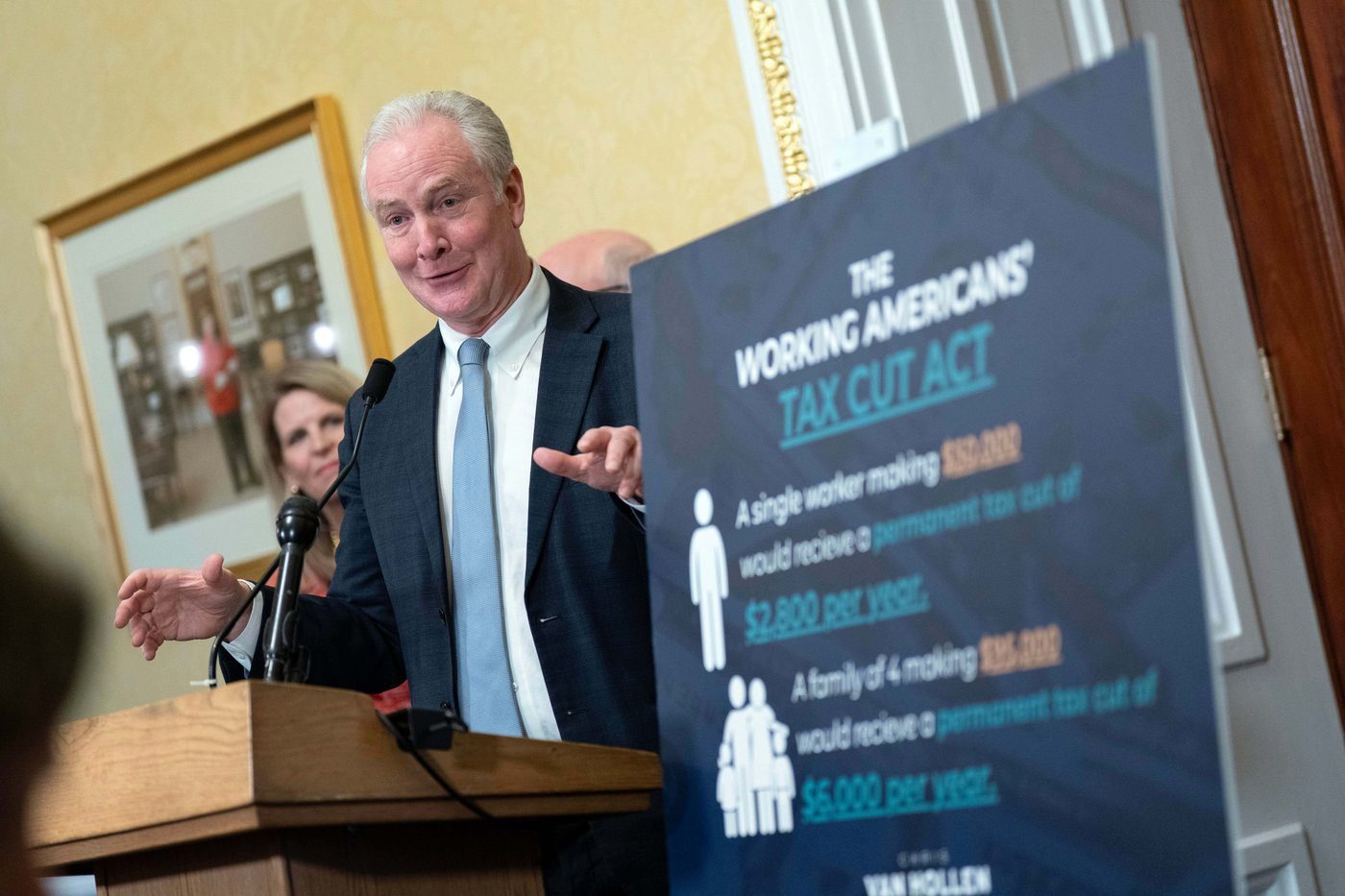
With voters’ concerns about affordability showing no sign of fading, some Democrats are rediscovering a traditionally Republican tactic for putting money back in people’s pockets — cutting taxes.
Sen. Chris Van Hollen of Maryland proposes effectively ending the federal income tax on individuals making $46,000 or less annually and reducing it for individuals making up to about $60,000 more than that amount. New Jersey Sen. Cory Booker wants to ensure households pay no income tax on the first $75,000 of earnings.
It’s an early sign that Democrats are trying to revamp their reputation by taking a page from the playbook of President Donald Trump, who stormed back to the White House with soundbite-friendly promises for things like “no tax on tips” and “no tax on overtime.”
But the plans could also undermine Democrats’ other goals, taking large pots of money off the table that could cover the cost of reversing Trump’s tax cuts for the wealthy or restoring funding to Medicaid. They would also limit funding for new initiatives that Democrats inevitably promise on the campaign trail.
Booker rejected comparisons to Trump, saying he was responding to voters who want “somebody to start fighting for them in a way that is bigger, bolder and more ambitious.”
Tax cut proposals are popping up in state races, too. Former Atlanta Mayor Keisha Lance Bottoms says she would exempt public school teachers from state income taxes as she runs for Georgia governor.
Rep. Katie Porter, who is running for California governor, says families that make under $100,000 shouldn’t pay state income tax. She said Democrats have long taken a too complicated approach to policymaking. She pointed to President Joe Biden’s Inflation Reduction Act, which included one credit for those making less than 150% the median income in their area. “I don’t even know what 150% the median income is in my area,” Porter said.
“I like this proposal more than a complex web of reductions because it’s more straightforward,” Porter said. “This is a conversation that I think Democrats should have been owning for the last decade.”
‘Make sure all those people benefit’
In the 2024 presidential election, the issue was largely owned by Trump. His ideas were panned by tax experts as inefficient and wasteful, but they resonated with voters.
Van Hollen recalled hairdressers at his local barber shop excitedly discussing their likely savings under Trump’s “no tax on tips,” which became part of last year’s Republican budget bill, which included sweeping tax cuts that mainly benefitted the wealthy and deep cuts in Medicaid.
“What our bill does is make sure all those people benefit,” Van Hollen said.
Even with their latest tax reduction proposals, Democrats are still sticking with their longstanding call for higher levies on the ultra wealthy.
Van Hollen would slap a surtax on every dollar of income over $1 million, which would pay for the tax cuts for lower incomes. Booker would raise the corporate rate nationally, and Porter would do the same in California.
Booker’s proposal, however, would still run a sizable deficit of about $7 trillion, according to the Yale Budget Lab, though Booker said the study undercounts the money he could save by ending “tax avoidance schemes” by the wealthy.
Savings for middle class ‘not impressive’
Tax cuts aimed at one group down the income ladder frequently trickle up. That has been the core of the Democratic critique of Republican tax cuts, which usually save small amounts of money for working-class people and larger sums for the more affluent because they already pay more money in taxes.
For example, Booker would increase the standard deduction from $31,500 for married couples to $75,000, which would eliminate taxes for working-class families but yield its biggest benefit for those higher on the income scale. The Yale Budget Lab found Booker’s proposal would lead to those making up to the 80th percentile in income — roughly $106,000 annually for an individual — saving 5.3% of their taxes, a slightly higher share than those in the 20th-40th percentile of income. Everyone up to the top 1% would save some money.
Van Hollen’s cuts would taper as they climb the income scale, but the Yale Budget Lab found even they would only reduce taxable income of the top 20% by about 2%, with the biggest hit — an about 12% drop — coming to the top 1%.
Because lower-income and some middle-income Americans pay so little in taxes already, the savings to the higher end of the middle class — all the way up to those who earn in the high six figures under Booker’s proposal — will be larger, analysts say.
“The breaks that middle-income people are getting out of these proposals is not impressive,” said Vanessa Williamson of the Tax Policy Center.
Tax plans for a wealthier Democratic Party
The Democrats’ choice to target the ultra rich while largely excluding the upper middle class comes as the party’s demographics have become more affluent, with increased support among educated urbanites who are not billionaires but out-earn most Americans.
“The Democratic approach is different than anything in the past, in that it’s trying to splice away the very wealthiest from people who are also wealthy,” said Alan Cole, an economist at the conservative Tax Foundation in Washington, D.C. “Democratic priorities mirror what their coalition looks like.”
Chuck Marr, vice president of the liberal Center on Budget Priorities and Policies, noted that Democrats will desperately need revenue to reverse Trump’s cuts. “Reversing those costs a lot of money,” he said.
Deficits, already high after the COVID-19 pandemic, have exploded in Trump’s second term, helping keep interest rates elevated, which aggravates voters’ affordability complaints. Marr worried the proposals may end up benefitting more affluent taxpayers than advertised. “I just don’t think the execution works as well as the intention,” Marr said.
Democratic politicians, however, are enthusiastic. Van Hollen’s legislation picked up 19 cosponsors from fellow Democratic senators, as well as the two independents who caucus with the party. It’s also been embraced by prominent labor organizations, including the AFL-CIO, whose president, Liz Shuler, contrasted the legislation with prior Democratic efforts to help workers.
“We need ideas that are as clear and simple as the demands workers have given us,” Shuler said at a press conference earlier this month introducing the bill. “That’s how we restore faith — give people real relief.”
Porter argued that her party needs to change how they think about taxes, nodding to concerns that California is losing residents for more conservative states like Texas.
“Democrats need to recognize that taxes are a tool, yes, for funding programs to help people,” she said, “but they are also a driver of unaffordability.”
Nicholas Riccardi And Mike Catalini, The Associated Press