dailynewsnblog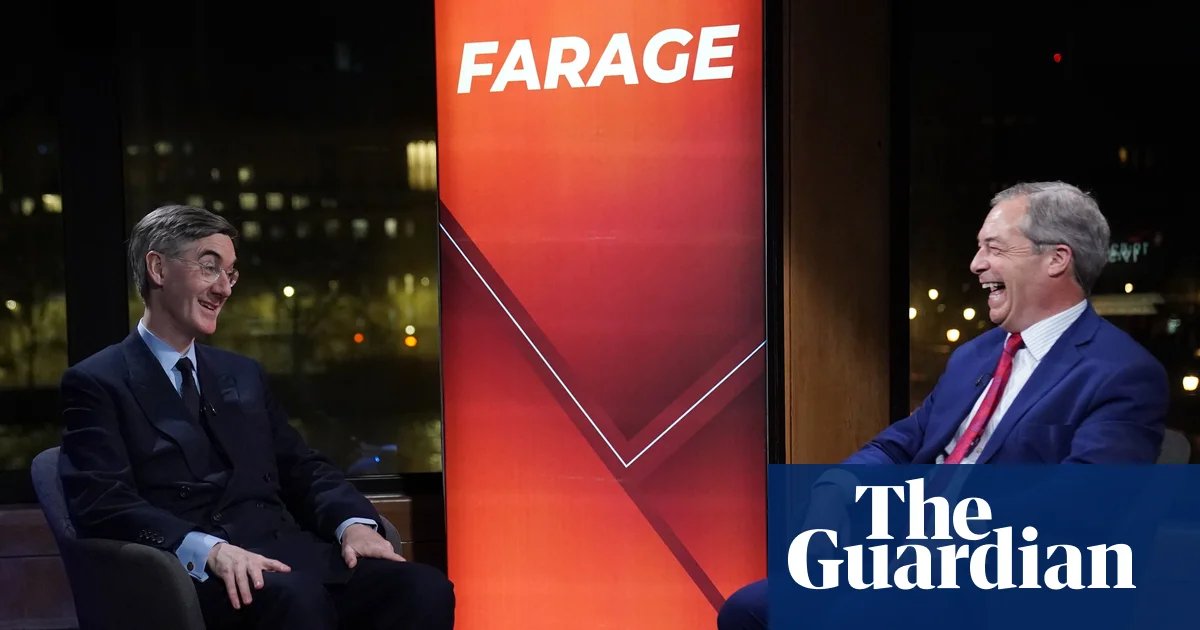
More than £170m was given to MPs, political parties, media organisations and thinktanks aligned with the UK’s populist right over the past five years, new research from the Labour MP Liam Byrne has found.
Byrne, a former cabinet minister who chairs parliament’s business committee, said he had identified a “media-political complex” funded largely by a handful of billionaires.
He said news organisations, such as GB News, are receiving large amounts of money to fund their broadcasting, while paying rightwing politicians to act as presenters, which in turn amplifies their views. Some of those views are then clipped on social media, which generates more money a click.
The research was carried out for Byrne’s new book, Why Populists Are Winning and How to Beat Them, with updated figures showing even greater sums of money have been given in the past year, including £12m to Reform from the crypto investor Christopher Harborne.
Byrne said his research “maps for the first time the financial architecture of Britain’s populist right – and found a media-political complex of extraordinary scale, built in plain sight in just five years”.
The research analysed almost 500 transactions covering January 2020 to February 2026 drawn from the Electoral Commission, the Register of Members’ Financial Interests, Companies House filings and civil society reports.
He said more than £130m can be traced to just four entities: Harborne, the hedge fund manager Paul Marshall, the Dubai-based investment firm Legatum and the financier Jeremy Hosking.
The vast majority – more than £133m, or 76% of the total – went not to political parties but to three media organisations: GB News, the Critic, and UnHerd. Byrne said GB News “privileges and channels coverage to Reform politicians” while the Critic and UnHerd predominantly feature rightwing and “anti-woke” voices, although UnHerd claims to be non-partisan.
GB News is funded by Legatum and Marshall, while the Critic is bankrolled by Hosking and UnHerd by Marshall.
Byrne said a further 14% of the funds identified took the form of direct donations to MPs or parties registered with the Electoral Commission.
In addition, Reform’s MPs recorded more than £770,000 in payments for work carried out for GB News in the register of members financial interests, while Nigel Farage, Richard Tice, Lee Anderson and Rupert Lowe declared more than £100,000 in combined earnings from X, Google and Meta.
Byrne said: “Populist funders are not simply bankrolling parties. They are heeding the advice of political strategists from Alain de Benoist to Pat Buchanan and Andrew Breitbart – that politics is downstream of culture. They’re investing directly to support populist parties, but more important they’re investing in a media ecosystem, bankrolling the “polytainment” platforms that reward populist politicians with the currency of our age: attention, amplification, clicks and cash.”
His book also looks at what he calls a fundamental gap in Britain’s democratic defences, arguing that funding to media companies and thinktanks, which is later used to pay politicians, attracts little meaningful public scrutiny.
The senior MP is calling for urgent reform as part of the government’s elections bill, including a ban on cryptocurrency donations, for media laws to cover digital and social media, and for any significant investment in a media organisation by a donor who also makes political donations to be disclosed to the Electoral Commission.
He also called for emergency powers for Ofcom during election periods, restrictions on foreign ownership of significant platforms, and provisions to treat systematic algorithmic bias in favour of one party as a recordable campaign contribution within spending limits.
Legatum, Harborne, GB News and Hosking were approached for comment. Legatum said it was proud to be an investor in GB News. “The channel is successful not because of some perceived political positioning, but because it has filled a gap in the media landscape where the views of many British communities were not represented.
“Unlike the Guardian, GB News has chosen to operate in the regulated broadcast market. It is editorially independent, with an editorial compass set not on the party-political spectrum but based on the very clear values expressed in its editorial charter.
“(The) characterisation of the funding of GB News is entirely misleading. Legatum has not ‘given’ anything to GB News. Legatum is an investment firm with an equity investment in the parent company of GB News, All Perspectives Ltd. This is a commercial investment in a media business and should in no way be mischaracterised as a donation. As the company’s recent financial results show, GB News is firmly on track to become the UK’s biggest news channel by 2028, with revenue up 65% in the last 12 months and significant audience growth across both TV and radio and expansion of digital platforms.”