Trending News:Strike on Sudan hospital kills at least 64 and wounds 89 more, WHO reports | SudanKendra Duggar, Wife of ‘19 Kids and Counting’ Star, Faces Child Endangerment ChargesAlmost 100 wounded in Iranian missile strikes on southern Israel | IsraelToday’s NYT Connections Hints, Answers for March 22 #1015Doug Ford's crackdown on ticket scalpers draws warnings it could push prices higherCiara Revives the Clear Shoe Trend in Silver Heels in MiamiHero modder restores the coolest bit of Elden Ring cut content: The heartbreaking tragedy of the second guy you meet that actually kinda justifies the game’s most evil endingKraft Hockeyville Reveals Taber, AB and Tumbler Ridge, BC as Top Two Finalists in 20th Anniversary YearFréchette and Drainville face off in first CAQ leadership debate – MontrealIPL 2026 – SLC tells Sri Lanka players to clear fitness test to get NOCOeuf review: a punishing platformer in a cozy shellAir Canada Adds 31% More Transatlantic Boeing 737 MAX Flights This SummerIranian missile strikes Israeli city near main nuclear research facility.Petrol theft expected to rise in Australia as police call for more CCTV and prepaid pumps | Petrol pricesTrump threatens to put ICE agents in airports starting Monday amid DHS funding impasseDetained immigrant children still face concerning conditions at Texas facility, lawyers sayJeff Bezos throws his hat in the ring for an orbital data center megaconstellation, tooCrimson Desert’s in-game artwork shows telltale signs of AI courtesy of missing fingers and human bodies melting into horsesCattle farmers slam N.B. plan to end vet services – New BrunswickLines at TSA checkpoints grow longer amid spring break travel rush2026 NCAA Tournament bracket: March Madness schedule and scores by regionICC Chief Prosecutor Khan cleared of sexual misconduct by judges: Report | ICC News20 Best Women’s Health Podcasts In 202616 Best Camera Bags, Slings, Straps, and Backpacks (2026), Tested and ReviewedIran hits Israeli town housing nuclear facility in retaliation for Natanz strike | IsraelWhat It Costs To Fly First Class On The World’s Longest Airbus A350 RoutesSneak preview of Propstore's latest auctionMore than 400 TSA officers have quit since shutdown beganAustralia news live: Tropical Cyclone Narelle crosses NT coast as category three system | Australia newsTrump threatens to deploy ICE agents to U.S. airports – NationalIt’s been 20 years since the first tweetNCAA tournament Sweet 16 updates: Tracking which men’s and women’s teams advance in March MadnessThese 20 one-season anime are perfect for unwinding during the weekendI spent five months in a mother and baby mental health unit – here's what I want mums to knowCanadians plan to sail to Gaza despite detention risks – NationalReddit is weighing identity verification methods to combat its bot problem30 Chic Mango, Topshop, and COS Picks at Nordstrom for 2026Zelensky Sends Negotiators to the U.S., Hoping to Revive Peace TalksFormer FBI Director Robert Mueller, who investigated Russia-Trump campaign ties, diesIran Fires Missiles at Far-Off Diego Garcia Base, but U.S. Remains Out of Range'Not good enough' – Rosenior rues Chelsea mistakesWhy Might The World’s Game-Changing Single-Aisle Aircraft Have Boeing Worried?CRTC to eliminate fees when cancelling or…‘Winding down’ the war and easing sanctions but adding more troopsThe Next Minecraft Drop Could Be Its Most Chaotic YetCanadians’ Easter meal to cost more this year as beef prices keep climbing – NationalToday’s NYT Wordle Hints, Answer and Help for March 22 #1737‘Tears and grief’: Mother’s Day in Gaza marked by mourning | Israel-Palestine conflict NewsICE officers soon will help with airport security unless Democrats end shutdown, Trump saysWind and solar — the cheapest energy sourcesHalide co-founder is suing Sebastiaan de With for taking code to AppleWomen’s March Madness live updates: Follow all of Saturday’s actionJets lose to Crosby and the Penguins 5-4 in shootout – WinnipegVideo Body camera footage from Justin Timberlake’s 2024 DWI arrest releasedThe Best Deals Today: Castlevania Blu-ray Box Set, Dragon Quest VII Reimagined, LEGO Project Hail Mary, and MoreHow to get the most out of a tank of gasGwyneth Paltrow Joined the Jude Date Mule Trend in New York‘Vile’ Trump condemned for gloating over Robert Mueller death | Donald TrumpMan critically injured in Etobicoke stabbing, suspect soughtAn early Indigenous site may not be early, but it doesn’t really matterRobert Mueller, ex-FBI chief who led Trump-Russia inquiry, dead at 81Fanny Utagushimaninde: Rwanda batter is youngest woman to make T20 international centuryIAEA looking into Iran’s report that Natanz nuclear site hit in strikesSenate blocks voting bill’s amendment on transgender athletes during rare weekend sessionHow BYD Got EV Chargers to Work Almost as Fast as Gas PumpsMinecraft Dungeons II Announced For Switch 1 & 2, Out This YearShockwave of War Is Rippling Through the Global EconomyLondon Knights remain in driver’s seat for home ice after shootout victory over Windsor – LondonThis Luxury All-Business Airline Is Launching London & Paris To Maldives Flights In DecemberThe 10 Best Eye Makeup Removers of 2026, Per ExpertsThis remote First Nation is using 1 generator to power the whole community — againPublisher pulls horror novel ‘Shy Girl’ over AI concernsWorld Cup 2027 – Edward Khoza, Qondisa Ngwenya get top posts in local organising committeeWith Fire and Song, Kurds in Turkey Hail the Start of SpringUS Touts Progress in Iran as Trump Floats ‘Winding Down’How fans and industry insiders feel about Ontario’s ticket resale crackdownHow Corey Lewandowski Wielded Power Inside D.H.S.https://www.youtube.com/watch?v=fjI_Akk5z8Y&feature=youtu.beTeen dies in Quebec pedestrian collision in Vaudreuil‑DorionWhat to read this weekend: Revisiting Project Hail Mary and The Thing on the DoorstepElon Musk Offers To Pay TSA Workers’ Salaries As Airport Wait Times WorsenEU urges members to start storing winter gas as Iran war causes price surge | Oil and Gas NewsG7 Foreign Ministers’ Statement on support to partners in the Middle EastState Street, Voya Seek Shelter From Default RiskGuelph, Ont., model becomes 1st transgender person to walk Chanel Exclusive’s runway at Paris Fashion WeekLittle Darlin’Giants’ Cam Skattebo says CTE, asthma are fake, calls it an ‘excuse’Chase Infiniti Brings Cobalt Drama to Series Mania in Louis VuittonBanff National Park breaks visitation record — againEmily Blunt and Cillian Murphy Returning for ‘A Quiet Place: Part III’Robert Mueller, former FBI director and special counsel, dies at 81March Madness 2026: How to Watch the First Round Without CableGod is dead and I am a bullet hell boss of my own making in the physics-based dicerolling roguelike DeeSicksSuperannuation should be used for aged care, not inherited by next generation, aged care CEO says | Aged careState Street, Voya Seek Shelter From Default RiskCanadian ski cross siblings Hannah, Jared Schmidt each earn World Cup silver on home snowCanadians plan to sail to Gaza despite detention risksFormer special counsel and FBI director Robert Mueller dies at age 81Ghost in the Machine’s Valerie Veatch isn’t drinking the AI Kool-Aid49ers’ reason for not releasing Brandon Aiyuk yet revealed by insider
Welcome to Daily News & Blog – your go-to source for the latest news, insightful blogs, and trending stories from around the world.
Who We Are
At Daily News & Blog, we are passionate about delivering accurate, timely, and engaging content across various categories, including world news, economy, technology, sports, gaming, travel, fashion, health, and more. Our goal is to keep you informed, inspired, and ahead of the trends.
What We Offer
✔ Breaking News & In-Depth Analysis – Stay updated with real-time updates and well-researched articles. ✔ Diverse Topics – Covering everything from global events to lifestyle, entertainment, and innovation. ✔ Engaging Blogs – Thought-provoking opinions and expert insights on trending subjects. ✔ Reliable Sources – We curate information from trusted news providers and industry experts.
Our Mission
We aim to be more than just another news website. Our mission is to create a platform where information meets authenticity, helping our readers navigate an ever-changing world with clarity and confidence.
Join Us
Follow us for daily updates and be part of a growing community that values knowledge and meaningful discussions.
📩 Have a story or feedback? Contact us at info@dailynewsnblog.com
Trending News:Strike on Sudan hospital kills at least 64 and wounds 89 more, WHO reports | SudanKendra Duggar, Wife of ‘19 Kids and Counting’ Star, Faces Child Endangerment ChargesAlmost 100 wounded in Iranian missile strikes on southern Israel | IsraelToday’s NYT Connections Hints, Answers for March 22 #1015Doug Ford's crackdown on ticket scalpers draws warnings it could push prices higherCiara Revives the Clear Shoe Trend in Silver Heels in MiamiHero modder restores the coolest bit of Elden Ring cut content: The heartbreaking tragedy of the second guy you meet that actually kinda justifies the game’s most evil endingKraft Hockeyville Reveals Taber, AB and Tumbler Ridge, BC as Top Two Finalists in 20th Anniversary YearFréchette and Drainville face off in first CAQ leadership debate – MontrealIPL 2026 – SLC tells Sri Lanka players to clear fitness test to get NOCOeuf review: a punishing platformer in a cozy shellAir Canada Adds 31% More Transatlantic Boeing 737 MAX Flights This SummerIranian missile strikes Israeli city near main nuclear research facility.Petrol theft expected to rise in Australia as police call for more CCTV and prepaid pumps | Petrol pricesTrump threatens to put ICE agents in airports starting Monday amid DHS funding impasseDetained immigrant children still face concerning conditions at Texas facility, lawyers sayJeff Bezos throws his hat in the ring for an orbital data center megaconstellation, tooCrimson Desert’s in-game artwork shows telltale signs of AI courtesy of missing fingers and human bodies melting into horsesCattle farmers slam N.B. plan to end vet services – New BrunswickLines at TSA checkpoints grow longer amid spring break travel rush2026 NCAA Tournament bracket: March Madness schedule and scores by regionICC Chief Prosecutor Khan cleared of sexual misconduct by judges: Report | ICC News20 Best Women’s Health Podcasts In 202616 Best Camera Bags, Slings, Straps, and Backpacks (2026), Tested and ReviewedIran hits Israeli town housing nuclear facility in retaliation for Natanz strike | IsraelWhat It Costs To Fly First Class On The World’s Longest Airbus A350 RoutesSneak preview of Propstore's latest auctionMore than 400 TSA officers have quit since shutdown beganAustralia news live: Tropical Cyclone Narelle crosses NT coast as category three system | Australia newsTrump threatens to deploy ICE agents to U.S. airports – NationalIt’s been 20 years since the first tweetNCAA tournament Sweet 16 updates: Tracking which men’s and women’s teams advance in March MadnessThese 20 one-season anime are perfect for unwinding during the weekendI spent five months in a mother and baby mental health unit – here's what I want mums to knowCanadians plan to sail to Gaza despite detention risks – NationalReddit is weighing identity verification methods to combat its bot problem30 Chic Mango, Topshop, and COS Picks at Nordstrom for 2026Zelensky Sends Negotiators to the U.S., Hoping to Revive Peace TalksFormer FBI Director Robert Mueller, who investigated Russia-Trump campaign ties, diesIran Fires Missiles at Far-Off Diego Garcia Base, but U.S. Remains Out of Range'Not good enough' – Rosenior rues Chelsea mistakesWhy Might The World’s Game-Changing Single-Aisle Aircraft Have Boeing Worried?CRTC to eliminate fees when cancelling or…‘Winding down’ the war and easing sanctions but adding more troopsThe Next Minecraft Drop Could Be Its Most Chaotic YetCanadians’ Easter meal to cost more this year as beef prices keep climbing – NationalToday’s NYT Wordle Hints, Answer and Help for March 22 #1737‘Tears and grief’: Mother’s Day in Gaza marked by mourning | Israel-Palestine conflict NewsICE officers soon will help with airport security unless Democrats end shutdown, Trump saysWind and solar — the cheapest energy sourcesHalide co-founder is suing Sebastiaan de With for taking code to AppleWomen’s March Madness live updates: Follow all of Saturday’s actionJets lose to Crosby and the Penguins 5-4 in shootout – WinnipegVideo Body camera footage from Justin Timberlake’s 2024 DWI arrest releasedThe Best Deals Today: Castlevania Blu-ray Box Set, Dragon Quest VII Reimagined, LEGO Project Hail Mary, and MoreHow to get the most out of a tank of gasGwyneth Paltrow Joined the Jude Date Mule Trend in New York‘Vile’ Trump condemned for gloating over Robert Mueller death | Donald TrumpMan critically injured in Etobicoke stabbing, suspect soughtAn early Indigenous site may not be early, but it doesn’t really matterRobert Mueller, ex-FBI chief who led Trump-Russia inquiry, dead at 81Fanny Utagushimaninde: Rwanda batter is youngest woman to make T20 international centuryIAEA looking into Iran’s report that Natanz nuclear site hit in strikesSenate blocks voting bill’s amendment on transgender athletes during rare weekend sessionHow BYD Got EV Chargers to Work Almost as Fast as Gas PumpsMinecraft Dungeons II Announced For Switch 1 & 2, Out This YearShockwave of War Is Rippling Through the Global EconomyLondon Knights remain in driver’s seat for home ice after shootout victory over Windsor – LondonThis Luxury All-Business Airline Is Launching London & Paris To Maldives Flights In DecemberThe 10 Best Eye Makeup Removers of 2026, Per ExpertsThis remote First Nation is using 1 generator to power the whole community — againPublisher pulls horror novel ‘Shy Girl’ over AI concernsWorld Cup 2027 – Edward Khoza, Qondisa Ngwenya get top posts in local organising committeeWith Fire and Song, Kurds in Turkey Hail the Start of SpringUS Touts Progress in Iran as Trump Floats ‘Winding Down’How fans and industry insiders feel about Ontario’s ticket resale crackdownHow Corey Lewandowski Wielded Power Inside D.H.S.https://www.youtube.com/watch?v=fjI_Akk5z8Y&feature=youtu.beTeen dies in Quebec pedestrian collision in Vaudreuil‑DorionWhat to read this weekend: Revisiting Project Hail Mary and The Thing on the DoorstepElon Musk Offers To Pay TSA Workers’ Salaries As Airport Wait Times WorsenEU urges members to start storing winter gas as Iran war causes price surge | Oil and Gas NewsG7 Foreign Ministers’ Statement on support to partners in the Middle EastState Street, Voya Seek Shelter From Default RiskGuelph, Ont., model becomes 1st transgender person to walk Chanel Exclusive’s runway at Paris Fashion WeekLittle Darlin’Giants’ Cam Skattebo says CTE, asthma are fake, calls it an ‘excuse’Chase Infiniti Brings Cobalt Drama to Series Mania in Louis VuittonBanff National Park breaks visitation record — againEmily Blunt and Cillian Murphy Returning for ‘A Quiet Place: Part III’Robert Mueller, former FBI director and special counsel, dies at 81March Madness 2026: How to Watch the First Round Without CableGod is dead and I am a bullet hell boss of my own making in the physics-based dicerolling roguelike DeeSicksSuperannuation should be used for aged care, not inherited by next generation, aged care CEO says | Aged careState Street, Voya Seek Shelter From Default RiskCanadian ski cross siblings Hannah, Jared Schmidt each earn World Cup silver on home snowCanadians plan to sail to Gaza despite detention risksFormer special counsel and FBI director Robert Mueller dies at age 81Ghost in the Machine’s Valerie Veatch isn’t drinking the AI Kool-Aid49ers’ reason for not releasing Brandon Aiyuk yet revealed by insider
(Bloomberg) — As rising energy prices and growing inflation fears make corporate bonds look increasingly risky, big money managers including State Street and Voya Investment Management have been looking at buying mortgage bonds and other securitized debt instead.
Mortgage bonds often perform better than US high-grade corporate debt in “risk off” markets where investors are becoming more fearful, wrote Spencer Rogers, strategist at Goldman Sachs, in a note this week.
Most Read from Bloomberg
The debt is getting extra support now from Fannie Mae and Freddie Mac, after US President Donald Trump in January directed the companies to buy another $200 billion of the bonds. It’s worth looking at mortgage bonds that might perform better if rates fall again, Rogers wrote. For instance, purchasing specified pools designed to protect against higher prepayment speeds means investors can hang on to those cashflows for longer as rates fall.
Meanwhile, there’s ample reason to be worried about corporate debt. Crude oil futures have surged amid the US and Israeli attacks on Iran, and Iran’s retaliation on energy sites in nearby countries. West Texas Intermediate futures topped the $95-a-barrel range this week, compared with $57.42 at the end of last year. Prices in other markets are rising even more. Higher energy prices can effectively act as a tax on manufacturers and consumers, and can weigh on profits.
Higher oil prices may also make it harder for the Federal Reserve to continue cutting rates. On Wednesday, Fed Chair Jerome Powell said that central banks usually view higher energy prices as transitory, but inflation has been above the Fed’s 2% target for five years, implying that the central bank has less leeway to dismiss higher oil prices now. Bond traders are no longer pricing in any US rate cuts this year.
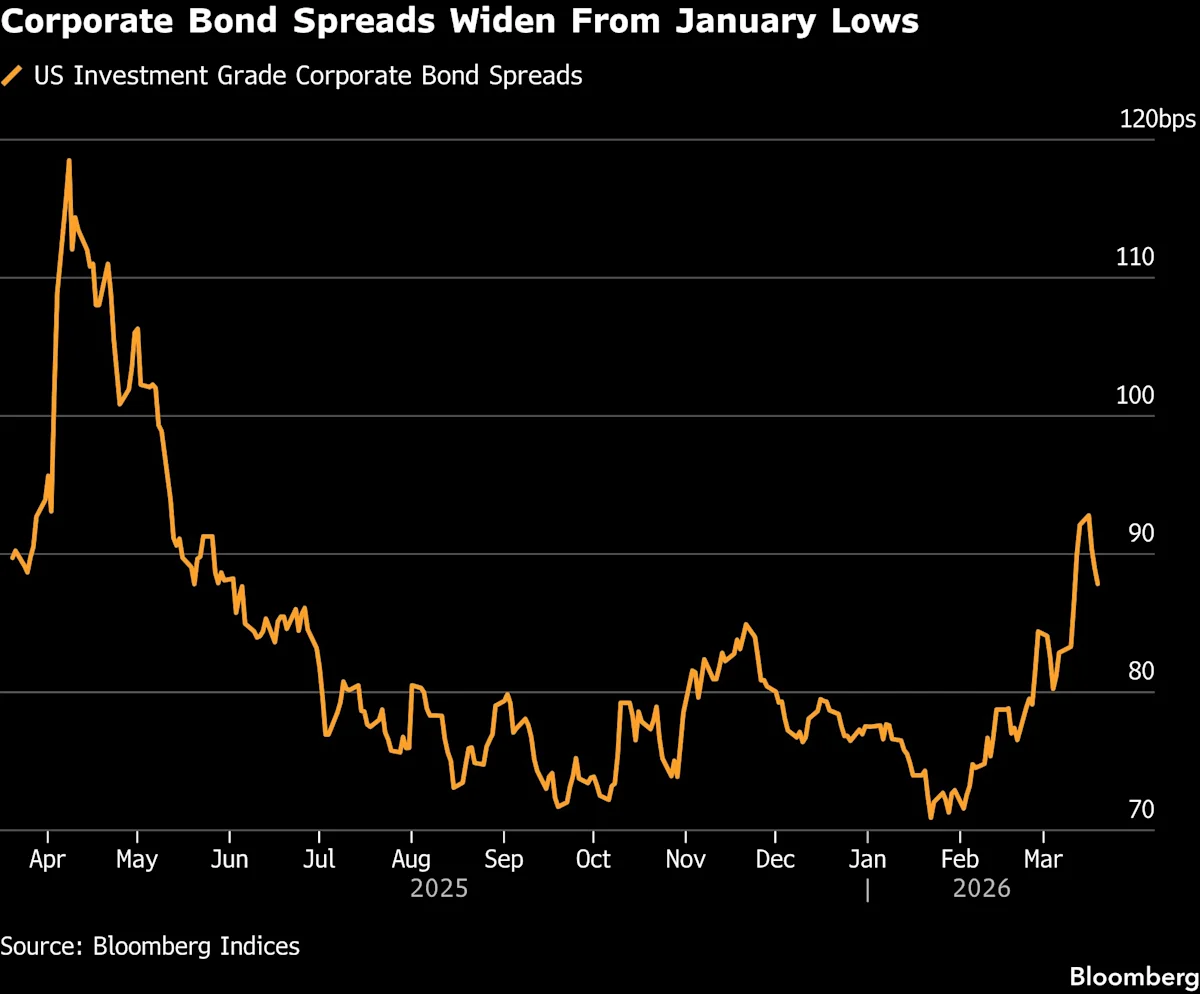
If rates stay higher for longer than expected, corporate profits could be hit as future borrowing costs rise. That’s at least part of the reason that US high-grade corporate bond spreads have widened by about 0.17 percentage point from their Jan. 22 lows. It may also be part of why the bonds have lost value this year on a total return basis.
Mortgage bonds, meanwhile, have gained a bit, according to Bloomberg index data. The securities look attractive from a relative value standpoint compared with corporate bonds, said Matthew Nest, global head of active fixed income at State Street Investment Management.
The gap between the current production mortgage bond spread and the high-grade corporate bond spread was around 0.33 percentage point as of Thursday’s close, according to Bloomberg index data. The average gap during the last decade was negative, because current coupon mortgage bond spreads have tended to be tighter than the high-grade corporate bond spread. By that standard, MBS are relatively cheap.
It makes sense to avoid credit risk in this part of the cycle, according to Nest. Mortgage bonds are more closely correlated with interest-rate fluctuations, and a measure of that volatility has been declining in recent days. The firm has been overweight mortgage bonds and other securitized debt relative to benchmarks for much of the past year.
“Late cycle, securitized debt tends to seem attractive,” State Street’s Nest said.
There are risks to the trade of favoring mortgage bonds and other securitized debt over corporate debt. The moment the war in Iran ends, or the Trump administration pulls back from the conflict, high-grade credit spreads could snap back quickly, narrowing 0.2 percentage point, said Tony Trzcinka, portfolio manager at Impax Asset Management.
“If we’ve learned anything from the past year, it’s that this administration will do everything in its power to provide a floor on markets,” Trzcinka said.
On top of that, many markets in the coming months may end up being driven by oil prices. As long as energy prices create inflationary pressure, and doubt about the future direction of rates, both corporates and mortgage bonds could be hit, said Brian Quigley, senior portfolio manager and head of MBS and agency debt at Vanguard.
“I think you need to be really careful with what correlation you’re assuming between MBS and corporate bonds at the moment,” Quigley said. While over a long period of time the two tend to have a low but positive correlation, the connection between them may be closer than usual in the near term, he said.
But credit faces other pressure too, including artificial intelligence disrupting software companies, and private credit potentially facing growing losses. Those factors had been weighing on corporate bonds even before the US and Israel first attacked Iran.
Given those risks, it might make sense to favor MBS and other securitized debt over corporate bonds, said David Goodson, managing director and head of MBS at Voya Investment Management.
“In a world like we have today, MBS offers an appealing source of diversification,” Goodson said.
Click here for a podcast on how a bank retreat from private credit is pressuring BDCs
WATCH: This week’s guests include Schwab Center for Financial Research’s Kathy Jones, Allspring Global Investment’s George Bory, BNP Paribas’ Head of Credit Strategy Meghan Robson, and CreditSights’ Head of US IG & Macro Strategy Zachary Griffiths.Schwab Center for Financial Research Kathy Jones, Allspring Global Investment George Bory, BNP Paribas Head of Credit Strategy Meghan Robson, and CreditSights Head of US IG & Macro Strategy Zachary Griffiths.
Week In Review
Goldman Sachs Group Inc. says investors should turn to high-yield debt from the energy sector, mortgage bonds and credit derivatives as turmoil in the Middle East disrupts global oil supply and stokes fears of global inflation. But the Iran war-induced credit market selloff is prompting some money managers to buy oversold investment-grade bonds, in a bet that solid fundamentals will help them withstand the conflict and economic uncertainties. Dealers have accumulated US high-grade corporate notes at the fastest pace in at least 10 years, according to Bank of America Corp., due to a near-record week of issuance.
Wall Street lending giants would get relaxed capital requirements under proposals unveiled by the Federal Reserve on Thursday, in a move that could potentially unleash billions of dollars for lending, share buybacks and dividends.
If finalized, the plans — along with moves to ease the enhanced supplementary leverage ratio and overhaul stress tests — would amount to some of the biggest bank-capital rule changes since those enacted after the 2008 global financial crisis.
Goldman Sachs and JPMorgan are among investment banks offering hedge fund clients ways to bet against the private credit market, by assembling baskets of listed companies with exposure to the space. Meanwhile, Pimco is staying away from loans being put up for sale amid the private credit tumult as they’re “pretty bad,” according to its president Christian Stracke.
The industry may need years to work through the “intense yet warranted reset” that caused a wave of redemptions from some of the market’s biggest funds, according to Sixth Street Partners. Redemption pressures may cause certain retail-oriented structures to be “frozen,” Park Square Capital’s Robin Doumar said.
Morgan Stanley expects that default rates in direct lending will climb to 8% as advances in AI continually disrupt the software industry.
Still, top executives from Deutsche Bank AG, UBS Group AG and Societe Generale SA touted the quality of their exposures to private credit amid the concerns over underwriting standards and AI’s impact. TCW Group’s Katie Koch sees buying opportunities and says the firm is looking to deploy capital across fresh loans and rescue financing. Sumitomo Life Insurance Co. is considering allocating about ¥300 billion ($1.9 billion) in private credit in the fiscal year starting April. Oak Hill Advisors is courting retail investors who have grown more skeptical of private credit with the launch of a fund that will deploy capital across public and private debt.
Banks led by JPMorgan attracted enough demand for the nearly $15 billion of debt it is selling to back the leveraged buyout of video game maker Electronic Arts Inc., the largest of its kind. In a reversal of fortunes, another group of banks led by JPMorgan halted a $5.3 billion debt deal for software firm Qualtrics International Inc. after failing to win over investors amid deepening anxiety around AI disruption.
JPMorgan is also leading a $2 billion debt sale to finance the purchase of Janus Henderson Group Plc by Nelson Peltz’s Trian Fund Management and General Catalyst, which are locked in a bidding war to buy the asset manager with Victory Capital.
Nexstar Media Group Inc. amended the financing tied to its acquisition of fellow TV-station owner Tegna Inc. as demand for risky debt comes under strain amid a flood of loan and bond sales tied to buyouts.
China Evergrande liquidators’ lawsuit to claw back funds from the builder’s auditors will finally reach its first public court hearing in May, about two years after being filed.
Market Financial Solutions Ltd. faces an investigation by the UK financial regulator, marking the first publicly disclosed action by authorities into the mortgage lender that collapsed owing billions to Wall Street lenders.
Meta Platforms Inc., Alphabet Inc. and Microsoft Corp. joining an index of high-grade firms’ credit default swaps is another sign of investors increasingly hedging hyperscalers’ debt amid surging bond sales.
Spandex maker The Lycra Company filed for Chapter 11 bankruptcy to implement a restructuring that will see most of its debt written off after creditors took control.
Billionaire Wes Edens reached a deal with creditors to restructure New Fortress Energy Inc., in a transaction that will cut the company’s debt by 90%.
On the Move
David Rogal, previously a managing director and fixed income portfolio manager at BlackRock, joined hedge fund Millennium Management as a senior portfolio manager in the fixed income group.
Justin Polselli, a leveraged finance banker at Jefferies Financial Group Inc., is leaving the lender to join Moelis & Co. as part of its debt capital markets team.
Derby Lane Partners LP, a real estate credit investment firm formed last year, tapped former Citigroup Inc. banker Nishant Nadella to lead its public investments including commercial mortgage-backed securities.
Deutsche Bank AG named Panos Stergiou global head of large corporate coverage, a newly created group across the corporate bank and the fixed income desk. Meanwhile Jan-Philipp Gillmann is leaving after working on corporate client coverage over the past six years.
Kraft Hockeyville Reveals Taber, AB and Tumbler Ridge, BC as Top Two Finalists in 20th Anniversary Year
Kraft Heinz Canada’s heritage can be traced back over a century to when James Lewis Kraft of Stevensville, Ontario began selling cheese from a horse-drawn wagon in 1903. Heinz Canada…
Lines at TSA checkpoints grow longer amid spring break travel rush
IE 11 is not supported. For an optimal experience visit our site on another browser. Markets drop as gas prices, mortgage rates rise 00:53 Cost of war in Iran hits…


 dailynewsnblog