dailynewsnblog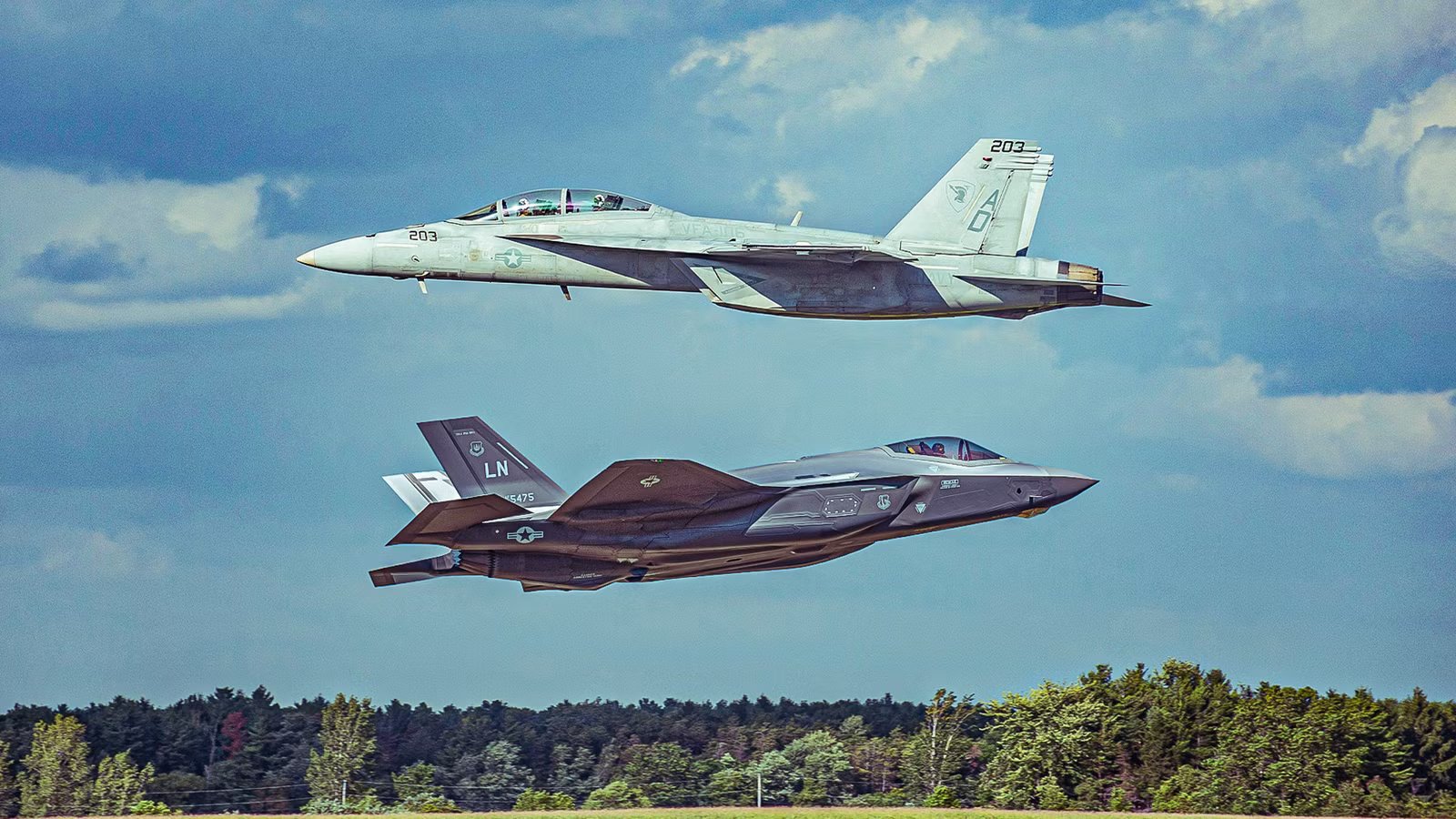
The first carrier-capable stealth fighter was introduced to the United States Navy in 2019 when the Lockheed Martin F-35C entered service. The Lightning II brought the Navy into the fifth-generation of air warfare, but the venerable  Boeing F/A-18E/F Super Hornet continues to serve as the workhorse strike fighter of Naval Aviation. Today, these jets serve on the same flight deck as complementary platforms despite the decades of technological disparity.
If the Super Hornet is the workhorse, then the Navy’s F-35C is a quarterback on the battlefield. Although the Lightning II is newer, the F/A-18 has evolved into a 4.5-Gen fighter that continues to be upgraded, and the final examples have not yet rolled off the assembly line. The Super Hornet is the superior asset in terms of payload and is a more rugged airframe that requires less delicate handling between sorties.
Although the Super Hornet doesn’t require the white-glove treatment of the Lightning II, the F-35 would win every time in a dogfight thanks to its stealth and cutting-edge weapons systems. As more advanced drones and missiles develop, the F-35 is an indispensable asset of the modern carrier air wing. The Super Hornet will remain on the flight deck for many years to come, but the chapter in history when it was the premier fighter of US Naval Aviation has officially come to a close.
CVW-F: The Air Wing Of The Future

The Joint Strike Fighter, or the F-35, was purpose-built to overcome both the threat of near-peer adversaries with their own stealth platforms, like China, and unconventional threats like the drones and missiles used by Iran. It is not only because of the stealth technology that the jet uses, but also the immensely powerful data processing power of the avionics and weapon systems onboard.
The F-35C acts as a battle manager or quarterback. Its systems automatically fuse data from its radar, 360-degree cameras, and electronic sensors into a single, clear picture for the pilot. It shares this real-time data with the rest of the Carrier Strike Group (CSG), including Super Hornets and AEGIS destroyers. This allows the F-35C to find targets for the Super Hornets to strike from a safe distance.
The F-35C is used for penetrating highly contested airspace to destroy air defenses and gather intelligence. The Super Hornet, even with Block III’s radar-absorbent coatings, remains easily detectable by modern air defenses. The F-35C’s stealth allows it to penetrate Anti-Access/Area Denial (A2/AD) zones to take out high-value targets that a Super Hornet cannot safely reach.
Fat Amy’s Secret: The F-35 Advantage

Fat Amy, as the F-35 is jokingly referred to, is becoming even more powerful as it is undergoing the Block 4 modernization. Naval News reported how its next evolution is taking place with the Technology Refresh 3 (TR-3) hardware suite. The upgrade will provide a 25-times faster processor and significantly improved memory, allowing for advanced science-fiction level sensor upgrades. The already superior electronic warfare suite is also being enhanced to far exceed that of the Super Hornet.
While the F-35C may have a payload disadvantage because it carries weapons internally to be as stealthy as possible on most missions, that larger fuselage, which gave it its moniker, also comes with an upside. The JSF carries nearly 20,000 lbs of internal fuel, giving it a combat radius of over 600 nautical miles. Additionally, because it is more aerodynamic, the aircraft is faster and more fuel efficient in the air with a combat configuration, making it better at air patrol and loitering over the front line to support troops or gather intelligence.
Block 4 also adds the ability to carry more internal missiles (Sidekick) and integrates new long-range precision weapons. Currently, the F-35C carries four AIM-120 AMRAAMs internally to maintain full stealth. The Sidekick rack allows for six internal AMRAAMs, a 50% increase in air-to-air firepower without increasing the aircraft’s radar signature. On top of this major improvement in dogfighting lethality, the JSF will gain several air-to-ground munitions with the latest round of upgrades.

Where Are The US Navy’s Most Advanced F-35C Fighter Jets Based?
Discover where the US Navy’s elite F-35C fighter jets are stationed, their cutting-edge capabilities, and their pivotal operational roles.
The New And Improved Lightning II’s Striking Power

The new joint strike missiles are being introduced as a high subsonic cruise missile tailor-made for the F-35 internal weapons bay. The JSM provides a stealthy anti-ship and air-to-ground attack tool that preserves the F-35’s stealth and performance. AGM-88G AARGM-ER will also be available as a critical door-kicker weapon for the Navy. It is an extended-range anti-radiation missile designed to home in on and destroy enemy radar systems.
Formerly known as the Small Diameter Bomb II (SDB II), the StormBreaker is another centerpiece of Block 4. The new air-to-ground weapon can track moving targets through fog, smoke, and heavy rain using a combination of infrared radar and Laser guidance. The aircraft is also being prepared to carry the AGM-158C long-range anti-ship missile on external hard points for major strikes from several hundred miles away against enemy fleets.

The World’s Most Superior Carrier-Based Aircraft
Engineering excellence and modern technology meld in the world’s best fighters found on the decks of aircraft carriers around the world.
The Super Hornet Carries On: Block III F/A-18s

The Block 3 upgrades for the Super Hornet are designed to make it more combat effective in an era of 5th gen Fighters. These enhancements will still improve its battlefield survivability and effectiveness, as Defense News reported. A combination of coatings, aerodynamic modifications, and new equipment is all intended to keep the F/A-18 lethal in the 21st century. Yet, it is still impossible to retrofit the aircraft to be stealthy in a manner that would be even fractionally comparable to the F-35C.
Block III aircraft utilize a more durable and effective version of the radar-absorbent material found on 5th-gen jets, applied to the leading edges and air intakes to reduce the frontal radar signature by roughly 10% compared to Block II. The air intakes feature an S-duct design that conceals the engine’s spinning fan blades, the most significant radar reflector on traditional aircraft, from incoming radar waves. The Block III was also designed to carry an EWP to house missiles and bombs internally, preventing the jagged edges of external weapons from bouncing radar signals back to enemy sensors.

Explained: The 6 Generations Of Fighter Jets
There are six generally accepted generations of fighter jets, with each leap frogging the previous generation.
The Rhino Sharpens Its Edge

The Super Hornet now focuses on detecting stealth aircraft without using its own radar, which would give away its position. The latest software updates for its Active Electronically Scanned Array radar allow for simultaneous air-to-air and air-to-ground tracking with higher resolution and better resistance to jamming. A new long-wave Infrared Search and Track (IRST) system, mounted on the front of the centerline fuel tank, allows the pilot to passively detect the heat signatures of stealthy threats like the Chinese J-20 or Russian Su-57 from long distances without emitting any radar energy.
With 11 hardpoints and an airframe life extended to 10,000 hours, it can carry a heavier and more diverse load of standoff weapons, such as the AGM-158 JASSM and LRASM, than the F-35 can fit internally. The Distributed Targeting Processor-Network (DTP-N) provides 17 times more computing power than previous versions. Combined with the Tactical Targeting Network Technology (TTNT) data link, the Super Hornet can receive targeting data from an F-35 or E-2D Hawkeye and fire its long-range missiles without ever turning on its own radar.

Which Aircraft Carriers Are Certified To Operate The Navy’s F-35C Fighters?
Perhaps four carriers have been modified to operate F-35C leaving seven more to be modified or to be retired without modifications.
Strike Fighters Head-To-Head: By The Numbers

Because of its stealth, the F-35C sees the Super Hornet on radar while remaining invisible itself. It can launch an AIM-120D missile from dozens of miles away before the Hornet pilot even knows they are being hunted. However, if the fight devolved into a low-speed, ‘knifefight’ turning contest, the Super Hornet has a legendary reputation for high Alpha (angle of attack), meaning it can point its nose very sharply at low speeds. But in the modern era, the F-35’s sensors usually prevent that scenario from ever happening.
The Navy views these jets not as competitors but as a symbiotic team. Neither is as effective alone as they are together. Below is a side-by-side comparison of the US Navy’s fighter jets in 2026:
|
Specification |
F-35C Lightning II (Block 4/TR-3) |
F/A-18E/F Super Hornet (Block III) |
|---|---|---|
|
Max Speed |
Mach 1.6 |
Mach 1.8 |
|
Combat Radius |
600+ nmi |
500+ nmi |
|
Internal Payload |
5,700 lbs (Stealth mode) |
None (Requires external carriage) |
|
Total Payload |
18,000 lbs (External Beast Mode) |
17,700+ lbs across 11 hardpoints |
|
Air-to-Air Load |
6 AMRAAMs (Internal via “Sidekick” rack) |
Up to 12+ missiles (External) |
|
Primary Sensors |
AN/APG-81/85 AESA; 360° DAS |
AN/APG-79 AESA; IRST21 Block II |
The F-35C is the Sensor. It flies deep into enemy territory, stays invisible, and identifies targets. The F-35’s Distributed Aperture System (DAS) projects a spherical view of the battlefield into the pilot’s helmet. A pilot can look through the floor of their own jet to track an enemy.
The Super Hornet is the Magazine. It carries the massive payload of ten+ missiles that the F-35 cannot fit internally. Through networking, the F-35 can hand off a target to a Super Hornet miles behind it, which then fires the missile. The Rhino can also stay on station with a massive rack of missiles to mop up enemy fighters once the F-35s have taken out the primary threats, like SAM sites.