dailynewsnblog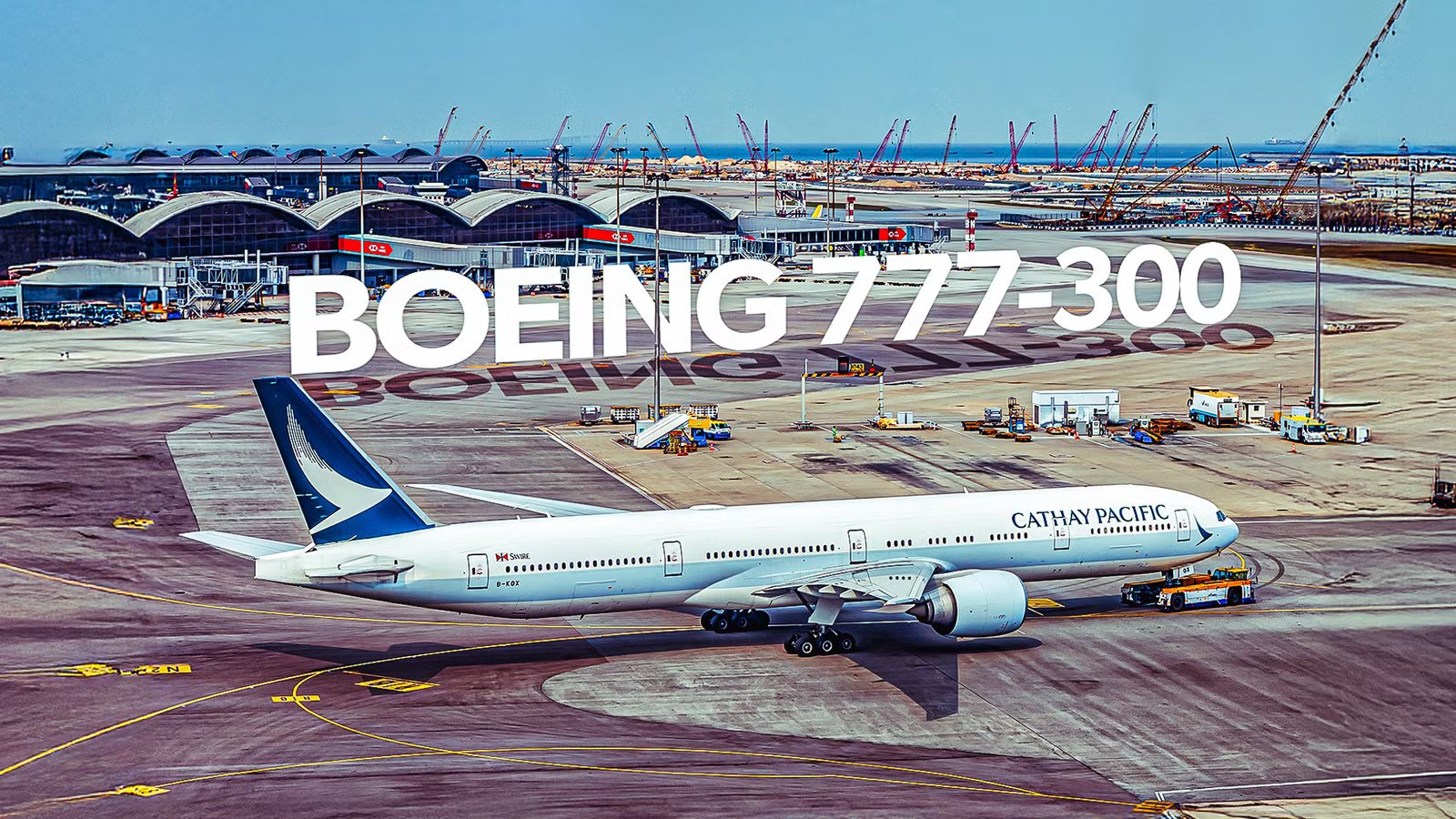
The Boeing 777, the largest twinjet aircraft ever developed, as well as the most powerful, has long been one of  Boeing’s most important commercial successes. Like any high-profile aircraft development program, Boeing built the jet in a multitude of variants to cater to diverse customer sentiment. Of the many Boeing 777 variants, some became bestsellers, which will certainly be core elements of the market for decades to come. Other aircraft, however, sold rather poorly.
The 777-300 was a unique variant of the Boeing 777 family that was designed to serve an extremely specific role. However, the aircraft failed commercially, only selling 60 units and likely not even recouping its lofty development costs. This stands in sharp contrast to the Boeing 777-300ER, another Boeing 777 family model that sold hundreds of units and became one of the most popular widebody aircraft ever developed.
A Brief Overview Of The Boeing 777

The Boeing 777 is an American-built long-range widebody aircraft that became the world’s largest twin-engine aircraft when it entered service and has since become the most-produced widebody jet ever designed. It was originally designed to bridge the capacity gap between the Boeing 767 and the Boeing 747 families, replacing the Douglas DC-10 and L-1011 trijets, while also being co-developed with eight carriers. The jet was launched in 1990 by  United Airlines and entered passenger service in June 1995.
Typical three-class capacity figures for the Boeing 777 tend to range between 300 and 370 passengers in a high-capacity ten-abreast configuration that features a dynamic range of between 5,200 and 8,500 nautical miles, depending on the variant. The aircraft’s signature features include large turbofan engines, raked wingtips, a six-wheel main landing gear setup, a circular fuselage, and a blade tail cone. It featured Boeing’s first fly-by-wire controls setup, as well as composite tailplanes.
The aircraft was produced in a number of different variants, each of which was intended to serve different kinds of customers that had diverse needs in terms of both range and capacity. Today, 1,781 units have been delivered from 2,457 orders across all variants, and the aircraft type is the best-selling widebody on the market, led by the Boeing 777-300ER, its best-selling model. The jet competes with widebodies like the Airbus A350.
The Boeing 777’s Different Variants

Let’s begin by taking a look at the different Boeing 777 variants, leaving out the discussion of the 777-300 for now, as we will talk about that next. The Boeing 777-200 was the 1995 launch model for the family, and it was mostly designed for high-volume domestic routes within the United States and some regional long-haul services. The aircraft could fly up to 5,240 nautical miles, allowing it to fly across the Atlantic. The Boeing 777-200ER added weight that could support bigger fuel tanks, fueling transoceanic missions up to 7,065 nautical miles.
The Boeing 777-200LR (which was dubbed the ‘Worldliner’) pushed the limits of aircraft range by flying up to 8,555 nautical miles, and it had additional options for extended raked tips, strengthened landing gear, and GE90 engines. It was built for ultra-long-haul routes like Los Angeles International Airport (LAX) to Singapore Changi International Airport (SIN). The Boeing 777F cargo model followed using the same airframe as the 777-200LR, with a maximum payload that allowed it to fly around 4,970 nautical miles.
|
Boeing 777 Family Variant |
Capacity |
|---|---|
|
Boeing 777-200 |
~305 seats |
|
Boeing 777-200ER |
~300 seats |
|
Boeing 777-200LR |
~300 seats |
|
Boeing 777-300ER |
~390 seats |
The Boeing 777-300ER ultimately became the family’s bestseller, and it offered a range of 7,370 nautical miles in a 392-seat configuration. Its per-seat operating economics beat those of the Boeing 747, and the third-generation Boeing 777X is set to introduce composite wings that feature folding wingtips and GE9X engines, features which industry observers have noted will further improve the aircraft’s performance.
A Closer Look At The Boeing 777-300

The Boeing 777-300, launched on June 26, 1995, was the first stretched variant in the 777 family. It was intended to upgauge the 777-200 by around 20%, and assembly of the type began in March 1997. The body of the first prototype was assembled on July 21, and it was rolled out of the factory shortly after, on September 8. The first flight took place on October 16. Boeing added another 33 feet (10.1 m) to the model’s length, making it the longest widebody that it had ever produced.
The aircraft increased capacity significantly over its predecessors, rising to 368 seats in a three-class configuration, or up to 550 seats in an all-economy setup. The aircraft retained the Boeing 777-200ER’s fuel capacity and utilized powerful Pratt & Whitney PW4000 or Rolls-Royce Trent 800 engines. The aircraft had unique features like taxi cameras and a reinforced structure. An additional set of evacuation doors was included to accommodate the increased passenger capacity.
|
Category |
Boeing 777-300 Specifications |
|---|---|
|
Maximum takeoff weight |
660,000 lbs (300,000 kg) |
|
Service ceiling |
43,100 feet (13,100 m) |
|
Cockpit crew |
2 |
A higher-weight version of the aircraft was briefly considered with semi-levered main landing gear, but was never actually developed. Boeing ultimately pitched the Boeing 777-300 as a replacement for the Boeing 747, arguing that it had a much lower fuel burn and far lower maintenance costs than its lumbering quadjet predecessor. The aircraft’s range with 368 passengers was around 6,000 nautical miles, and eventually, eight customers placed orders for the jet.

Here’s How Much More Range The Boeing 777X Has Compared To The 777-300ER
While the 777-300ER has more range than the larger 777-9, the similarly sized 777-8 can fly 1,375 NM further, while carrying a few more passengers.
What Was The Purpose Of The Boeing 777-300?

The Boeing 777-300 was designed initially to serve as a higher-capacity stretch of the family’s baseline model, with the intention of upgauging busy trunk routes without the added complexity of operating a larger four-engine aircraft. During Boeing’s initial studies of the model, the manufacturer determined that demand for this kind of larger model clearly exists.
Across multiple kinds of markets, there were airlines interested in the exact blend of capacity and medium-haul capabilities that the Boeing 777-300 could bring to the table. The jet was specifically targeted at dense intra-Asia, trans-Pacific, and Europe-Asia corridors that were looking for a higher-capacity version of the Boeing 777-200.
The aircraft’s development also laid the groundwork for the success of the Boeing 777-300ER, which the manufacturer designed to be the true replacement for its bestselling Boeing 747-400. As a result, the aircraft had a clear purpose, and Boeing believed that its development would make both commercial and financial sense.

Which Airline Operates The Most Boeing 777s?
With 140 Triple Seven aircraft, this airline has the world’s largest 777 fleet.
Who Ultimately Purchased This Unpopular Model?

There were only a handful of airlines that ever purchased the original version of the Boeing 777-300, with Cathay Pacific being the first to put the type into service after receiving it from the manufacturer on May 21, 1998. The initial commitments to the type at the Paris Air Show came from Japanese legacy carrier All Nippon Airways, Korean Air, and Thai Airways International, according to The Spokesman Review.
Singapore Airlines ordered and soon took delivery of its first Boeing 777-300, which arrived on December 10, 1998. Japan Airlines notably used the type for high-density services within Japan. At the same time, other operators (like  Emirates) put the jet into service on dozens of global routes before retiring the type in 2019.
In addition to these purchases, several lessors also ordered the jet. In total, only 60 Boeing 777-300s were sold, distributed among eight customers. Most, however, proved much more interested in waiting around for the Boeing 777-300ER, the longer-range version of the type to enter service. For them, it simply made much more sense.

The Evolution Of Boeing Commercial Jets: From The 707 To The 777X
The American planemaker has come a long way since the 707 first flew more than 67 years ago.
The Boeing 777-300ER Sold Far Better Than The 777-300

Despite being a capable aircraft in its own right, the Boeing 777-300 failed to sell as well as expected. Its capabilities, ultimately, were significantly limited by the fact that it was not designed for ultra-long-haul services. Airlines all across the globe were looking for an aircraft that could operate high-capacity short-haul routes, but they also wanted one that could add this kind of capacity to ultra-long-haul services as well. The Boeing 777-300ER was thus a much better option for most carriers that wanted range diversity as well as additional capacity.
That, however, is not to say that the Boeing 777-300 was a complete commercial failure. The aircraft didn’t set any sales records, but it did lay down the important groundwork needed for the Boeing 777-300ER to sell incredibly well. Boeing ultimately sold more than 800 Boeing 777-300ER jets, which would eventually enter service with carriers all across the globe. This is one of the key reasons why it is critical for manufacturers to keep in mind the success of an entire family, not just individual aircraft variants.