dailynewsnblog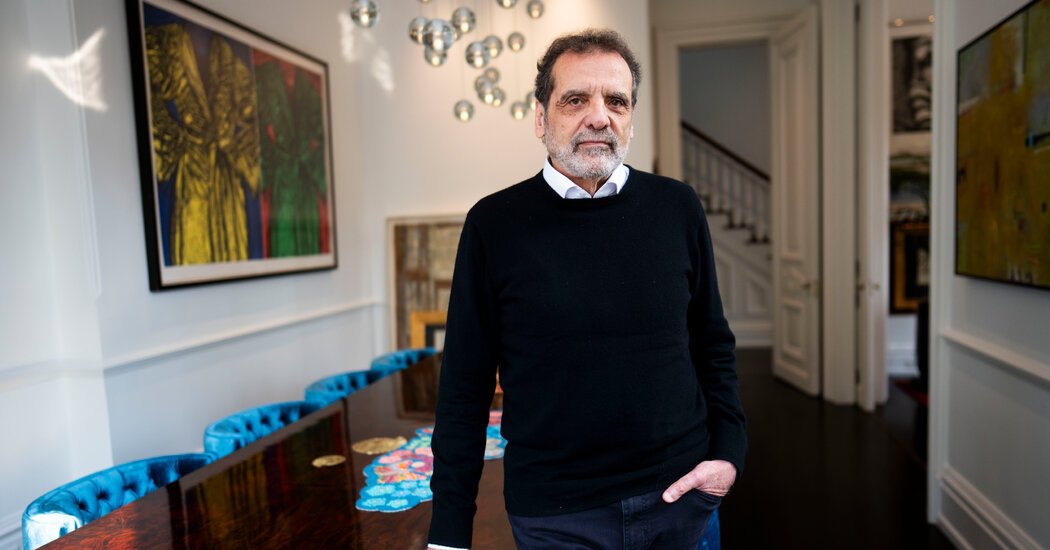
He is successful, rich and approaching the end of a long career. So fellow architects and colleagues wonder why Shalom Baranes — who renovated the Pentagon, modernized the Treasury Department and over 50 years changed much of the face of Washington — signed on to the headache of President Trump’s White House ballroom.
The $400 million, 90,000-square-foot-project has appalled preservationists, drawn tens of thousands of overwhelmingly critical comments from across the country and prompted a lawsuit trying to shut it down. It has also earned Mr. Baranes the ire of other architects, 29 of whom said in an angry letter that the project would reduce the White House, a little more than half the size of the addition, to the “tail wagging the dog.” They urged him to decline the job.
“I don’t understand why he would put himself in such a hot seat right now,”, said David M. Schwarz, a prominent Washington architect who has known Mr. Baranes since their days at the Yale School of Architecture.
“I am totally baffled why he would take this on,” said Nancy MacWood, a longtime Washington preservationist and civic leader who for decades has watched Mr. Baranes massage city review boards and make the case for his work.
Mr. Baranes, 75, is under a nondisclosure agreement with the White House and declined to discuss his motivations and specifics about the project. But in an interview last week, his first since signing on to the ballroom, and in subsequent conversations, Mr. Baranes did say that three fourths of his previous projects have ignited controversy, particularly in residential neighborhoods. He described his life story — he is the son of a tailor who found once-unimaginable opportunities in America — and expressed discomfort with the Trump administration’s immigration policies.
“What’s happening now is heartbreaking,” Mr. Baranes said. “I do hope there’s a realization at some point that this country depends on immigration. We have to normalize our policies.”
Mr. Baranes also said that he did not take on the ballroom project, as some architects have speculated, because his architectural firm is in trouble.
“No, we’re not laying people off right now,” he said affably during an 1½-hour interview in his nine-bedroom, $8 million Federal style home in Georgetown, where two large Frank Stella prints and a smaller Salvador Dalí print hung in the living room. Half the space was dominated by a Roche Bobois modular sofa covered in wake-me-up fuchsia, grape, floral and striped fabrics from the Italian fashion house Missoni.
Mr. Baranes said his firm currently employs 60 people, up from the 16 during a 1989-1990 downturn but down from a high of 175 when he was simultaneously working on six buildings in the 10-acre CityCenterDC downtown and repairing the Pentagon after the damage in the Sept. 11, 2001, attacks.
He declined to comment on how much he is being paid for the project, which Mr. Trump has said will be financed by private contributions.
He also refused to address the outcry about the ballroom, including Mr. Trump’s abrupt tear-down of the East Wing. But he shrugged off neighborhood outrage about some of his previous work. “There are a lot of complaints, oh my God,” he said. “Every project I’ve ever done in Georgetown, somebody gets up there and says, ‘This is the biggest building that will ever have been built in Georgetown.’”
In many ways Mr. Baranes is an odd choice, both personally and stylistically, for the president. He arrived in the United States as a 6-year-old Libyan refugee with parents fleeing the anti-Jewish riots in Tripoli after World War II. Decades later he criticized, gently, Mr. Trump’s first-term travel ban.
“My hope is that the Trump administration will take actions to ensure that the travel ban is indeed temporary, so that good, hard-working individuals fleeing tyranny can find a new home as I did,” Mr. Baranes wrote in The Washington Post in March 2017. His hopes are far from realized: The second Trump administration has expanded the travel ban, ended virtually all visas for Libyans and paused admission for the vast majority of refugees.
Professionally, Mr. Baranes is known for his modern additions to Washington’s historic buildings, not for the traditional style of the White House ballroom. “Designing classical architecture would not necessarily speak to his bread and butter,” said Rebecca Miller, the executive director of the DC Preservation League, a nonprofit group.
But in other ways Mr. Baranes is a natural fit for this mercurial president. Known for his ability to work well with real estate developers, who often push to make office buildings bigger and therefore more profitable, Mr. Baranes so far appears to be getting along with the former developer in the White House, who is deeply immersed in the project. Mr. Baranes meets regularly with Mr. Trump.
“If I had to pick who would do this job, it would be Shalom,” said Richard Nash Gould, a New York architect and avid Trump supporter who has known Mr. Baranes since Yale and spoke to him recently about the ballroom. “He’s happy, he’s bullet proof and he’s really smart.” To Mr. Gould, it is no mystery why Mr. Baranes signed on.
“Why wouldn’t he?” he said. “It’s an incredibly interesting job.”
Colleagues say Mr. Baranes took on the project because he thought he could make it better after a previous architect, James McCrery, disagreed with Mr. Trump over its scale. To that end, Mr. Baranes told the U.S. Commission of Fine Arts in January that while the ballroom can seat a whopping 1,000 guests, it is not the most immense design the president considered. Mr. Baranes’ latest plans have also removed a large pediment from above the ballroom’s portico.
“He’s done certain things that I actually think are good moves,” said Priya Jain, an associate professor of architecture at Texas A&M University and chairwoman of the Heritage Conservation Committee of the Society of Architectural Historians.
Still, the ballroom remains enormous and the tweaks have done little to silence opponents. Paul Goldberger, a former architecture critic for The New York Times and The New Yorker and the author of “Why Architecture Matters,” called the ballroom “a huge, dumb box” in a Times op-ed article last week. He added that it was “nominally designed” by Mr. Baranes “but for all intents and purposes designed by Mr. Trump.”
Mr. Goldberger, who also knows Mr. Baranes from Yale, added that he is well suited to the task because of his abilities with developers and is able to “produce work of whatever type in whatever style his clients want.’’
Mr. Baranes took offense. “That’s kind of below the belt,” he said. “All my work is very contemporary.”
But the White House project is not contemporary at all. “I can’t comment on that,” Mr. Baranes said, mindful of his NDA.
An Immigrant’s Story
The 6-year-old Mr. Baranes would likely not be admitted into the United States under the Trump administration restrictions of today. Back in the 1950s, his arrival by ship in New York Harbor was the start of an immigrant’s classic American success story.
His parents were Orthodox Sephardic Jews who left Libya in 1948 with a plan to eventually get to the new nation of Israel. They went first to Tunisia, then Rome, where Mr. Baranes and a sister were born, and where the elder Baranes, who had made fine men’s clothing in Tripoli, looked at photographs of Israeli men in cotton work shirts and khaki shorts in the newspapers of the time and realized, his son said, “there isn’t a single person in Israel wearing a suit.” He could make a better living in America.
In 1957 the refugee organization then known as the Hebrew Immigrant Aid Society secured the family visas to the United States and found a job as a tailor for the elder Mr. Baranes in Rochester, N.Y., a center of the men’s clothing industry in the United States at the time.
The young Mr. Baranes, who had arrived speaking only Italian, eventually went to a Rochester vocational school that taught plumbing and car mechanics and where he struggled until a teacher told his parents he was smart enough for Phillips Exeter Academy, the elite boarding school. Admitted in 1966 on a full scholarship, he was overwhelmed by the other students and intense academics.
“It was really lonely,” he said.
He went on to undergraduate studies at Yale, where he was inspired by the architecture historian Vincent Scully, and then to the architecture school itself. In 1976 he was passing through Washington with his new master’s degree and serendipitously got a job at a Georgetown firm.
Five years later he struck out on his own — he at first drew designs for a few CVS pharmacies and Roy Rogers restaurants — but got a break in 1982 when he was commissioned to add two floors to the top of a historic Beaux-Arts confection, the Southern Building at 15th and H Streets downtown. It was the work of Daniel Burnham, an early 20th-century giant from Chicago who had designed New York’s Flatiron Building and Washington’s Union Station.
In 1978, the District of Columbia had passed one of the country’s toughest historic preservation laws, a challenge for the 31-year-old Mr. Baranes, who had to get approval for the new floors from two review boards. He managed to convince them that architectural drawings he unearthed in Chicago indicated that Mr. Burnham had left open the possibility that two floors could be added on. Mr. Baranes brought them in right at a downtown Washington height limit (to maintain unobstructed views of the city’s monuments) of 130 feet.
Other developers with historic properties took notice. “They all have these buildings that are below the height limit,” Mr. Baranes said, and “this kid over here knows how to build additions.” He went on to add floors to dozens of other historic properties by making the argument, he said, that “it was the natural evolution of how cities grow, and you don’t treat buildings as museum pieces.”
Mr. Baranes declined to say how he came to the attention of the White House, but it is hard these days to miss his work in Washington. In his half century in business, he has designed a large modern glass addition to the General Services Administration, modernized the Interior Department, renovated the headquarters of the American Red Cross adjacent to the White House and added a pavilion to MedStar Georgetown Hospital, among hundreds of other commercial and government projects.
A Legacy
The White House ballroom is set to get the go-ahead by a panel packed with Trump allies on April 2. But on Tuesday an exasperated federal judge indicated he might stop the construction already underway until the White House gets approval from Congress.
During a hearing in a lawsuit brought by the National Trust for Historic Preservation, Judge Richard J. Leon of the Federal District Court in Washington, a President George W. Bush appointee, called one of the White House arguments in favor of the ballroom a “brazen” interpretation of the law. He noted that Mr. Trump is a “steward” of the White House, not its owner, and said he could rule by the end of the month.
Mr. Baranes is in the meantime moving ahead with his plans, well aware that despite the giant body of his work in Washington, the Trump ballroom will be his legacy, and what many fellow architects say will not be in a good way. He remains outwardly cheerful.
“Washington,” he said, looking out a floor-to-ceiling window to his swimming pool, “has been a great place to practice.”