dailynewsnblog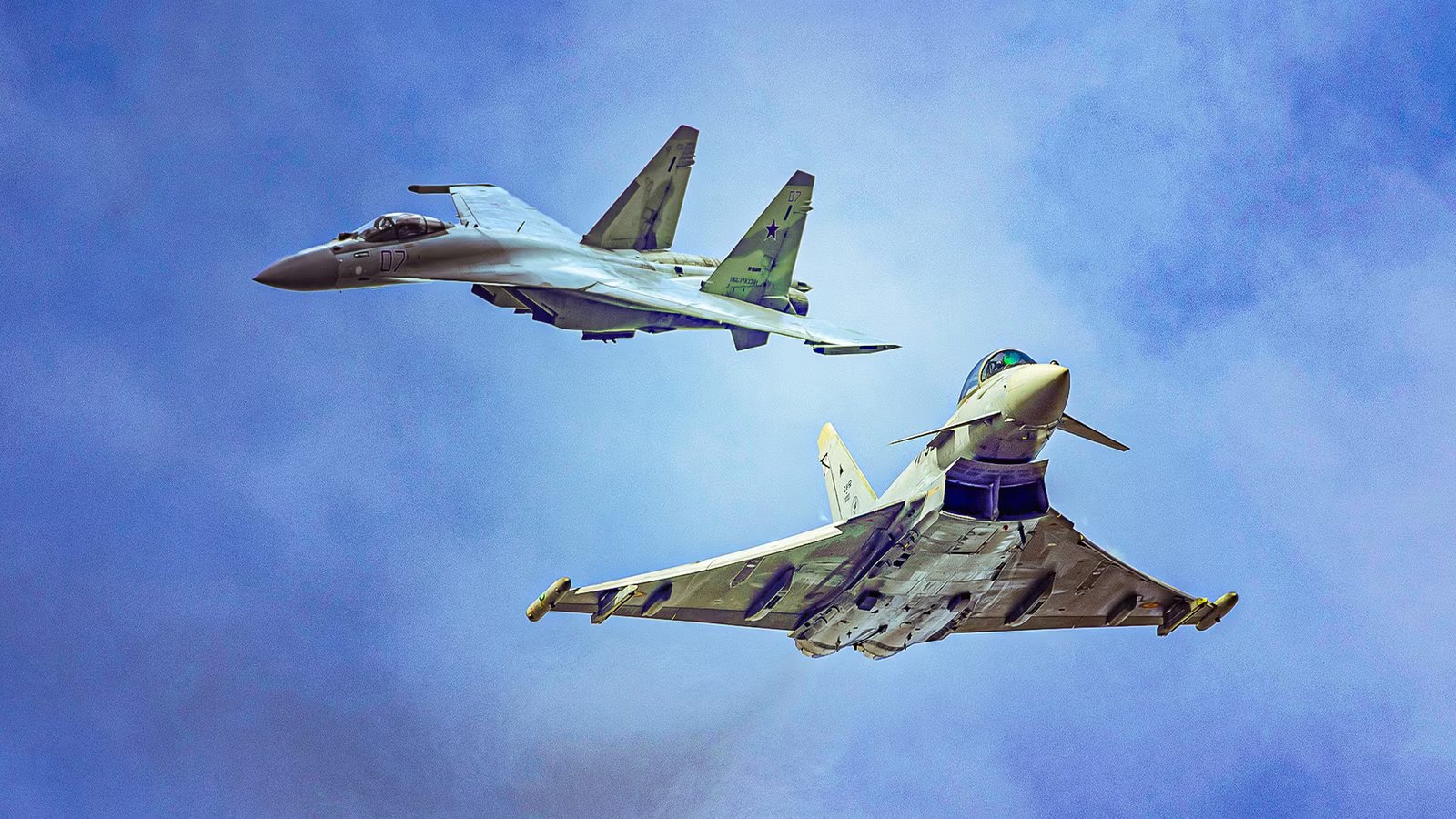
The modern air combat landscape is defined by a few highly capable multirole fighters. Among them, two aircraft frequently appear in discussions about air superiority: the Eurofighter Typhoon and Russia’s SukhoiSu-35S Flanker-E. Both jets represent the pinnacle of fourth-generation fighter development, incorporating advanced avionics, powerful engines, and sophisticated weapons systems designed to dominate contested airspace.
Drawing on publicly available fleet data, manufacturer specifications, and operational reports from NATO air policing missions and recent combat activity, this analysis examines how the two fighters actually compare today. While the United States has shifted much of its air combat capability toward stealth aircraft like the F-35, European Typhoons regularly operate alongside American fighters in NATO missions, meaning the aircraft’s performance against Russian platforms remains strategically relevant for US defense planners.
Below, we compare the Eurofighter Typhoon and the Su-35S Flanker-E across five key factors: aerodynamic performance, sensor technology, weapons and missile capability, real-world operational experience, and the strategic doctrine behind each aircraft’s design. Together, these elements explain why both fighters continue to dominate discussions about air superiority—even as fifth-generation aircraft increasingly shape the future of global air combat.
Two Elite Fighters Built For Air Superiority

The Eurofighter Typhoon and Sukhoi Su-35S Flanker-E were designed with a similar core mission: air superiority. However, they approach the task from very different technological traditions. The Typhoon emerged from a multinational European program aimed at creating a lightweight yet extremely agile fighter capable of defending NATO airspace. The Su-35S Flanker-E, meanwhile, is the latest evolution of Russia’s heavy Flanker family, optimized for long-range dominance and powerful sensors.
The Eurofighter program began in the 1980s, and today the Typhoon is operated by the United Kingdom, Germany, Italy, Spain, and several export customers, including Saudi Arabia, Qatar, Kuwait, and Austria. As of 2026, over 600 Typhoons have been built. The aircraft has continuously evolved through upgrade programs, most notably the Phase 3 Enhancement (P3E) and the introduction of the Captor-E AESA radar, which significantly enhances detection range and electronic warfare capability.
The Sukhoi Su-35, by contrast, entered Russian service in 2014 as the most advanced non-stealth fighter in Russia’s inventory. Approximately 100-120 aircraft were produced, with an estimated 80–100 operational accounting for attrition, with additional export customers including China and Algeria. The Su-35 incorporates thrust-vectoring engines, an extremely powerful radar system, and a massive weapons payload designed to challenge Western fighters in beyond-visual-range combat.
Both aircraft sit at the top tier of fourth-generation fighters, sometimes referred to as “generation 4.5”, meaning they combine legacy aerodynamic advantages with many technologies that bridge toward fifth-generation capabilities.
Performance And Aerodynamics: Speed, Range, And Agility

At first glance, the Su-35 appears to have a clear advantage in raw size and power. The aircraft is significantly larger and heavier than the Typhoon, reflecting the Russian design philosophy of building long-range fighters capable of operating across vast geographic areas.
The Su-35 is powered by two Saturn AL-41F1S turbofan engines, each producing roughly 31,900 pounds of thrust with afterburner. Combined with thrust-vectoring nozzles, these engines allow the aircraft to perform dramatic post-stall maneuvers, such as the Pugachev’s Cobra and other high-angle-of-attack tricks, which can provide advantages in close dogfights.
The Eurofighter Typhoon, meanwhile, is powered by two Eurojet EJ200 engines, each delivering around 20,000 pounds of thrust with afterburner. While the raw thrust figures are lower, the Typhoon benefits from an exceptionally high thrust-to-weight ratio approaching 1.15 in combat configuration, giving it remarkable acceleration and climb performance.
|
Specification |
Eurofighter Typhoon |
Sukhoi Su-35 |
|
Length |
52 feet (15.96 meters) |
71.9 feet (21.9 meters) |
|
Wingspan |
35.9 feet (10.95 meters) |
49.2 feet (15.0 meters) |
|
Height |
17 feet (5.28 meters) |
19.5 feet (5.92 meters) |
|
Maximum Speed |
Mach 2.0 (~1,535 mph / 2,470 km/h) |
Mach 2.25 (~1,726 mph / 2,780 km/h) |
|
Combat Radius |
~863 miles (1,390 kilometers) |
~932 miles (1,500 kilometers) |
|
Ferry Range |
~2,355 miles (3,790 kilometers) |
~2,796 miles (4,500 kilometers) |
|
Service Ceiling |
55,000 ft (16,760 meters) |
59,000 ft (18,000 meters) |
|
Maximum Takeoff Weight |
~51,800 lb (23,500 kg) |
~76,100 lb (34,500 kg) |
|
Engines |
2 × Eurojet EJ200 turbofans |
2 × Saturn AL-41F1S turbofans |
|
Maximum Weapons Payload |
~16,500 lb (7,500 kg) |
~17,600 lb (8,000 kg) |
|
Hardpoints |
13 |
12 |
In terms of agility, both aircraft excel, but in different ways. The Typhoon relies on delta-canard aerodynamics and advanced flight control systems to maintain exceptional energy retention during high-speed maneuvering. NATO pilots often highlight the aircraft’s ability to maintain speed during tight turns, a crucial factor in both dogfighting and missile evasion. The Su-35, on the other hand, emphasizes extreme maneuverability at very low speeds thanks to its thrust vectoring engines. This allows the aircraft to point its nose rapidly during close-range engagements, though modern air combat increasingly relies on beyond-visual-range missile engagements rather than traditional dogfighting.

How Many Lockheed F-104 Starfighters Were Built?
Discover the verified production total and how NATO exports shaped this Cold War fighter’s legacy.
Sensors, Radar, And Situational Awareness

Modern air combat is often decided long before aircraft ever see each other. Sensors, data links, and electronic warfare systems determine which pilot detects the opponent first and launches the first missile. The Eurofighter Typhoon’s most significant recent upgrade is the Captor-E active electronically scanned array (AESA) radar, developed by the EuroRADAR consortium. Unlike traditional mechanically scanned radars, AESA systems use hundreds of transmit/receive modules that allow the radar beam to be steered electronically rather than physically.
This design enables faster target tracking, improved resistance to electronic jamming, and the ability to monitor multiple airborne threats simultaneously. The Captor-E radar is believed to detect fighter-sized targets at distances of roughly 100–124 miles (160–200 kilometers), depending on conditions and the target’s radar signature. Complementing the radar is the PIRATE infrared search and track (IRST) system, which allows Typhoon pilots to detect and track aircraft using heat signatures without emitting radar energy, a valuable capability when attempting to remain undetected.
The Typhoon’s sensor suite is closely integrated with NATO’s Link 16 tactical data link and the Multifunction Information Distribution System (MIDS), enabling the aircraft to exchange targeting data with other fighters, airborne early warning aircraft, and ground-based radar stations. Defensive protection is provided by the Praetorian Defensive Aids Subsystem, an advanced electronic warfare package designed to detect incoming radar threats, jam hostile sensors, and deploy countermeasures automatically when necessary.
The Sukhoi Su-35 uses a different technological approach centered around the N035 Irbis-E passive electronically scanned array (PESA) radar, which remains one of the most powerful mechanically steered radars ever installed on a fighter aircraft. With a peak power output reportedly exceeding 20 kilowatts, the Irbis-E can detect large airborne targets at distances approaching 217–249 miles (350–400 kilometers) under ideal conditions. Against smaller fighter-sized targets, detection ranges are significantly shorter but still considerable by modern standards.
Like the Typhoon, the Su-35 also incorporates an infrared detection system. The aircraft’s OLS-35 infrared search-and-track sensor allows pilots to locate and track airborne targets passively without relying on radar emissions. Russian fighters also employ their own tactical data links for information sharing between aircraft and ground control stations, although these networks typically operate differently from NATO’s integrated Link 16 architecture.
Electronic protection on the Su-35 is provided by the Khibiny-M electronic warfare suite, which is designed to jam enemy radar systems and confuse incoming missiles. While the Irbis-E radar’s raw power gives the Su-35 impressive long-range detection capability, the Typhoon’s AESA radar architecture offers advantages in multi-target tracking, electronic warfare resilience, and network-centric combat operations, particularly when operating within NATO’s broader command-and-control network.
Weapons And Air-To-Air Combat Capability

Both fighters carry formidable air-to-air arsenals designed to engage targets well beyond visual range, reflecting the reality that most modern aerial engagements occur long before pilots ever see each other. The Eurofighter Typhoon is equipped with 13 external hardpoints and can carry roughly 16,500 pounds (7,500 kilograms) of weapons, while the larger Sukhoi Su-35S Flanker-E features 12 hardpoints and a slightly greater payload capacity of approximately 17,600 pounds (8,000 kilograms). Despite the similar payload limits, the two aircraft approach air combat with different missile philosophies.
For the Eurofighter Typhoon, the centerpiece of its long-range air-to-air capability is the MBDA Meteor missile. Widely considered one of the most advanced beyond-visual-range air-to-air missiles currently in operational service, Meteor differs from conventional rocket-powered missiles by using a solid-fuel ramjet propulsion system, allowing it to maintain high energy and maneuverability throughout its flight. Publicly available figures place Meteor’s engagement range at over 93 miles (150 kilometers), though the exact envelope remains classified. The missile’s “no-escape zone” ensures that targets cannot evade interception even with aggressive maneuvers, and data-link guidance allows mid-course updates until the missile’s seeker takes over in the terminal phase. Typhoons also carry AIM-120 AMRAAM for medium-range engagements and infrared-guided missiles like IRIS-T or ASRAAM for close combat, which pair with helmet-mounted cueing systems for high off-boresight targeting.
The Su-35S employs a different but equally formidable missile suite. Its primary medium-range weapon is the R-77-1 (NATO: AA-12 Adder), an upgraded active radar-guided missile with improved range and maneuverability. For extreme long-range engagements, the Su-35S can carry the R-37M (NATO: AA-13 Axehead), a missile originally designed to intercept high-value support aircraft such as AWACS, tankers, and reconnaissance planes. While the R-37M’s maximum range is reported at over 186 miles (300 kilometers), this figure applies primarily to large, high-altitude, non-maneuvering targets; against agile fighters, the effective range is significantly reduced. In short-range combat, the aircraft carries the R-73 (NATO: AA-11 Archer), a highly agile infrared-guided missile used with helmet-mounted sights, allowing pilots to lock onto targets at high off-boresight angles. Together, the Su-35S arsenal emphasizes flexibility across engagement ranges, from close-range dogfighting to long-range intercept missions, while the Typhoon prioritizes networked, high-energy, beyond-visual-range engagements, particularly with Meteor integrated into NATO’s digital sensor networks. In practice, the effectiveness of either aircraft depends on pilot training, supporting sensor networks, and integrated combat tactics.

The Top 5 Fighter Jets Used By The Russian Air Force
Some of these fighters have already been shot down in Ukraine.
Real-World Encounters And Interceptions In Recent Years

Although the Eurofighter Typhoon and Sukhoi Su-35 have never directly fought each other, both aircraft have been heavily involved in real-world interception and combat missions over the past decade. These operational experiences provide valuable insight into how each platform performs outside test environments.
Typhoons stationed across NATO’s eastern flank routinely intercept Russian aircraft operating near alliance airspace.
Eurofighter Typhoons have conducted hundreds of NATO air policing intercept missions over the Baltic Sea, North Sea, and Eastern Europe since 2022. Aircraft from the United Kingdom, Italy, Germany, and Spain regularly scramble to identify Russian aircraft flying near NATO airspace without active transponders. These intercepts frequently involve Russian fighters escorting strategic bombers such as the Tu-95 or Tu-160, and occasionally include modern aircraft like the Su-30SM or Su-35.
In several cases reported by European defense ministries, Typhoon pilots visually identified Russian aircraft flying without transponders over the Baltic Sea. These encounters typically remain professional but tense, with aircraft often flying within visual range for short periods.
Meanwhile, the Su-35 has gained extensive combat experience during Russia’s military operations in Syria and Ukraine, where the aircraft has performed a wide range of missions, including air-to-air patrols, strike escort, and suppression of enemy air defenses (SEAD). Russia has deployed Su-35S fighters to Khmeimim Air Base in Syria since 2016, where they continue to support Russian military operations and protect Russian aircraft conducting strike missions. The Su-35s stationed there typically perform combat air patrol (CAP) missions over western Syria and the eastern Mediterranean. Their role includes escorting strike aircraft such as the Su-34 and Su-24M, monitoring coalition air activity, and occasionally intercepting unidentified aircraft approaching Russian-controlled airspace.
During the war in Ukraine, Russian Su-35 fighters have reportedly engaged Ukrainian aircraft using R-73 short-range infrared missiles and R-77-1 active radar-guided missiles, typically during combat air patrols protecting strike aircraft. Russian reports have also described air-to-air engagements against Ukrainian Su-27 fighters during the early phases of the war, although such claims remain difficult to independently verify due to the information warfare surrounding the conflict. One widely reported episode involved a Russian Su-35 pilot allegedly intercepting and shooting down a Ukrainian Su-27 during the early days of the invasion. In another engagement, Russian sources claimed that two Ukrainian fighters were destroyed after a Su-35 pilot gained a positional advantage and launched air-to-air missiles during an aerial patrol.
At the same time, the conflict has also shown the vulnerability of even advanced fighters in a modern integrated air defense environment. Ukraine’s layered defenses and fighter patrols have occasionally resulted in Russian aircraft losses, and there have been claims that a Su-35 was shot down during an aerial engagement with a Ukrainian MiG-29 escorting a Su-25 attack aircraft.
Which Fighter Has The Advantage In 2026?

Determining which aircraft is superior is not straightforward because air combat outcomes depend on far more than the aircraft alone. Training, tactics, sensor integration, and support from airborne early warning systems all play crucial roles.
The Eurofighter Typhoon benefits enormously from operating within NATO’s network-centric warfare environment. Through systems such as Link 16, Typhoon pilots can receive targeting data from AWACS aircraft, ground radars, and other fighters, effectively extending their situational awareness far beyond the limits of onboard sensors.
The Su-35, meanwhile, remains one of the most capable heavy fighters ever built. Its long-range, powerful radar, and large weapons payload make it extremely dangerous in certain scenarios, particularly when operating under the coverage of Russia’s integrated air defense systems.
Ultimately, by 2026, the comparison reflects two very different strategic approaches to airpower. The Typhoon represents a highly networked Western fighter optimized for networked coalition warfare and advanced missiles such as the Meteor. The Su-35 embodies Russia’s traditional emphasis on powerful standalone fighters with long reach and formidable maneuverability. As air forces around the world increasingly transition toward fifth-generation aircraft like the F-35 and the upcoming European Global Combat Air Programme, both the Typhoon and Su-35 will likely continue playing key roles for years to come, ensuring that the debate over which aircraft has the edge remains far from settled.