dailynewsnblog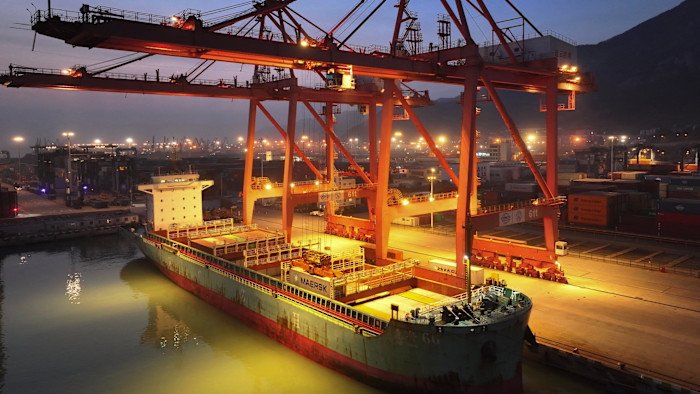
Unlock the Editor’s Digest for free
Roula Khalaf, Editor of the FT, selects her favourite stories in this weekly newsletter.
That clashing of cogs and grinding of gears you can hear is the global trading system rapidly trying to adjust to President Donald Trump’s attacks on Iran having thrown a very large spanner into it.
Since the bombing started, shipping companies, freight forwarders, airlines and exporters have been frantically reshuffling routes, moving transshipment (offloading and reloading) from one port to another and shifting sea cargo to land or air. Exporters around the world, from Indian rice growers to Brazilian meat companies, are being hammered by the cost of war-risk insurance and “demurrage” charges for containers forced to spend weeks in port.
The furniture retailer Ikea has several stores in the region. Susanne Waidzunas, global supply manager of Inter Ikea, which owns the brand, says: “There’s a lot of emergency work to be done in the Gulf.” There’s also a battle of wills over who will bear the cost: the Chinese government, for whose economy exports are existentially important, rapidly summoned the shipping giants MSC and Maersk to warn them against raising freight rates.
Is all this turmoil a lethal blow — or evidence of a fatal flaw — in the modern trading system? No. The basic logic of highly flexible global value networks remains. Ten or twenty years from now, absent a world war or other huge dislocation in the international order, globalisation will not only have survived but also helped economies to ride energy shocks with progressively greater ease.
The performance of goods trade over the next few years will depend on the macroeconomic reaction to the energy shock. A global recession will hurt trade in the cyclical way it always does, but in the longer term trade will help mitigate rather than amplify disruption.
It’s still early days, but the increases in freight costs seen so far are considerably less than after the Covid lockdowns lifted or even Russia’s invasion of Ukraine, and have been somewhat localised to the Gulf. There is a massive increase in freight insurance rates in the region, obviously, but a comfortable majority of Asia-Europe container traffic through the Suez Canal started going round the southern tip of Africa after the Houthi attacks on ships in the Red Sea in 2023 and didn’t come back. Waidzunas says Ikea still takes its goods from Europe to the Middle East round Africa, despite the much longer journey. The supply chain company Freightos notes some reports that the market is resisting higher costs being loaded on to container rates outside the Gulf region.

It will take a huge rise in fuel prices fundamentally to threaten the container trade. Emile Naus, partner at the supply chain consultancy BearingPoint, notes that oil having risen to $100/barrel will add only $100-200 to rates for a 40-foot shipping container on a major route like Asia-Europe, which were $2,000-3,000 before the Iran war. The average such container carries about $100,000 of goods and the largest container ships carry as many as 12,000 containers.
Supply chain experts say the shocks of the last couple of decades have forced freight companies to become more flexible, for example by more use of transshipments to deal with disruptions. Those changes have introduced inefficiencies but the impact of higher costs on production networks has been limited.
Naus says: “There has been some selective reshoring, but the economies of scale remain massive. It costs less to take a container from Shanghai to Europe than from the UK to Italy.” Exporters have become more adaptable: Waidzunas from Ikea says the company has had to learn to do sales and supply planning at all different time horizons.
The long-term future for globalisation looks more stable than the near term, certainly if lessons are learned. It should be lost on no one that some countries are experiencing a softer blow from the oil shock by having moved towards green technology. Pakistan, for example, has become an exemplar for the mass adoption of rooftop solar power, which has helped it cope with a sharply higher import bill for liquefied natural gas. The renewables share in European power generation has markedly increased since the Russian invasion of Ukraine.
As I have noted before, the Iran war will hugely increase the attractiveness of tapping the vast global market in renewables technology, mainly from China, as Pakistan has done. It’s undoubtedly true that relying on Chinese equipment, particularly more sophisticated connected tech such as wind turbines, can pose serious security risks which need to be addressed. But the threat from continuing to rely on fossil fuels has also become even more starkly apparent.
A combination of the astonishing innovation of the private sector in freight and logistics and judicious intervention by governments in the energy sector should be able to mitigate somewhat the current shock and insure against the next one. The shipping world is currently in turmoil, but it has coped with worse before. And governments have shown that they can learn remarkably quickly when a huge trauma underlines the cost of failing to adapt.
alan.beattie@ft.com