dailynewsnblog
Despite being declared the third-hottest year on record, 2025 was a relatively quiet year for climate disasters in the US. No major hurricanes made landfall, while the total number of acres burned in wildfires last year—a way of measuring the intensity of wildfire season—fell below the 10-year average.
But starting this week, the West is experiencing what looks to be a record-breaking heat wave, while forecasting models predict that a strong El Niño event is likely to emerge later this year. These two unrelated phenomena could set the stage for a long stretch of unpredictable and extreme weather reaching into next year, compounding the effects of a climate that’s getting hotter and hotter thanks to human activity.
First, there’s the heat. Beginning this week and heading into next, a massive ridge of high-pressure air will bring record-breaking temperatures to the American West. The National Weather Service predicts that temperature records across multiple states are set to be broken in dozens of locations, stretching as far east as Missouri and Tennessee. The NWS has issued heat warnings for parts of California, Arizona, and Nevada, as well as fire warnings for parts of Wyoming, Nebraska, South Dakota, and Colorado.
“This will be the single strongest ridge we’ve observed outside of summer in any month,” says Daniel Swain, a climate scientist at the University of California Agriculture and Natural Resources.
The other remarkable thing about this heat wave, Swain says, is just how long it’s going to last. “This is not a day or two of extreme heat,” he says. “We’ve already in some of these places been seeing record highs every day for a week, and we expect to see them every day for another at least seven to 10 days.” The later end of March will be much more intense, with temperatures in some places breaking April and May records. “There aren’t that many weather patterns that can result in an 85- or 90-degree temperature in San Francisco, Salt Lake City, and Denver in the same week.”
This late winter heat wave is adding on to an already warm winter in the West—with big implications for the summer. A month ago, snowpack levels across multiple states were at record lows thanks to warmer-than-average temperatures. According to data provided by the Department of Agriculture, snowpack levels were still sitting below 50 percent of average across many Western states. Snowpack is a critical natural reservoir for rivers in the West; between 60 to 70 percent of the region’s water supply in many areas comes from melting snow. Low snowpack is a bad sign for already-stressed rivers like the Colorado, which supplies water for 40 million people in seven states.
The ongoing heat wave, Swain says, will more than likely make conditions even worse. “April 1st is typically the point at which snowpack would be, at least historically, at its peak,” he says. Even if temperatures cool off until summer, these low snowpack levels are also a worrisome sign for the upcoming fire season. Snow droughts like the one the West is experiencing can dry out soil, kill trees, and lessen stream flow: ideal conditions for a wildfire to grow. Meanwhile, the water supply in the Colorado River could drop even lower. States that rely on the river are already facing a political crisis as they attempt to renegotiate water rights; a drought would only up the ante.
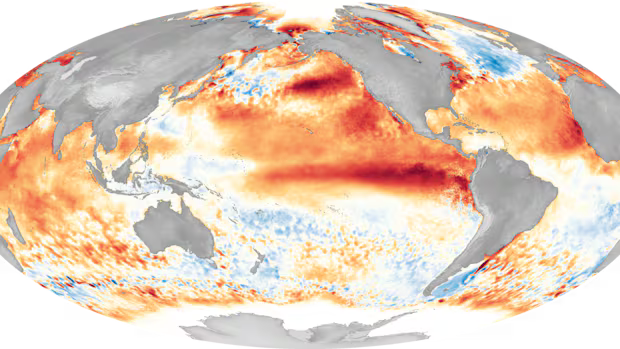
Then there’s El Niño. Last week, the National Weather Service announced that there was more than a 60 percent chance of an El Niño event emerging in August or September. Various weather models suggest that this El Niño could be particularly strong. While we likely won’t know for sure until summer, “the fact that [all the models] are moving upwards is worth watching,” says Zeke Hausfather, a research scientist at Berkeley Earth.