dailynewsnblog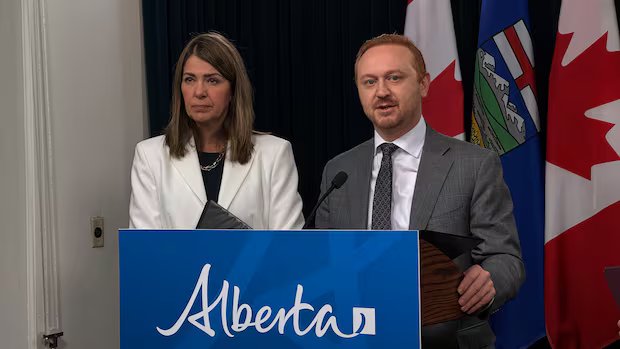
New legislation would prevent anyone in Alberta from accessing medical assistance in dying (MAID) if they are unlikely to die within the next 12 months.
Bill 18, the Safeguards for Last Resort Termination of Life Act, if passed, would prevent doctors or nurse practitioners from administering MAID to patients whose sole underlying condition is mental illness.
The act would also require a direct family member of the patient to be present for administration of MAID in almost all cases.
Alberta Premier Danielle Smith said at a news conference on Wednesday she thinks the federal guardrails around MAID are weakening as the government considers broadening the eligibility.
“These escalating factors put the safety and well-being of vulnerable individuals at far too grave a risk,” Smith said.
Justice Minister Mickey Amery tabled the bill in the legislature Wednesday.
Should the legislation pass as written, it would make Alberta the first Canadian jurisdiction to place these types of limitations on federally permitted assisted deaths.
The legislation would also pre-emptively limit access to MAID in cases where the federal government has signalled it could make changes.

The province is set to make some restrictions to medical assistance in dying, also known as MAID. It says the changes are to protect minors and Albertans with disabilities. As Travis McEwan reports, it will impact elgibility and how doctors approach MAID with their patients.
Although federal law requires a person requesting MAID to have the mental capacity to request it, Quebec in 2024 began allowing people diagnosed with incurable illnesses to request access to MAID in advance, while they are lucid. Alberta’s legislation would disallow such advanced requests.
The federal government has also passed legislation slated to allow people suffering solely from mental illnesses to request MAID, beginning in March 2027.
Smith told reporters the Alberta government is “highly skeptical” of the federal government legalizing MAID for mental illnesses alone.

Dr. Ramona Coelho, an Ontario family doctor who was at the news conference to support the legislation, said she sees examples of some health-care workers offering marginalized patients MAID instead of comprehensive support for poverty or social isolation that would help ease their suffering.
“Patient suffering can be addressed, and their lives can greatly improve if we take that time,” she said.
Bill would put new limits on practitioners
Bill 18, if passed, would also put new requirements and limits on the health-care providers who administer MAID.
Doctors and nurse practitioners would be barred from referring a patient out-of-province to be assessed for MAID eligibility. They would be prohibited from suggesting MAID to any patients as an option — the patient would have to request information on MAID first.
The law would prevent health facilities, such as clinics or continuing care homes, from publicly displaying any information about MAID, to “reduce the risk of undue influence or coercion,” according to briefing from the government.
Although health-care workers already have a right to refuse to provide MAID, Bill 18 would enshrine that right into provincial law, and create an “exclusion zone” of 150 metres around any health-care facility that refuses to allow MAID consultations on their premises.
Catholic health facilities that refuse to facilitate MAID assessments have faced criticism and legal challenges after patients either had to transfer to another facility to get them, or met assessors on sidewalks or in bus shelters outside Catholic hospitals.
Provincial statistics from 2023 show about nine per cent of patients who received MAID required a transfer to a different facility.
Bill 18 would require health providers to contact every practitioner who has been the primary care provider for the patient requesting MAID in the previous year, and review all of the patient’s personal and health information.
The law would require anyone providing MAID or MAID assessments to meet professional training requirements in advance.
Professional regulatory bodies in Alberta would be mandated to sanction any health-care worker who violates provincial legislation.
Government officials say those sanctions would start with remedial training for a first offence, and escalate to suspension and revocation of the ability to provide MAID with subsequent offences.
In 2021, the federal government amended MAID eligibility to include people whose death is not foreseeable in the next 12 months in response to a Quebec court ruling that this restriction violates the Charter of Rights and Freedoms.
Alberta government officials said they do not believe the provincial legislation would contravene the Criminal Code.
Support for proposed changes
Some organizations advocating for people with disabilities are pleased by the legislation, particularly the prohibitions on what’s called “track 2” MAID for people whose death is not immediately foreseeable.

Inclusion Alberta CEO Trish Bowman said MAID was leading to medical systems sometimes offering death as an alternative to people with disabilities instead of the supports they need for a higher quality of life. She said Alberta’s limits could save lives.
“We know it reinforces incredibly negative and dangerous stereotypes about the value and worth of the lives of people with disabilities. And so we’re very pleased to see this legislation today that serves to protect them,” Bowman said.
Krista Carr, CEO of Inclusion Canada, says she hopes other provinces follow Alberta’s example. However, she said the limits should also compel governments to invest more into programs and support that improve the quality of life for people with disabilities.
Canadian Mental Health Association research librarian Robert Olson called the legislation “heartening.” He said the organization opposes the expansion of MAID to people with mental illness because many people can recover from, or find successful treatment for, mental illnesses.
Disappointment for right-to-die supporters
Tania Stilson’s father chose a MAID death in 2023 at age 83 after living with chronic and debilitating pain for 12 years that became increasingly worse and unresponsive to treatments.

She says her dad, John Warren, went through extensive evaluation and a 90-day waiting period when his suffering became intolerable. Stilson said it’s “illogical” for the provincial government to try and remove the option for people who are in anguish, but not facing a foreseeable death.
“Canadians shouldn’t have to suffer,” she said. “And they make that own individual choice themselves. Nobody should make that for me or for you.”
Alberta’s proposed restrictions will also make it harder for people who do face a foreseeable death to access the legal, publicly funded service, said Kerrie Hale, co-chair of the Calgary chapter of Dying with Dignity.
If governments wanted to protect vulnerable people, they would provide better health and social supports, she said.
Hale is troubled that health providers won’t be able to point to MAID as an option, because some people don’t know it’s legal, she said. She said the legislation lacks compassion for people with intractable conditions.
“They are suffering intolerably and they want to end their lives,” she said. “I feel that we should have compassion for those people and not make this option even harder than it already is.”
Challenges to federal MAID law
Before the bill was tabled, Lola Dandybaeva, a spokesperson for federal Justice Minister Sean Fraser, said in a statement that provinces and territories are responsible for delivering health care and have the right to develop frameworks around MAID delivery.
Dandybaeva said a special committee is studying the potential expansion of MAID eligibility, and its findings will guide any potential changes. Despite the law set to expand eligibility criteria in March 2027, she did not give a timeline for any potential changes.
Amery, the justice minister, says the Quebec court ruling does not apply in Alberta.
Smith said she doesn’t have immediate plans to use the notwithstanding clause to defend the bill in court, should it become law and prompt a legal challenge, though she did not rule out that option.
“I fully anticipate it will be the law in Alberta,” she said.
University of Ottawa health policy professor Patrick Fafard said the legislation is careful to legislate in areas the province controls, such as the provision of health services and regulation of professionals. He thinks a court challenge is likely, regardless.
“People will allege that this somehow contradicts whatever the federal government does under its criminal code authority,” he said. “But it will be litigated. Partly to make a point, and partly because there may be a genuine conflict of laws.”