dailynewsnblog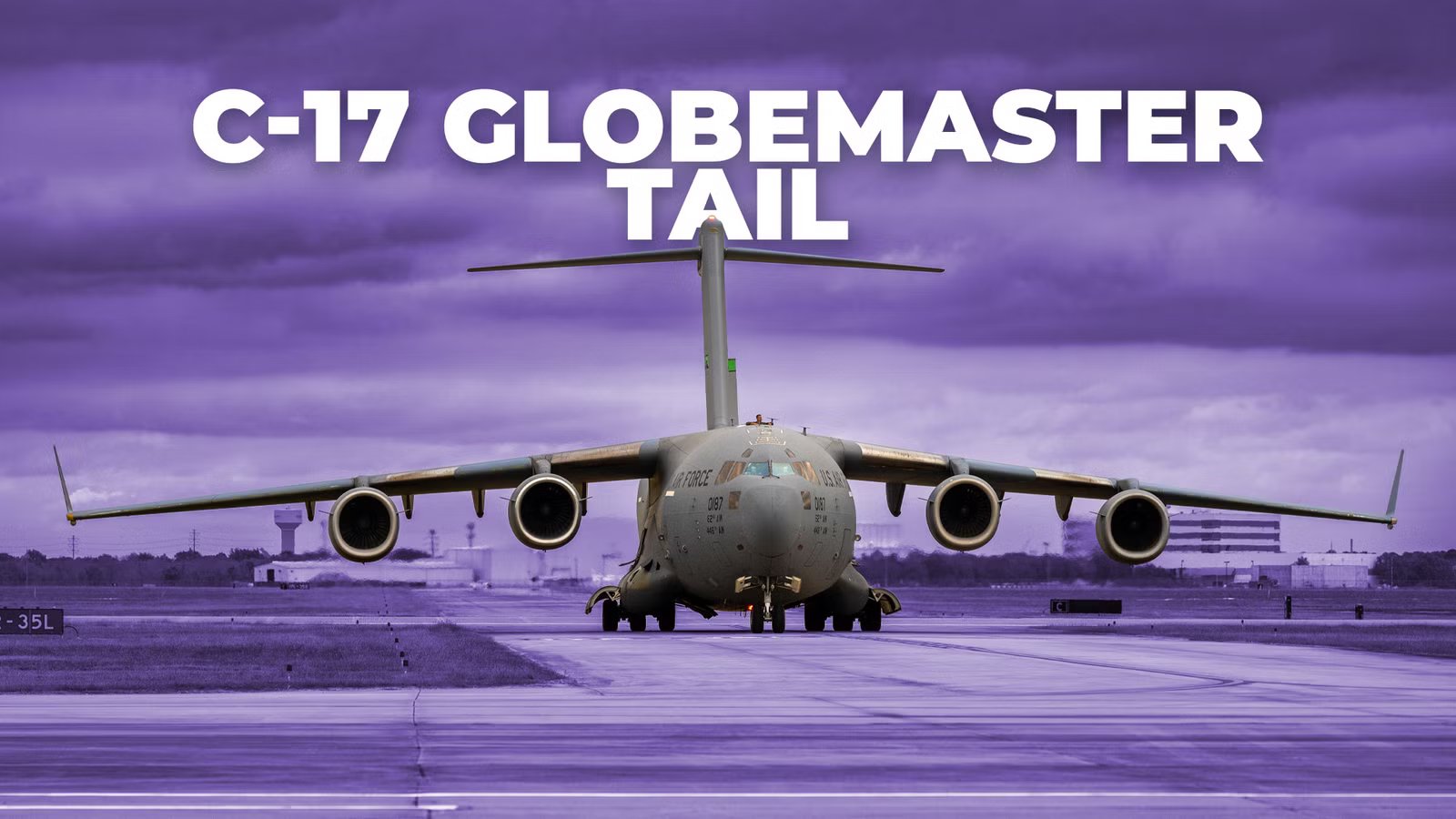
Aircraft designs serve specific purposes, and the C-17 Globemaster is no different. To make room for its rear loading operations, McDonnell Douglas built the C-17 Globemaster with a T-tail. This allowed it to transport large loads of equipment at airfields quickly and with ease thanks to the clearance. Another benefit of the horizontal stabilizer positioned high on the vertical fin and the airflow is stability during mid-air drops when the open cargo doors disrupt the air stream.
Keeping the elevator away from engine exhaust and turbulent airflow also ensures a cleaner flow over the tail surfaces, which makes it easier to fly. T-tail designs were common in early jet aircraft, but the C-17 Globemaster’s T-tail design adds to its stability, and its simplified design reduces considerations for aerodynamic interferences and offers greater short-field performance. The iconic jet was groundbreaking when it was announced in the 1980s, and its reliability, flexibility, and performance were game changers.
Multi-Mission By Design

The C-17’s exceptional capacity for both military and humanitarian missions transformed strategic airlift not only for the US Air Force but also for allied powers as well. Despite a handful of early design flaws and a challenging manufacturing spool-up, the aircraft first went into service in 1993. The T-tail and high wing offer greater clearance at the rear for cargo loading, unloading, and airdrops.
The C-17’s speed and payload for supporting forward operations, even on improvised and short fields, solidified its role as a powerful tool for projecting global power. Its primary features are its high speed, ability to land on austere runways, its global range (with aerial refueling), and high reliability. Its versatility has proven highly valuable in carrying out missions beyond airlift, like humanitarian relief, aeromedical evacuation, and special operations.
|
Specifications |
Boeing C-17 Globemaster III |
|---|---|
|
Thrust |
40,440 pounds, each engine |
|
Speed |
450 knots at 28,000 feet (8,534 meters) (Mach 0.74) |
|
Service Ceiling |
45,000 feet at cruising speed (13,716 meters) |
|
Cargo Compartment |
Length: 88 feet (26.82 meters); width: 18 feet (5.48 meters); height: 12 feet 4 inches (3.76 meters) |
Steady, predictable handling during complex flight maneuvers and expeditiously performing ground operations are crucial to the C-17’s missions. The high-wing configuration is also beneficial to the same two ends, as is the robust landing gear. McDonnell Douglas’ earlier experimental aircraft, the YC-15, was the origin of the T-tail on the C-17. The prototype demonstrated short takeoff and landing capabilities for operating in austere environments, becoming the model for the C-17.
The Best Handling At Any Altitude

The T-tail design of the C-17 offers benefits like improved stall condition management, maneuverability, and consistent elevator response under all conditions. Pitch and roll stability is optimized by the C-17 Globemaster’s downward sloping high-wing design, especially when carrying a heavy payload. The wing aspect ratio and configuration aid in lowering lift-induced drag during flight, and perform well going ‘low and slow’ at high angles of attack.
During typical flying conditions, the T-tail design ensures a steady elevator response, lowering induced drag and enhancing rudder efficiency. The aerodynamics of the wing minimize the effect of wingtip vortices to reduce drag and improve the big jet’s performance. Better maneuverability and spin characteristics are also improved by the T-tail design, which maintains unobstructed airflow over the rudder.
Global Airlift Without Limits

Because the elevator’s airflow is less affected in the event of a stall, recovery is considerably easier to handle. A versatile and effective military transport aircraft, the C-17 excels at handling large, heavy cargo and ensuring a steady elevator response. The C-17 can take off and land on runways as short as 3,500 feet (1,064 meters) and only 90 feet wide (27.4 meters), and it can make a 180-degree star turn within 80 feet while on the ground.
It is also capable of backing itself up with reverse thrust when on the ground. The directed flow thrust reversers can be used to go up a 2% gradient slope with a fully loaded aircraft. The T-tail is designed to perform well both at low altitude during expeditionary missions and at cruise when the C-17 is transiting between air bases. Four 40,440-lb thrust Pratt & Whitney PW2040 turbofan engines, with engine thrust reversers and speed brakes, power the big jet.
Its cruise speed is between Mach 0.74 and 0.77, and the range without in-flight refuelling is 2,400 nautical miles. Aerial refuelling provides an intercontinental non-stop range that is virtually unlimited. The Globemaster III is capable of carrying payloads up to 77 tons, or, in terms of human capacity, 134 passengers, 102 paratroopers, six high-dependency medical patients or 36 stretcher patients. Its other loads can include one CH-47F Chinook helicopter or 18 military pallets.
Inside The Globemaster III

A variety of vehicles, palletized cargo, paratroopers, airdrop loads, and aeromedical evacuees can all be transported by the C-17 thanks to its cargo compartment. Three Black Hawk helicopters, four Bushmaster vehicles, and an Abrams tank are among the items that can be loaded into the cargo bay.
The pilot, co-pilot, and two observer positions are all part of the fully integrated electronic cockpit of the C-17 Globemaster III. Four Honeywell multifunction cathode-ray tube displays, two full-capability HUDs, and cargo systems are all part of the digital avionics system. There is also a mechanically operated backup system for the electronic flight control system. The Northrop Grumman large aircraft infra-red countermeasures system is equipped with 56 USAF C-17 aircraft, with 25 upgraded aircraft entering service in 2007.
Over Three Decades Of Service

Boeing was a part of the program from the beginning of the C-17’s development and manufacturing in 2006. McDonnell Douglas eventually merged with Boeing in 1997, which saw the program fall under its widened umbrella. Currently, there are almost 300 aircraft in the global C-17 fleet serving the USAF and allied nations, including the UK, Canada, Australia, India, Kuwait, Qatar, the United Arab Emirates, and the 12-nation Strategic Airlift Capability.
Despite Boeing’s announcement that C-17 production would end in 2009 once existing orders were completed, the USAF was authorized to purchase 15 more aircraft in 2008. In July 2008, Qatar ordered two C-17s, and in February 2009, the UAE declared that it would purchase four C-17s in January 2010. In 2025, the US Department of Defense awarded a follow-on contract worth up to $2.26 billion to Boeing for the sustainment of the C-17 fleet.
The Indian Ministry of Defence signed a $4.1bn agreement with Boeing in June 2011 to acquire ten more C-1s. The C-17 met all the IAF’s requirements during rigorous field evaluation trials held in India in June 2010. Kuwait purchased two C-17s in 2014, along with equipment and training support. The final Globemaster III left the company’s production facility in Long Beach, California, in November 2015, marking the end of production after more than two decades.
Boeing, in partnership with Mahindra Defence Systems, opened a C-17 training centre in 2016 to serve the Indian Air Force and signed an $8m contract to train C-17 aircrews at its international training centre in the UK under the NATO Strategic Airlift Capability program. It also trains Emirati C-17 students. Royal Air Force C-17 engineers and aircrew are trained by Boeing at the C-17 International Training Centre in Farnborough.
The C-17 Goes Green

In 2021,  Boeing told its defense customers that its military aircraft can run on sustainable aviation fuel (SAF) up to a 50% blend with conventional fuel. There are no technical problems with Boeing defense aircraft using synthetic aviation turbine fuels. All defense aircraft manufactured by Boeing and their derivatives were covered by the study as well. As such, on top of the smooth, steady, efficient flying that its T-tail and high wing deliver, the C-17 can run on eco-friendly fuel too.
When compared to conventional jet fuel, unblended, or ‘neat’ SAF, can cut lifecycle carbon emissions by up to 84%. It also presents the industry’s biggest opportunity to cut carbon over the next 30 years across all aviation segments. At the moment, a 50/50 blend with traditional fossil fuels is the highest amount of SAF that can be used in the C-17 and other Boeing military aircraft. Darren Cole, the Air Mobility Command’s Director of Logistics, Engineering & Force Protection, said about the SAF program that:
“The C-17 continues to serve as the strategic airlift workhorse for the nation, as evidenced by its impressive performance in the recent airlift of more than 124,000 evacuees from Afghanistan in an around-the-clock operation. As the command responsible for operating the U.S. Air Force C-17 fleet, AMC looks forward to the continued partnership with our Boeing teammates as we work to keep the Globemaster fleet healthy for years to come.”
Boeing has been a pioneer in making SAF a reality and has a long track record of advancing alternative fuels. In 2010, the company collaborated with the US Air Force on an in-depth fuel study as part of its efforts to certify the C-17 Globemaster to use SAF blends. The same year, Boeing also helped make possible the supersonic flight of a US Navy F/A-18F ‘Green Hornet’ on a 50/50 SAF blend.