dailynewsnblog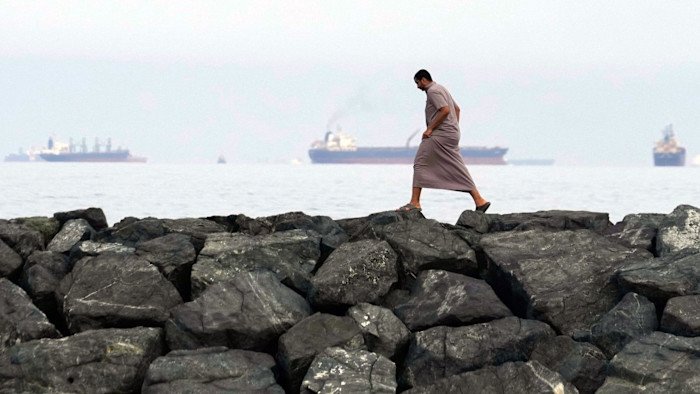
The conflict in the Middle East has turned the container shipping sector into a “wild west”, with carriers adding thousands of dollars in extra charges and dumping containers at far-flung ports, according to shipping customers and removal companies.
The effective closure of the Strait of Hormuz following Iranian strikes and fears that Houthi rebels will resume their attacks in the Red Sea have prompted shipping lines to suspend bookings and reroute goods. Fire as a result of debris from aerial strikes on Sunday over the main hub port in Dubai, Jebel Ali, has triggered further cancellations and congestion at safer ports.
The largest shipping groups, including MSC, Maersk, CMA CGM and Hapag-Lloyd have told customers they reserve the right to invoke a 19th-century rule to allow them to leave containers at the nearest available port at their client’s expense.
Charges for shipping containers, meanwhile, have risen as much as fourfold on certain routes thanks to war-risk insurance costs and fuel surcharges.
David Ozard, general manager at the removal group John Mason International, said that containers due to go to the Middle East had been dropped at the port of Nhava Sheva in India, while others destined for Saudi Arabia had instead been left at the port of Khor Fakkan in the UAE, leaving the company to pick up additional storage costs and import charges.
“At the moment it’s a complete wild west,” Ozard said, adding that shipping customers were forced to pay the additional charges. “If we don’t, shipping lines put our accounts on hold and hold us to ransom.”

Hakan Bulgurlu, outgoing chief executive of the appliance manufacturer Beko, claimed that shipping lines were “pretty much an oligarchy” and “very opportunistic”.
Beko had been insulated from the immediate charges thanks to its long-term contracts with shipping lines. However, the disruption to international supply chains had created a “whack-a-mole situation” with effects in the Middle East rippling throughout fragile trade networks.
Philippe Binard, general delegate of Freshfel, the European fresh produce industry group, said that his sector had been hit particularly hard as March is one of the peak months for export from Europe to the Middle East.
Refrigerated containers were being taken as close as possible to the region before being transported into Gulf countries by land.
“If you go to Jeddah [in Saudi Arabia], you then need to find land transportation [and] it’s not easy, there is big competition. You then have to cross border control, which is not easy in a period of instability,” Binard said, adding that fruit often needed specific documents that had to be changed.
“It’s a huge extra cost,” he said. Companies need to negotiate how much of the cost they will pass on to the buyer, but margins in fresh produce are extremely thin, say executives.
Halal meat consumption also means that shipping companies are having to find new routes to transport live animals into the Gulf. Four livestock carriers are heading for Jeddah port, according to S&P Global. Several ships have already been routed through the Saudi port.
About 90 per cent of the world’s goods are transported by sea, with approximately 5 per cent going through the Strait of Hormuz. Around 3,200 vessels are stuck in the Gulf as a result of the strikes.
Global freight rate increases have been modest compared to the pandemic. Rates between Shanghai and northern Europe, for example, rose 11 per cent to $1,618 per 20-foot equivalent unit container (TEU) last week, “well down” from peaks of almost $8,000 per TEU during the Covid era, according to Clarksons Research, a maritime analytics firm.
However, rates for freight headed to the Gulf have soared. Craig Reilly, chief executive of Dubai Arabian Shipping Agency, said that a typical TEU moving household goods from the UK to Jebel Ali had previously cost about $1,500 but is now at almost $6,000.
On top of this, additional land transport, storage costs, port charges and import fees meant that “unplanned additional cost can readily reach the low four-figure range per container above the original quotation”.
In some cases, shipping customers have said the disruption is worse than Covid because the Gulf region is in effect shut.

Emergency fuel surcharges resulting from rocketing bunker fuel prices, driven by the squeeze on oil supplies, have also pushed up costs.
Shipping lines including Maersk, CMA CGM, Hapag-Lloyd and MSC have all added surcharges of between $160 and $400 per TEU for long-haul voyages starting later this month to compensate for higher fuel prices.
Charter rates for container ships were also at their highest level since Covid as the need to reroute vessels had boosted demand, according to Clarksons.
Lars Jensen, chief executive at the consultancy Vespucci Maritime, said that fuel surcharges are usually set on a route-by-route basis, depending on distance and vessel size, but in this case shipping lines had added blanket surcharges across all routes.
Hapag-Lloyd said that it was in “continuous exchange” with its customers to explain the charges and that they covered war risk, fuel prices and an additional “contingency surcharge” for cargoes to and from the Red Sea to cover “unexpected increase in operational costs”.
Maersk said that it was in touch with customers to “find the best possible solutions”, including temporary storage or land transport.
“The reshuffling in our fuel supply chain, rerouting of vessels and equipment shortage are contributing to additional short-term and potentially also longer-term costs,” it said.
MSC did not respond to a request for comment.
France’s CMA CGM said it had applied surcharges on rates to make up for rising insurance, fuel and security costs. The group has reopened bookings for Gulf deliveries and is managing some of the logistics itself by truck from Jeddah, for instance, or from Oman, including for pharmaceutical goods and other necessities.
“It’s not as fast obviously,” a person at the group said, adding that the length of the journey and bottlenecks at ports around the region were adding to costs and difficulties.
Additional reporting by Sarah White in Paris