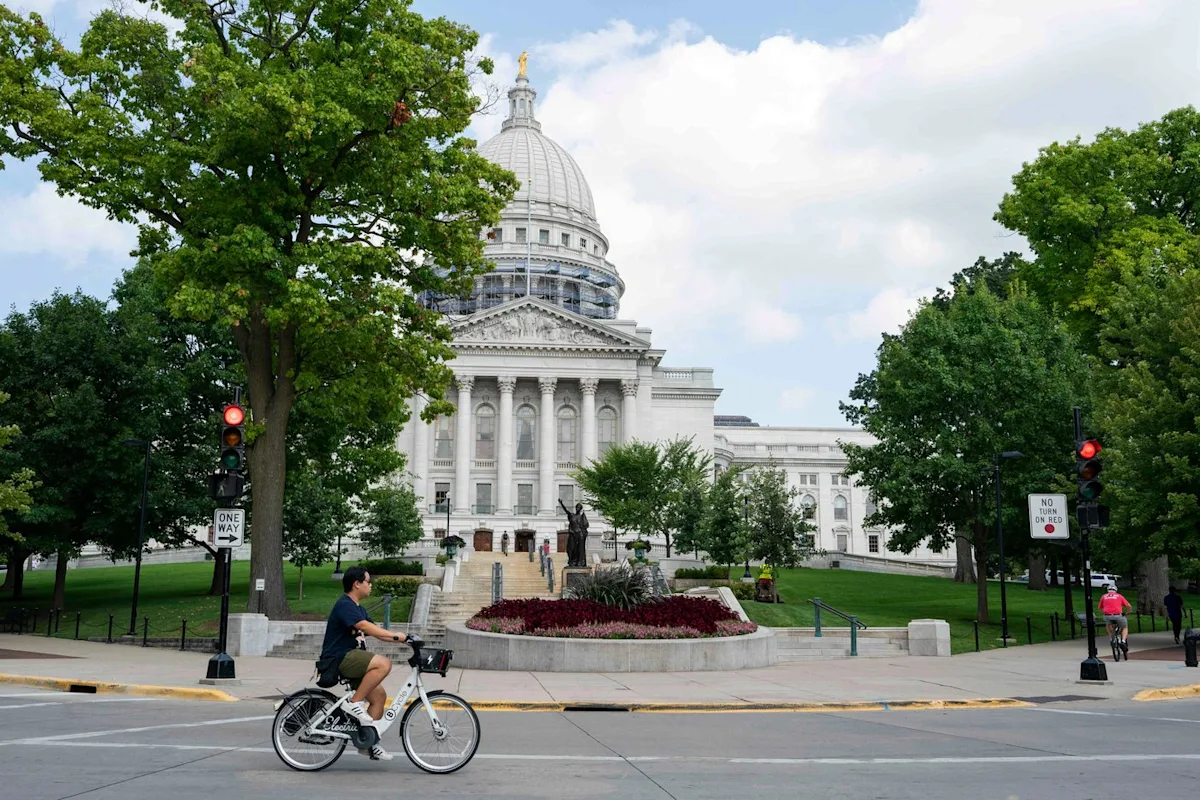
MADISON, Wis. (AP) — As sports fans wager billions of dollars on the NCAA basketball tournaments, Wisconsin lawmakers are taking a shot at an expanded sports betting plan that could bank big bucks for the state in the future.
A measure given final approval Tuesday would let the state’s tribal gambling sites start offering online sports betting to people anywhere in Wisconsin. But the bill is contingent on the signature of Democratic Gov. Tony Evers, which is no sure bet. And it wouldn’t take effect until after the state negotiates new deals with American Indian tribes who would run the sports betting — long after the current basketball tournaments wrap up.
Here’s how Wisconsin and other states are approaching sports betting:
Sports betting is booming in states
Legal sports betting has spread from one state — Nevada — to 39 states and Washington, D.C., since the U.S. Supreme Court opened the door in 2018. If Evers signs off on the expansion, Wisconsin would become the 32nd state to allow online sports wagering, which is how most people place bets.
Across the U.S., state-regulated sportsbooks handled nearly $167 billion of bets last year, generating revenues of nearly $17 billion after winnings were paid out to customers, according to the American Gaming Association. That marked an almost 23% increase over the previous year.
Gambling in Wisconsin goes through tribes
Gambling is legal in Wisconsin only on tribal lands under exclusive contracts between tribes and the state. Sports bets currently can be placed only at certain tribal casinos, and online sports betting is illegal.
Under the Wisconsin tribal compacts, a percentage of the money tribes earn through that gambling is returned to the state. In 2024, the tribes paid the state just over $66 million from revenue generated at casinos.
Wisconsin proposes to follow the Florida model
Under the Wisconsin legislation, online sports betting would be allowed only if the infrastructure to manage the bets, such as computer servers, is located on tribal lands in the state. That approach, known as the “hub-and-spoke” model, already is used in Florida.
Supporters of the measure include several Wisconsin tribes and the Milwaukee Brewers. They contend people currently are placing bets using offshore sportsbooks or prediction markets or crossing into other states where it’s legal, including neighboring Illinois.
Republican Wisconsin Assembly Speaker Robin Vos said he opposes online gambling, but people are already doing it and “I would rather make sure that Wisconsinites have some sort of control over that.”
The legislation has drawn opposition from the Sports Betting Alliance, which represents FanDuel, DraftKings, bet365, BetMGM and Fanatics. They argue it wouldn’t make financial sense for them to partner with Wisconsin tribes, because federal law requires 60% of gambling revenues must go back to the tribes. They would prefer a state constitutional amendment opening sports betting to all operators.
“It is simply not economically feasible for a commercial operator to hand over 60% or more of its revenue to an in-state gaming entity, just for the right to operate in the state,” Sports Betting Alliance representative Damon Stewart said in submitted testimony opposing the bill.
Governor’s support is unclear
Wisconsin’s measure has divided Republicans since it was introduced last year. It took 12 Democrats joining with nine Republicans to pass the bill in the Senate. The Assembly, also controlled by Republicans, passed it on a voice vote without debate last month.
It now heads to Evers, who initially said he would sign it as long as it was passed in consultation with — and the support of — the state’s tribes. Evers has since raised concerns, noting last month that not all of the state’s 11 tribes are registered as in support. Evers’ spokesperson Britt Cudaback did not return a message seeking comment Tuesday.
Revenues from sports bets can take a while to start flowing
If Evers signs the legislation, Wisconsin residents may still have to wait to place bets through smartphones and computers. It often takes months to launch new sports betting programs.
North Carolina’s governor signed legislation in June 2023 to expand sports betting from three tribal casinos to online platforms. But online betting did not begin until March 2024.
Missouri voters narrowly approved sports wagering in November 2024. But it didn’t launch until last December. And the state has yet to reap a big windfall. Through the first two months, Missouri sportsbooks handled $928 million of bets, but that resulted in just $659,000 in state taxes.
Some states look to squeeze more out of sports bets
Since adopting sports betting, some states already have revamped their laws to try to take a bigger share of the money. Taxes have been raised or restructured in Illinois, Louisiana, Maryland, New Jersey, Ohio, Tennessee and Washington, D.C. And Colorado and Virginia have pared back the tax deductions they originally allowed.
Illinois has taken multiple bites, most recently adding fees of 25-50 cents on every sports bet that gets placed. And Chicago began charging an additional 10.25% tax on sports betting revenues on Jan. 1.
Louisiana raised is sports betting taxes last year to help fund college athletics. The new law directs one-quarter of the tax revenue from online sports wagering to be split among public universities with Division I football programs and be used “for the benefit of student athletes.”
Collegiate prop bets face push back
Sports betting often involves more than just guessing which team will win. Some of the most popular bets focus on player performance, like how many points a particular athlete will score. Those proposition bets also have been at the center of recent scandals, with players alleged to have rigged their performance.
The NCAA in 2023 began encouraging states to adopt restrictions on bets involving college athletes. Since then, Louisiana, Maryland, Ohio and Vermont have joined the ranks of states banning individual prop bets on college athletes.
More than a dozen states place no limits on collegiate prop bets while nearly an equal number prohibit all such bets. Other states fall somewhere in between, including some that allow prop bets on collegiate athletes only for games that don’t involve their home-state schools.
___
Lieb reported from Jefferson City, Missouri.
Scott Bauer And David A. Lieb, The Associated Press


 dailynewsnblog