dailynewsnblog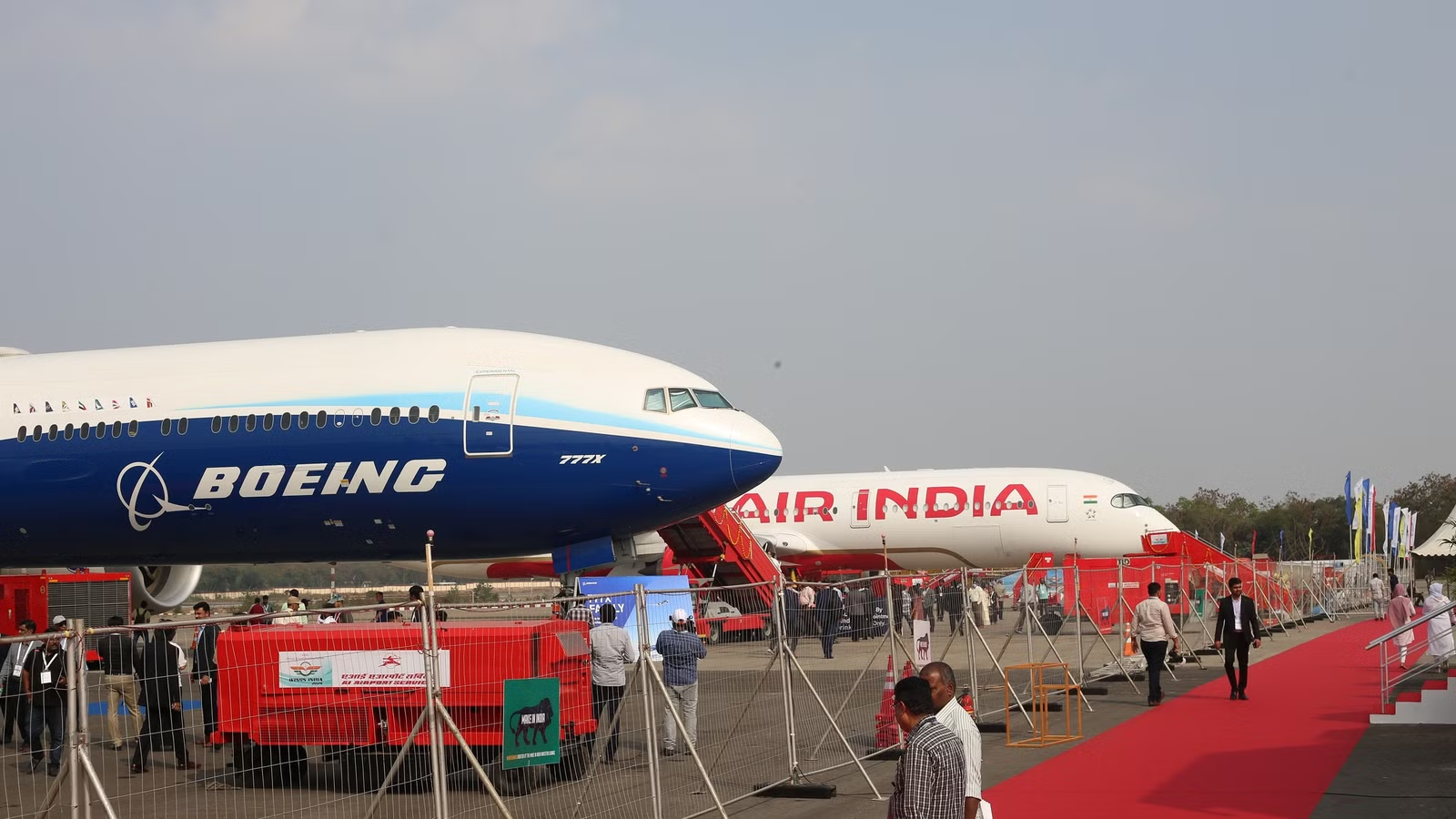
Airbus’s A350-1000 and Boeing’s upcoming 777X family are the two widebodies that dominate the conversation around the flagship class of airline fleets. Although the 777X has not yet entered service, it is highly anticipated in the race to replace the old four-engine widebodies of the past. Both aircraft represent distinct approaches to the traditional needs of air carriers despite their promises of revolutionary improvements in long-haul economics. Airbus has a distinct advantage, with the A350 having been in service for several years.
During this time, it has accumulated a sizable amount of operating data, which makes reliable predictions, maintenance planning, and crew training simpler. The Boeing 777-9, meanwhile, is scheduled to enter service in 2027. The 777X will have a fuselage diameter that is wider than its European competitor, allowing it to accommodate about 426 passengers in a typical two-class arrangement (50-60 more than the A350-1000) while maintaining similar economic and comfort standards. The question is, which will take the lead once the race is on? Let’s explore the strengths and weaknesses of each of these epic twinjet airliners.
Two Different Design Philosophies

A comparatively light airframe paired with Rolls-Royce Trent XWB-97 engines are used in the A350XWB, which was primarily constructed from carbon-fiber composites. Its stated maximum range is approximately 13,500 km (9,000 NM). Thanks to its endurance, carriers can schedule city pairs as distant as Singapore to New York or Doha to Auckland. In addition, Airbus asserts that the A350-1000 has approximately 13% lower fuel consumption and 16% lower operating costs per seat compared to its widebody counterparts.
 Boeing’s 777X program, on the other hand, places the emphasis on aerodynamic improvements and class-leading capacity. The most noticeable feature of the aircraft is its carbon-fibre wing with folding tips, which supports the giant fuselage. To improve lift-to-drag ratios, the span extends to 71.75 meters in flight. To keep the 777X compatible with existing airport infrastructure on the ground, the tips fold up after landing. Boeing claims that the new engine and high-aspect-ratio wing will reduce or even surpass the A350’s fuel-burn advantage.
Ultimately, the market’s decision will depend more on airline network strategy than on any single performance indicator. Because of the A350-1000’s demonstrated range and in-service maturity, carriers with ultra-long routes and moderate passenger numbers may opt for the reliable option. Operators targeting maximum seat revenues on congested intercontinental legs or slots at limited hubs would find the 777-9’s larger cabin and higher absolute payload more valuable.
Which Widebody Reigns Supreme?

In long-haul flying, ‘better’ is a flexible aim. Whether the 777X will surpass the A350-1000 depends on range, seat count, economics, risk, and passenger appeal. The cabin dimensions and capacity clearly favor Boeing, as, with a significantly wider cabin, the 777-9 will be able to accommodate around 50-60 more passengers than the A350-1000 in a typical two-class configuration. This will allow carriers to fit the most economy seats of any twinjet without reducing seat comfort below the threshold of what flyers want.
Currently, however, Airbus has the advantage of proof. With millions of flight hours under its belt since 2018, the A350-1000 has established a solid reputation for dependability and low fuel consumption. Its design range already allows for some of the longest nonstop services in the world, while the airframe’s composite structure makes it lighter than the 777-9 when empty. In ultra-long sectors, the Airbus continues to be the safer option for operators who value simple, low-risk flying economics.
The most important unknown is risk. The 777X is currently undergoing a rigorous certification procedure, particularly for its foldable wingtips, and Boeing has repeatedly delayed its arrival into service. A flawless launch could substantiate Boeing’s performance claims and provide carriers with a high-capacity instrument that no other member of the A350 family can match, but that remains to be seen.

Why Might The World’s Largest Twinjet Aircraft Have Airbus Worried?
Will the 777X’s innovative features and larger capacity outshine the A350-1000’s fuel efficiency and range?
The 777X Is The Largest Twinjet Ever Made

The 777X is set to be better for airlines that require maximum seats at acceptable fuel burn on slot-constrained, high-demand routes. The debate is not so much about technical superiority as it is about how much uncertainty an airline is willing to accept in exchange for a larger cabin until the Boeing widebody establishes its own track record in daily operations. Its spotlight feature is a carbon-fiber wingtip that locks into position for flight and folds upward on the ground.
The wings, when spread out to their full 71.8-meter span, provide the high lift-to-drag ratio required to be competitive in fuel burn per seat despite the jet’s huge cabin. When folded, the span reduces to around the same size as the current 777-300ER, allowing the aircraft to utilize existing Code-E gates and taxiways without requiring airports to redeploy stands. For an airline, the new wing means that the aerodynamic benefits of an ultra-long wing can be realized without having to pay for the custom infrastructure that has plagued larger aircraft.
Using ceramic-matrix-composite combustor liners, composite fan blades, and a very high pressure ratio, the GE9X achieves double-digit fuel efficiency gains over the GE90. Its 3.40-meter fan makes it the largest turbofan ever certified. Captain Ted Grady, the 777X program’s Chief Pilot, said during an August 2025 test flight that:
“The 777-9 flies beautifully, and this airplane performed just as we expected. We appreciate the hard work of our teams who designed, built and prepared this airplane for flight, and we’re continuing our focus on getting the 777-9 certified and in our customers’ fleets.”
The 777X has a very unique value proposition when combined with its folding wings, next-generation engines, modernized and spacious cabin, and legacy fleet commonality. It will fit through the same airport parameters while carrying more passengers and cargo with lower fuel consumption than its smaller competitors. That combination of capacity, efficiency, and compatibility is what makes the aircraft so appealing to airlines in a future with slot-restricted hubs and increased cost-cutting concerns.

Delayed Again: Boeing 777X Delivery Timeline Pushes Back To 2027
The long-awaited next-gen widebody will wait even longer to debut.

The Airbus A350-1000 is unique in that it combines low structural weight, ultra-long-haul capabilities, and a passenger-centric ‘Airspace’ interior. It blends in almost imperceptibly with the gates and airport slots already occupied by previous twinjets, thanks to its carefully tailored dimensions. More than two-thirds of its structure, like fuselage skins, spars, stringers, and even the wing’s 32-meter one-piece upper cover, is made from carbon-fiber–reinforced plastic.
This yields an airframe that is lighter, corrosion-free, and with fatigue timelines that run far more slowly than those of an aluminum equivalent, allowing airlines to fly longer blocks between intensive checks and reducing inspection hours. A high-aspect-ratio wing with smoothly curved sharklets and droop-nose devices to maximize airflow at low speed is supported by that lightweight framework. The design enables the A350-1000 to travel approximately 13,500 km (9,000 NM) while using about a quarter less fuel than the quadjets it is replacing.
The Rolls-Royce Trent XWB-97 engines are currently the most efficient large turbofans in commercial service. At hubs like  London Heathrow Airport and
  New York JFK Airport that are sensitive to noise, lower thrust levels on climb and cruise also result in noticeably quieter departures, which is advantageous for compliance and operational flexibility. The table below details a few key specifications, per Airbus.
Metric | Airbus A350-1000 Specifications |
|---|---|
Maximum passenger capacity | 480 seats |
Typical three-class configuration | 375-400 seats |
Range | 9,000 NM (16,700 km) |
Overall length | 242 feet (73.78 m) |
Wingspan (geometric) | 212 feet five inches (64.75 m) |
Height | 56 feet four inches (17.08 m) |
The aircraft’s interior features wider electrochromic windows, curved side walls that restore elbow room, 18-inch-wide economy seats arranged nine-abreast, and an LED lighting system that can simulate sunrise, sunset, or a circadian-friendly midpoint in between. These features are all part of the Airspace cabin architecture. On 17-hour sectors like Doha to Auckland, passengers benefit from greater humidity and a cabin altitude of 6,000 feet equivalent.
While still providing belly space for high-yield freight, the stretch in comparison to the A350-900 also makes room for fifty additional economy seats or, more profitably, a second aisle of lie-flat business pods. The A350-1000 is also cost-effective enough to switch to medium-distance routes during seasonal slumps if needed, enabling carriers to launch or maintain the longest city pairs in the world with fewer weight-restriction issues.
Without requesting special gates or towing protocols from airports, its composite structure reduces maintenance man-hours, its engines control fuel expenses, and its cabin receives positive reviews from passengers. This combination of efficiency, flexibility, and instant deployability is exactly why the A350-1000 has become the preferred flagship for many international airlines at a time when regulators, investors, and passengers are all closely monitoring every kilogram of CO2 per seat.