dailynewsnblog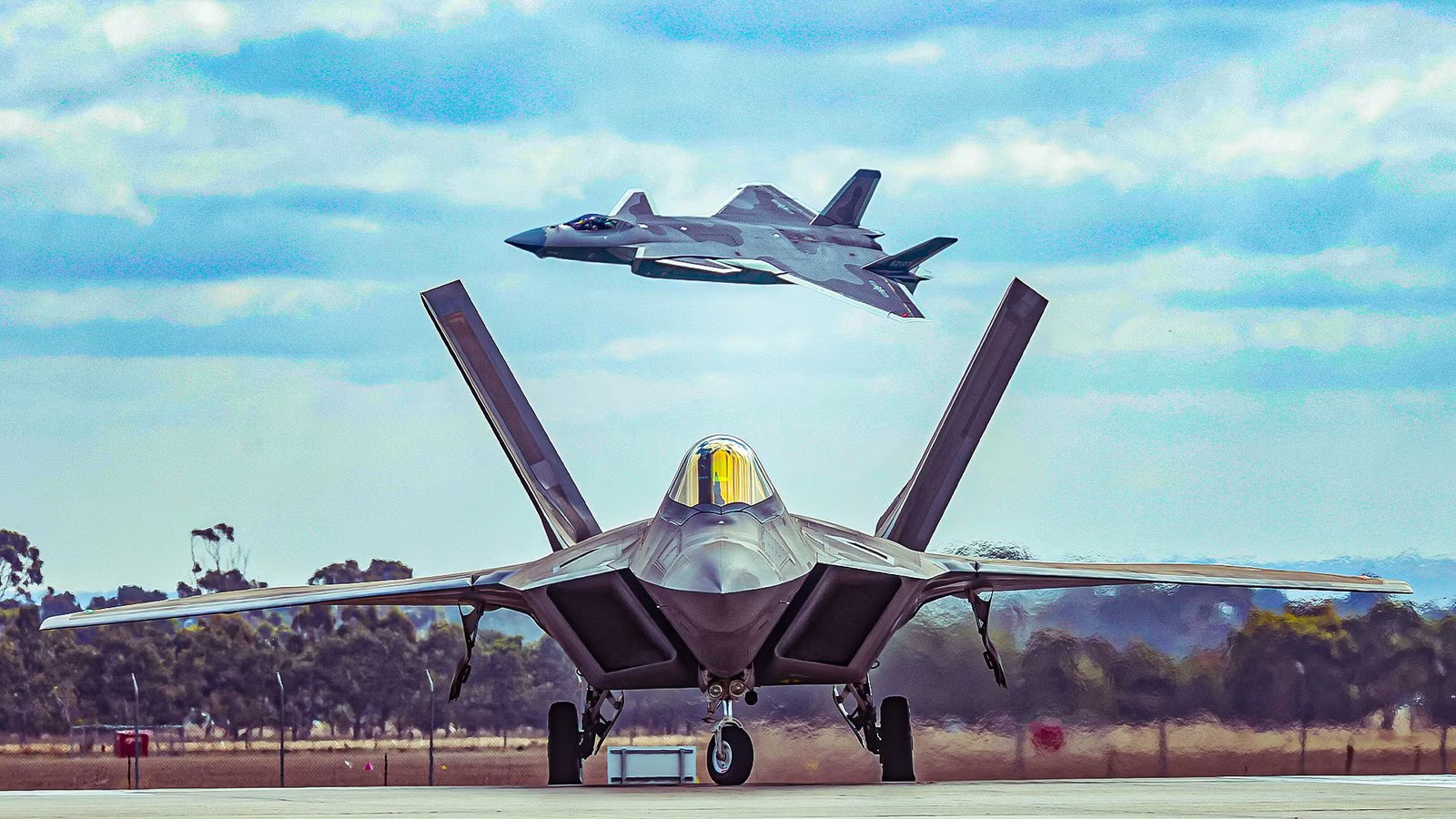
The Lockheed Martin F-22 Raptor and the Chengdu J-20 Mighty Dragon are often compared online, but they are built for different mission sets. In a conflict, there may be F-22 vs J-20 engagements, but these might be avoided. Wargaming by think-tank CSIS has shown time and again that the biggest threat to US aircraft is being destroyed on the ground, not so much in the air. Still, these are the two air superiority fighters in the US and Chinese inventory and are expected to be the tip of each’s proverbial spear.
Also, importantly, the US famously imposed an export ban on the F-22, denying its key allies, particularly Japan, Australia, and Israel, from operating it. China is likewise believed to have an export ban on the J-20, although this is not publicly published. Instead, China is focusing on exporting J-10C and possibly its new high-end J-35, as well as the low-end Sino-Pakistani JF-17. The US focuses on exporting the high-end F-35 and F-15EX, as well as the F-16 Block 70.
Production Numbers

The first thing to take into account is production and availability numbers. The US Air Force had originally intended to acquire 750 F-22s, but ultimately only 187 were purchased. 32 of these are Block 20 trainer variants that can’t be used in combat, although Lockheed is pitching to upgrade them. Around 183 of these jets remain today after mishaps, of which 143 are combat-coded. The F-22 is out of production, and so the Air Force can not replenish or increase its Raptor fleet.
Meanwhile, the J-20 entered service in 2017, and in 2025, the 300th example was seen in public. As time goes on, the J-20 is being adapted, and more variants are appearing, including a two-seater variant. In January 2025, Rusi’s Justin Bronk estimated that China delivered 0-40 J-10 fighters, 80-100 J-16s, 20-30 J-15s, and 120 J-20s.
Open source China-watchers Hurin and Ruprecht_A commented on these numbers, saying they seem high. Hurin said his estimates are 20-30 J-35s, 12 J-10s, 60 J-16s, 30 J-15s, and 100 J-20s. Ruprecht_A said the J-20 is “highly likely less” than the 120 figure. Regardless, it seems that J-20 is now the most produced fighter jet in China, and its 2025 deliveries may have been more than all European and Russian fighter jet deliveries combined.
Countering Fighter Jets Vs Aerial Tankers

According to analysts, one of the biggest differences between the F-22 and J-20 is the problems they are designed to solve. The F-22 is intended to be the USAF’s ‘silver bullet’, ensuring air dominance. It is an air dominance fighter without equal, designed to have first-look, first-kill, and has demonstrated its superiority repeatedly in exercises against other fighter jets like the F-16, F-15, Eurofighter, and others.
With the exception proving the rule, the rare occasions that the F-22 loses in exercises are reported as news—including one time it was carrying external tanks and a German Eurofighter took it out with guns. Few fighters are believed to match the F-22 in air-to-air combat, though meaningful comparisons are difficult due to classified capabilities. The F-22 is designed to be able to take on any enemy fighter jet and win before the enemy even knows there was a fight to be had.
|
Raptor vs Mighty Dragon (USAF) |
F-22 |
J-20 |
|---|---|---|
|
Prime contractor |
Lockheed Martin |
Chengdu Aircraft Corporation |
|
Number in service (approx.) |
183 |
300+ |
|
Stealth |
All-aspect |
Front-optimized |
|
Combat radius (internal fuel) |
460-600 nautical miles |
1,100-1,200 nautical miles |
|
Range extenders |
Aerial tankers, stealth drop tanks |
little to none currently |
Analysts don’t believe the J-20 is optimized to take on the F-22 or F-35 directly. It is also unclear how it would fare against the F-15EX. It is believed to be optimized for the range needed to take out key enablers such as KC-135 and KC-46 aerial tankers, as well as AWACS aircraft such as the E-3 Sentry and E-7 Wedgetail.
A Question Of Range

Range is complicated. The F-22 is designed with a good range for its class and has a combat range of 460–600 nautical miles on internal fuel. Unlike other fighter jets, such as the F-15, its configuration doesn’t significantly affect range, as it is designed to carry comparatively light air-to-air missiles in its internal weapons bay, which also means its munitions don’t increase drag.
The J-20 is believed to have a much longer combat radius of 1,100–1,200 nautical miles with internal fuel, although this is uncertain. But a straightforward comparison of the F-22 vs the J-20 range is somewhat misleading. China operates a small fleet of tanker aircraft (e.g., Y-20Us, H-6Us), and even most of its J-6 bombers lack the ability to refuel in the air. By contrast, the USAF has around 75% of the world’s tankers by some estimates, and these are critical in extending the range of its fighter jets.
As stated, the J-20 is designed with the range to engage or threaten these tankers, forcing them to operate further out. Additionally, the US Air Force is responding by developing the stealthy Low Drag Tank and Pylon drop tanks for the F-22. The F-22 previously had unstealthy tanks that it couldn’t use in combat. Lockheed Martin says these new stealthy tanks will add another 850 nautical miles or so to the Raptor’s range.
A Question Of Stealth

The F-22 Raptor set the standard for what it means to be a fifth-generation fighter jet, and today it is still considered the world’s stealthiest fighter jet. The F-35 is also extremely stealthy, but it is designed for a greater range of missions and is not the one-trick air dominance pony that the Raptor is. But stealth is extremely complicated. Radar cross-section values, like those found on Global Security Org, are frontal estimates.
Aircraft can be observed from more aspects than just the front; they can be viewed from the side, from below, from behind, etc. Additionally, fighter jet stealth is also about masking the aircraft’s infrared signature, hiding or eliminating its electronic emissions, and much more. It is also about fighting back against radars with electronic decoys, jamming, generating noise, and more. However, the aircraft’s capabilities are classified.
That said, the F-22 is believed to be optimized for a greater range of all-aspect stealth, while the J-20 is optimized head-on. This means it is difficult to detect and engage the Raptor from all angles, while the J-20’s canards and engine nozzles are believed to compromise its side and rear aspects. One thing that can be noted is that the USAF believes upgrades will keep the F-22 at the cutting edge into the 2040s. Additionally, continual Chinese advancements, including with 6th-gen fighters, are spurring the USAF to rush the development of its F-47 air dominance fighter.
China Still Catching Up With Engine Development

The J-20’s engines are one area where it’s known to have weaknesses. Like the Russian Su-57, the J-20 was designed with a new generation of engine that would reduce its infrared signature. However, like the Su-57, delays with the engine development have seen initial aircraft produced with older, inferior engines. The first units were produced with Russian engines.
Only in January 2026 did the South China Morning Post report, “Beijing has released footage of flight tests of an upgraded J-20A stealth fighter, with signs that the jets have been equipped with long-awaited high-thrust WS-15 engines and better avionics.” This would suggest that most of the 300 or so J-20s currently in service will have the older, less-stealth optimized WS-10 engines.
China is making rapid progress in breaking its historic dependency on Russian/Ukrainian/Soviet engines, but it is still a newcomer. In 2025, the first carrier-based J-15s were seen with Chinese engines, suggesting that Chinese engines are now to the point that they supply enough power to support carrier operations. China is also developing turbofans for its commercial airliners and cargo transports, but these engines are not expected to be ready before 2030.
What Is Not Seen Is Decisive

There are many aspects to evaluating the performance of fighter jets, and many of these aspects are unknown to the public. For example, Rusi’s Justin Bronk points out that almost every nation that is given access to the F-35 and is able to “peer behind the black curtain” and see what’s in the cockpit chooses to purchase the F-35. Online discussions about maneuverability, RCS, expense, speed, etc., are secondary. Finland even said it is better for its dispersed model of operating fighter jets from unprepared runways than the Gripen.
Justin Bronk has noted that of so-called 5th-gen projects like the Su-57, Su-75, KF-21, and Kaan, ” it’s comparatively easy to produce something that looks like a stealth fighter-ish thing, that will fly. It is incredibly difficult and unbelievably expensive to sustain the production of a weapons system that works as a low observable fighter… and also all the things you don’t see when you look at a plane. The integration between the weapons and the sensors… [and other integrations].”
This serves as a caution that it is extremely difficult to compare the J-20 and F-22 in any meaningful way, apart from broad generalized strokes. No journalist writing about these aircraft, including the author of this article, has been in the cockpit of these two aircraft, been briefed on and seen firsthand the networking, sensor fusion, and classified capabilities of these aircraft.