dailynewsnblog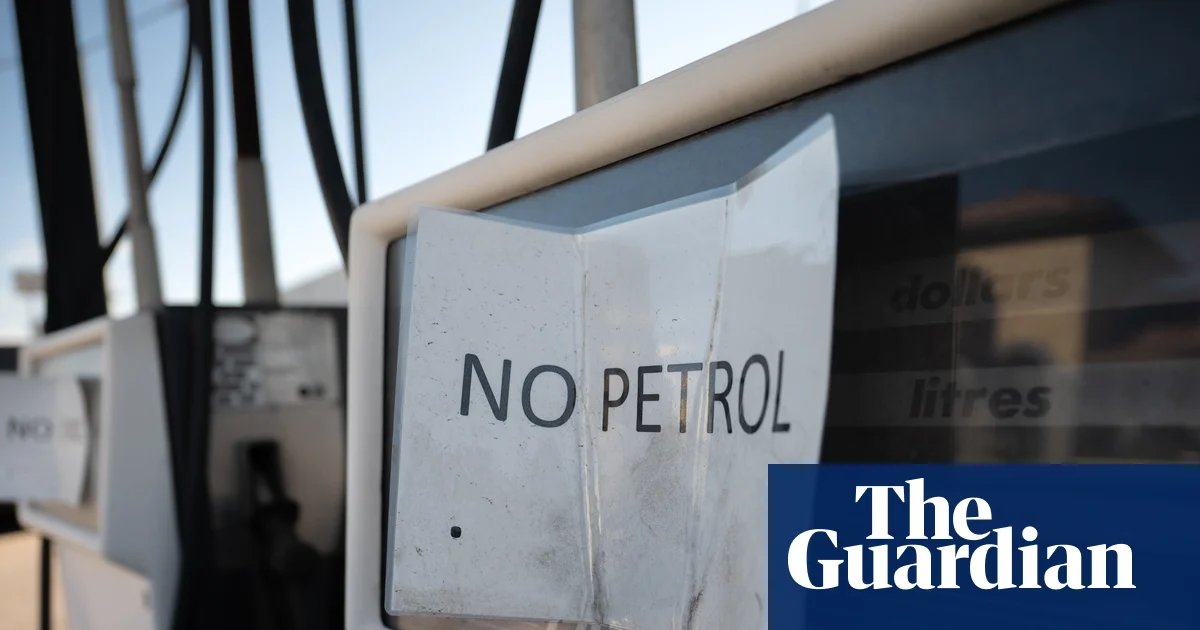
Dozens of service stations across Australia have run out of petrol as distributors struggle to keep up with customers panic-buying as the conflict in the Middle East continues to disrupt prices.
The NRMA has warned regulators “missed” the chance to stop price hikes, as booming wholesale demand pushes fuel prices to a “permanent high” on the east coast.
The New South Wales government said 32 out of 3,000 service stations in the state were out of at least one fuel type on Monday morning – but enough to leave single-station towns short.
The premier, Chris Minns, said NSW had enough fuel but was struggling to distribute it to the regions as motorists stockpiled at their local stations.
“It’s harder to restock those petrol stations if they’ve got more than expected out of the bowser on any given day,” he said.
The Victorian Farmers Federation president, Brett Hosking, said entire towns had run dry, including Wedderburn and Bonnie Doon in the state’s centre, and Robinvale in the north-west.
“[Tankers] are going to find some fuel stations needing fuel very close to Melbourne and you’re probably going to empty your truck into there and then go back for another load,” he said.
“How do you ensure that when you’ve got 100,000 city motorists crying out, saying ‘we need fuel too’, how can you guarantee that [tanker] truck will keep driving past them,” he said.
The federal government has allowed fuel companies to temporarily sell lower-quality petrol and release about a fifth of their mandatory stockpile, with regional Australia to be prioritised, but ruled out fuel rationing.
Hosking said he was not confident that companies would prioritise delivering to the regions, calling for rationing to be considered even if limiting purchases would be difficult to enforce.
In Western Australia, the town of Manjimup saw two service stations run dry on Friday, while industrial fuel suppliers have limited sales to 10,000 litres per customer, according to local shire president, Donelle Buegge.
“The independent ones [stations] are probably doing it a little bit hard,” Buegge said. “BP are doing OK but Dunning’s and United, they seem to be struggling with their fuel supply.”
Regional and independent stations have reported difficulty accessing fuel after suppliers Ampol, BP, Mobil and Viva Energy prioritised supply to regular customers, cutting off smaller groups that buy fuel on the spot market.
Some independent suppliers had also stopped offering fuel they could no longer afford as wholesale prices surged and caught up to the recent retail price spike, according to Peter Khoury, the spokesperson for the NRMA.
Retail prices for households and businesses were set to stay at their near-record highs in Sydney, Melbourne and Brisbane, which Khoury blamed on stations that jacked up prices early in the conflict.
“We are now in a permanent high point … in those three cities,” Khoury said.
“The opportunity to crack down on that behaviour and just get them to, at the very least, hold their price – we missed it.”
Unleaded petrol prices surpassed 230 cents a litre in Darwin on Friday and in Melbourne on Sunday, and is continuing to approach the mark in other capital cities, according to Informed Sources data.
Shortages have also hit urban retailers, with a 7-Eleven in Canberra running out of fuel over the weekend. Customers at the Holt store were told the shortage was due to sudden bulk-buying, with restocks continuing on schedule and expected on Monday night.
Another 7-Eleven in Canberra’s Phillip has been running low, with customers told stocks could run out by Monday evening.
‘Serious dysfunction’
Calls for stronger interventions have grown as shortages hit more towns. The NSW government held crisis talks with fuel suppliers and key industries on Monday, when industry bodies agreed to share more information with the government so fuel could go where it was most needed.
The president of NSW Farmers, Xavier Martin, who attended Monday’s roundtable, said food production was at risk as “serious dysfunction” left farmers, villages and towns without fuel.
“Tractors and trucks run on diesel not petrol, and there’s been this huge focus on petrol … those harvesters need thousands of litres a day.”
Stuart King, the Swan Hill rural city council mayor, said Robinvale was full of temporary workers for the wine grape and almond harvest season, who were travelling up to 100km daily to get to farms.
“If you haven’t got fuel, you can run out pretty quickly, which means then you can’t get to work,” King said.
Shortages had spilled over to other small towns while stations in the regional city of Swan Hill had blocked people from filling up jerry cans or mobile fuel tanks, King said.
King called for the fuel excise to be cut, as it was in 2022, saying prices in his area had risen 30% in a fortnight. He said he had heard from locals who had put off trips to visit family in Melbourne and were forced to drop out of the town’s major winter sport leagues.
“I’ve spoken to some young people over the weekend and they’re saying … ‘I don’t think I’ll be able to afford the travel and I’m already stretched as it is, so I might just work on Saturdays instead of playing sports,’” King said.
“That then becomes a cumulative effect on community wellbeing.”
Surging prices are set to have the biggest impact on the lowest-income households, which spend about 10% of their income on petrol, according to analysis by the e61 Institute.
However, a fuel excise cut would deliver bigger benefits to high-income households, which buy nearly two times as much as the lowest-earning fifth of Australians but are more insulated from higher prices. The federal government has also ruled out excise changes.