dailynewsnblog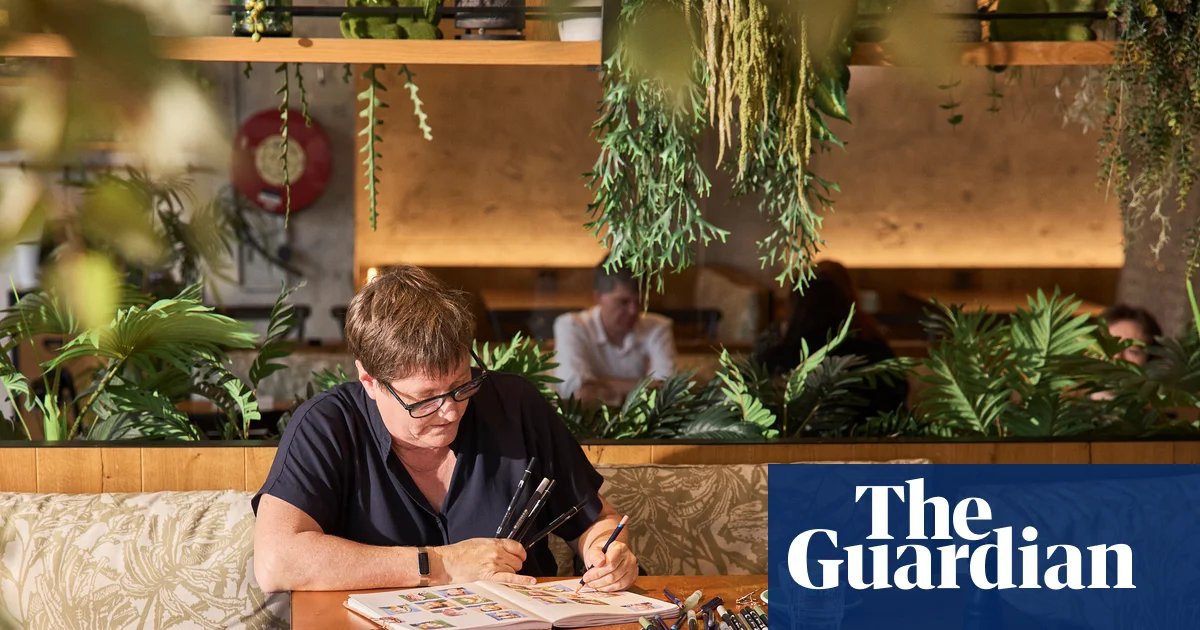
If you’re lucky, you may spot Liz Steel tucked into the corner of a sun-dappled Sydney cafe, water-soluble pencils and markers in hand. Half a world away, Marc Taro Holmes is led by his sketchbook on to the thawing streets of Montreal, “like a bear coming out of hibernation”.
The duo are co-founders of #OneWeek100People challenge, an informal global initiative that asks artists to sketch 100 people in seven days. The challenge, now in its 10th year, took place this week, but Steel and Holmes stress it is entirely for enjoyment and anyone can take it up and post with the hashtag at any time.
The two friends met at the International Urban Sketchers Symposium in Lisbon in 2011 (this year’s event is in Toulouse in July), and began the challenge as a way to stay connected. Since then it has grown into a phenomenon within the Urban Sketchers community, with hundreds taking part around the world.
“Liz and I started the challenge as an excuse to keep drawing together,” Holmes says. “Speaking selfishly, this event is my free pass to spend an entire week drawing.”
Steel says sketching people wasn’t always her forte, but “it’s no understatement to say that sketching the world around me changed my life and my career” – an architect by trade, she is now an art educator, as is Holmes.
He was the one who first challenged himself to sketch 20 people a day for a week. Together they turned the personal experiment into a global challenge.
The goal of 100 is intentionally ambitious. Holmes says high targets encourage drawing without self-criticism.
“Quantity is the only goal, not quality,” he says. “Secretly, that’s the best way to improve your drawing.”
There’s a “special type of magic” in the momentum, Steel says. “It’s about practice rather than perfection.”
‘My motivation to live a good life’
Quincy Nadel sits in a Chicago park while her children play.
Taking advantage of a moment to herself, she starts to sketch – noticing people leaned into conversation, a parent carrying a tired child, the posture of someone waiting alone.
“There is a profound, quiet beauty in the way strangers interact with the world,” she says.
The one-week challenge is “exposure therapy” for her perfectionism, she says, after teaching herself to sketch in her thirties.
“I was digitally burnt out.
“Sketching is my ‘permission slip’ to sit and watch the world without the pressure of productivity. My sketchbook has become a record of me being ‘here’ instead of ‘online’.”
Nadel documents her journey on Instagram, but says the art is a byproduct of a deeper goal.
“It was about recalibrating my brain to notice the people who usually move through my peripheral,” she says.
Allow Instagram content?
This article includes content provided by Instagram. We ask for your permission before anything is loaded, as they may be using cookies and other technologies. To view this content, click ‘Allow and continue’.
Nadel says people-watching is “endlessly interesting if you slow down enough”.
“I like to sketch strangers … anywhere people naturally gather,” she says.
Less concerned with capturing a perfect likeness, she aims for simple sketches to reflect the small details she notices that “tell little stories”.
Steel and Holmes say the slowness of sketching changes how we process our surroundings.
“Drawing uses the brain in a different way than taking a photo,” Holmes says. “You’re forced to really look. It’s active and creative, rather than passively consuming media.
“Drawing is a terrific way to engage with the world. I go places and do things I wouldn’t normally get to. My sketchbook is my motivation to live a good life.”
Steel says it creates a “tactile relationship” with the environment. When sketching on location, she says, she finds the world “happens” around her.
“You see things you wouldn’t normally … People stop and talk to you, you hear the sounds, and that gets encoded into your page,” she says.
When she looks back on old sketchbooks, she is vividly transported to the captured moment.
“You can actually remember what the conversation of the person next to you was about.”
‘By day five I’m in the flow’
Holmes says the challenge is designed to be accessible, despite the ambitious goal. There are no expensive tools required, and “success” is defined simply by the act of trying.
“We don’t want people turning a game into hard labour,” he says. “We wanted an activity that you can’t fail. You can actually draw 100 sketches in a single day if you approach it as a game.”
Steel says the challenge can be simplified as much as the individual wants: “We don’t care about people hitting 100.”
The goal is to “sketch more than usual, however you define that”.
Her advice is to work small, simplify your sketch and use a limited selection of materials. She often alternates between sketching from photos to refine her technique and going out on location to find a rhythm.
“I’m usually rusty on day one, and by day five I’m in the flow,” she says.
“It gets addictive. I’ve done 100 in just over an hour before. Once you get going, you just can’t stop.”
This year, Steel is using a combination of water-soluble pencils and markers.
“I can soften the edges if I make a mistake mid-sketch, I can kind of lift it or soften it.”
She recommends busy spots where subjects are seated or performing repetitive motions.
Though sketching isn’t a skill to pick up overnight, she says anyone can learn by committing time to retrain the eyes and hand.
“Anyone can take up a sketchbook practice,” Holmes says. “It’s forgiving, and it’s accessible. It’s never boring looking at people and imagining their lives.
Nadel says the practice fundamentally changed her perspective.
“It has increased my empathy. When you spend your time looking up, watching and truly seeing people … it’s impossible not to feel a sense of gratitude for the ‘ordinary’.”
She hopes the challenge encourages others to put down their phones, even briefly.
“There’s a whole world happening at eye level if we just choose to see it.”