dailynewsnblog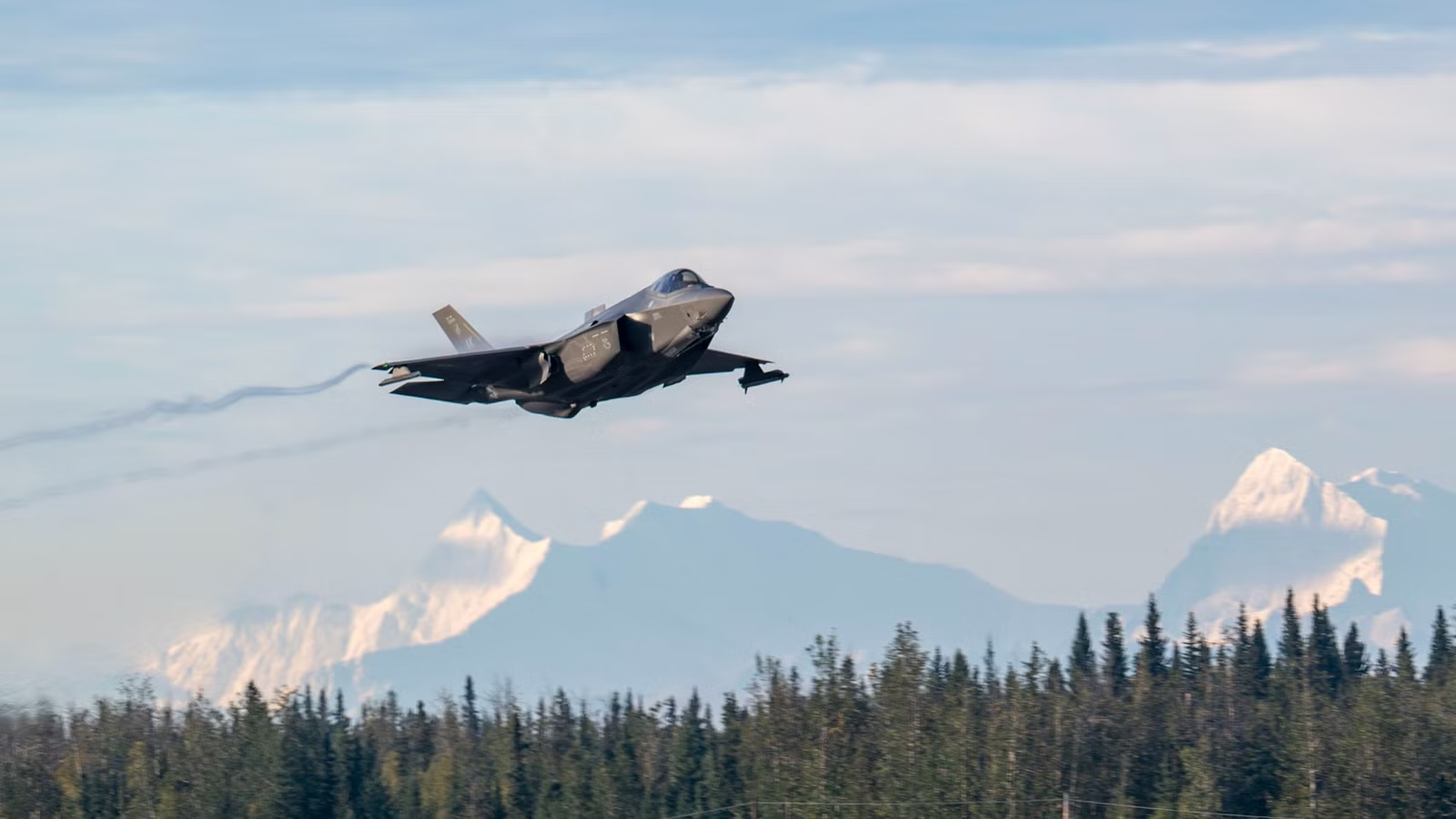
Lockheed Martin’s F-35 stealth fighter has reached thousands of delivered units. The fifth-generation stealth fighter has become an icon of air power for America and many of its allies. Its three variants have all shown their capabilities to be a massive leap in technology over their fourth-gen predecessors, but the jet has had its shortcomings make the news as well.
China’s top fighter is considered to be the Chengdu J-20 ‘Mighty Dragon. Compared to the F-35 Lightning II, it is a much larger and more intimidating-looking fighter jet. The huge fighter is believed to be a fifth-generation jet in terms of its systems and capabilities, but the comparatively poor quality of Chinese engines, avionics, weapons, and stealth tech is well known.
Comparing the two jets is not as simple as a clear-cut run-down of the numbers. The jets fulfill different primary roles on the battlefield, and the way they execute their missions is starkly contrasting. For its part, the F-35 is a much vaunted ‘sensor node’ built into a capable (but not dominating) fighter platform. Meanwhile, the J-20 is a powerhouse of speed and range with the stealth and tech aboard to give it respectable fangs against its Western adversaries.
Cut From The Same Cloth?

The J-20 is presumed to have been a development based on leaked or stolen stealth technology acquired over years of probing into the F-117 Nighthawk and F-22 Raptor programs for data. It doesn’t look much like the iconic Skunk Works’ jets that came decades before it, but there is little evidence that the necessary tech breakthroughs could have been achieved in many other ways to make the J-20 a reality.
The F-35, on the other hand, is a culmination of roughly a half-century of research and development into not only stealth tech but also weapons, data-networking, ‘sensor fusion,’ advanced engine design, and a myriad of other fields. Take all that data, battlefield intelligence, and wrap it in a clean-sheet design from arguably the best defense aerospace division in the world, and you have the new standard fighter of 20 countries and counting.
The F-35 is made to perform virtually any mission with an equal level of lethality, precision, and survivability. The J-20 is a purpose-built air superiority fighter designed to hunt high-value assets like airborne control planes, AWACS, and tankers across vast expanses of open land and sea. In a head-to-head dogfight, it would likely come down to pilot skill, but the F-35 has a sensor advantage thanks to far more advanced sensors and beyond visual range weapons.
For the two aircraft to ever end up trading shots, a long list of peacetime diplomacy measures that keep China and the Western bloc of allies apart would first have to fail. Not much is known about the inner workings of the J-20, but the tech is likely decades behind the F-35. After all, that jet is the most expensive defense procurement program in history, even more so than the atomic bomb or the  Boeing B-29 Superfortress.
Winning The Air War Of The Future

The opening salvos in a theoretical dogfight between the F-35 and J-20 would likely focus on blinding or punching holes in sensor networks. Long-range missiles and electronic attacks would try to pick apart early-warning radars, and both sides would use cyber tools to weaken command systems. Only after some of that outer armor cracked would stealth fighters slip forward to exploit the gaps and look for targets of opportunity, such as tankers, drones, or ships acting as missile batteries.
A pair of J-20s into the Philippine Sea or the East China Sea would probably launch from a hardened base on the mainland, under the umbrella of China’s coastal missile belts. Meanwhile, two F-35s might take off from a US Navy carrier, a Marine Corps amphibious ship, a Japanese airfield in Okinawa, or an Australian base, depending on whose territory or fleet had been targeted. The F-35s would use an infrared search system and detect faint engine plumes on the horizon.
Similarly, the J-20s can use thermal scans to detect heat spots over the ocean. Both jets would hone in and launch long-range missiles within seconds of each other, if they can acquire a good lock-on. All four jets would then break off or climb to dodge the incoming BVR missiles and position for the next stage of the intercept. Electronic countermeasures come next, with the J-20s pouring jammers into the air to blind the F-35 missiles’ seekers.
The F-35s would reply with their own but also trust their missiles’ newer sensors to home through the noise. Assuming all the jets survive the hailstorm or long-range air-to-air missiles, the only choice is to cut and run or turn into the merge. The F-35’s smaller size, lighter weight, and more advanced targeting systems would give it the edge in a turning fight at low to medium altitude. However, if the two rivals went toe-to-toe high above the clouds, the J-20 may have an edge.
All things being equal, it’s more likely than not that the F-35 would stand the better chance of taking home the win by a small margin, which is the consensus among most analysts, like the National Security Journal. That’s largely due to its much higher-quality weapons and sensors, but also its more balanced performance range. They would allow the pilot to take advantage of the J-20’s weaknesses in a close-range dogfight, which it doesn’t appear to be optimized for, according to all publicly available information.
Breaking Down The Joint Strike Fighter

The F-35 “Joint Strike Fighter,” as it was first called during development, is a flying computer with a stealth fighter shell on it. All three variants have different features but remain a jack-of-all-trades capable of supporting ground, air, and sea units during combined operations, but also a lethal platform in its own right. Lockheed Martin has developed around 850 systems for the F-35.
Precision air-to-air and air-to-ground targeting is done by the Electro-Optical Targeting System. It is connected to the central computer of the aircraft and is integrated into a data link that receives and shares information with other units. Infrared and high-resolution imagery are all features of advanced EOTS. The table below details a rundown on some of its key specifications, according to the US Air Force.
Specifications | Lockheed Martin F-35A |
|---|---|
Power Plant | One Pratt & Whitney F135-PW-100 turbofan engine |
Thrust | 43,000 pounds |
Wingspan | 35 feet (10.7 meters) |
Length | 51.5 feet (15.7 meters) |
Height | 14 feet (4.38 meters) |
Payload | 18,000 pounds (8,160 kilograms) |
Maximum Takeoff Weight | 70,000-pound class |
Speed | Mach 1.6 (~1,200 mph) |
Range | More than 1,350 miles with internal fuel (1,200+ nautical miles), unlimited with aerial refueling |
Ceiling | Above 50,000 feet (15 kilometers) |
Armament | Internal and external capability. Munitions carried vary based on mission requirements. |
The F-35 helmet-mounted display brings in data from Raytheon’s Electro-Optical Distributed Aperture System. It is a 360-degree situational awareness system that warns the pilot of approaching aircraft and missile threats. It provides precision tracking, fire control capabilities, and day/night vision. With its six electro-optical sensors, the AN/AAQ-37 system improves the aircraft’s operational efficacy and survivability.
DAS facilitates weapons support, missile detection, launch point detection, situational awareness, day/night navigation, and Infrared Search and Track System cueing. Additionally, the F-35 is equipped with an advanced electronically scanned array fire-control radar system.
The Mighty Dragon By The Numbers

The J-20 is a long-range stealth aircraft with its body shaped like a flat arrowhead. The wings, nose, and tail blend into one smooth upper and lower surface, and its dark, radar-absorbent skin adds another layer of stealth, and missiles can be tucked inside internal bays that open only for a moment when it is time to fire. Two large jet engines power the airplane, giving it immense levels of peak thrust when its afterburners are pushed to the limit.
A fully digital control system stabilizes the plane in tricky attitudes and guards against stalls, freeing the pilot to think about tactics rather than stick-and-rudder chores. The table below details a few key data points for reference, according to ODIN’s files.
Specifications | Chengdu J-20 |
|---|---|
Number of Hard Points | Four under-wing pylons capable of carrying drop tanks. |
Internal Weapons Bay | PL-10 short range AAM; PL-12 Medium Range AAM; PL-15 BVR long range AAM; PL-21 Long Range AAM; LS-6 Precision-guided bomb |
Length | 66.9 feet (20.4 meters) |
Width (Wing Span) | 44.3 feet (13.5 meters) |
Engine Name | 2 × WS-10B or AL-31FM2 afterburning turbofan |
Engine Power | 31,000 or 33,000 pounds-force (140 or 145 kilonewtons) with afterburner per engine |
Maximum Range | 3,728 miles (6,000 kilometers) |
Maximum Speed | Mach 2 (1,522 miles per hour or 2,450 kilometers per hour at sea level) |
Combat Range | 1,243 miles (2,000 kilometers) |
The nose houses a radar that is reportedly electronically steered, while a separate heat-seeking sensor scans for the hot glow of other aircraft. Side antennas scan for enemy radars, and the computer processes all these streams into one picture. The cockpit is built around large touch displays and a helmet that projects cues onto the visor, allowing the pilot to keep eyes out instead of heads down.
The skeleton under the stealthy skin combines carbon fiber, aluminum-lithium, and titanium to keep weight low, shrug off corrosion, and soak up heat from high-speed flight. New code packages can be added to the jet, allowing it to evolve without slicing metal. Pylons can be bolted under the wings for extra weapons, trading invisibility for raw firepower.